Houseplant · Araceae
Peace Lily
Spathiphyllum wallisii
A forgiving, low-difficulty houseplant that flags its own thirst and returns white spathes for a little added light.
Bright indirect
68–85°F · 20–29°C
USDA 11–12
1–6 ft · 0.3–1.8 m
Overview
Few houseplants ask less of a grower than the peace lily, which explains its near-permanent place on home and office windowsills. Its native ground is the humid rainforest understory of Colombia and Venezuela, where it lives in the deep shade beneath the canopy. That ecology is the mechanism behind its tolerance for the dim interiors most rooms provide.
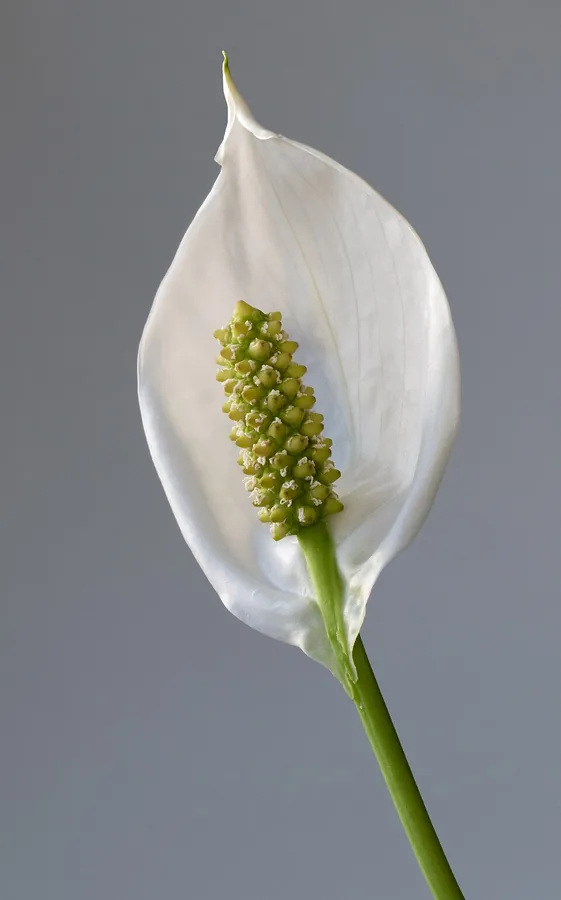
The draw is the flowering. What reads as a single white bloom is a spathe, a modified leaf bract curved around a slender spike that holds the true flowers. Against the polished dark green foliage the pale spathes carry the whole display, and a well-sited plant pushes them out on and off through spring and summer.
It carries one more practical trait: it telegraphs its water need. Once the mix runs dry the entire plant loses turgor and droops, then recovers its posture within hours of irrigation. That margin of error suits a beginner, but each repeated wilt costs the plant foliage over the long run.
Care
The short version: bright indirect light with no direct sun, a mix held evenly moist yet never waterlogged, warmth kept above 60°F (16°C), and humidity on the high side. Site it beyond the reach of pets and children, as every part irritates on contact.
Light
Position it in bright, indirect light and shield it from direct sun, whose intensity scorches the foliage. Its tolerance for low light is genuine, yet a dim corner yields leaves and next to no flowers, since bloom output depends on light level, so favour a brighter spot if you want spathes.
Water
Hold the mix evenly moist but never waterlogged, allowing only the surface to dry between waterings. The plant droops sharply once it dries too far and rebounds within hours of irrigation, though that response should not stand in for a routine. Apply room-temperature, dechlorinated water and never leave the pot standing in a saucer.
Soil
Set it into a rich, free-draining potting mix carrying ample organic matter. It performs in slightly acidic conditions, near a pH of 6.0 or just under, and the free drainage is what keeps the roots out of trouble.
Temperature
Ordinary indoor warmth suits it, with an ideal band of 68°F to 85°F (20°C to 29°C). It carries no frost tolerance and sustains injury in the cold, so hold it comfortably above 40°F (4°C) and clear of cold drafts and winter windowpanes.
Humidity
Coming from tropical forest, this is a high-humidity plant by nature. Dry indoor air registers as browned, brittle leaf tips, so cluster it among other plants, stand it on a pebble tray, or position a humidifier close by.
Feeding
Its nutrient demand is modest. Apply a balanced liquid fertilizer at roughly quarter strength through the spring and summer growth phase, about every 6 to 8 weeks. Excess feed scorches the leaf tips brown, so err toward less when uncertain.
Pruning
Maintenance here is minimal. Simply remove yellowed or damaged leaves and finished flower stalks at the base as they show up, which keeps the plant neat and channels its resources into fresh growth.
Repotting
Move it up every 1 to 2 years, or once roots begin emerging from the drainage holes, ideally in late winter to early spring. Flowering improves while the plant sits slightly potbound, so avoid jumping to an oversized container.
Size & spacing
Indoors it generally holds at 1 to 3 feet, while the biggest cultivars reach as high as 6 feet (183 cm) and spread close to 5 feet (152 cm). Allow a large specimen enough clearance that its arching foliage is not pressed against a wall.
Troubleshooting
Nearly every peace lily complaint comes down to water, light, or accumulated salts, and the plant signals which one clearly. A sudden droop reads as thirst, browned tips read as a salt or humidity problem, and yellowing in saturated mix reads as failing roots. Identify the pattern below before you intervene.
Yellowing at the base while the mix stays saturated
Yellowing lower foliage on a plant held in waterlogged mix indicates root rot, the result of overwatering starving the roots of oxygen. Halt irrigation, drain any saucer, and inspect the root system, which goes dark and soft once decay sets in. Move the plant into fresh, free-draining mix, cut off the dead roots, and from then on let the surface dry a little before each watering.
Fix:
- Stop overwatering and empty any saucer of standing water
- Improve drainage; repot into fresh, well-drained mix and trim away rotted roots
Sudden full collapse that reverses once the plant is watered
That alarming slump signals thirst rather than injury. As soon as the root zone passes a dry threshold the foliage loses turgor and folds, and turgor returns within a few hours of a deep soak. Treating it as a built-in moisture gauge works, but repeated wilting cycles trigger leaf drop, so irrigate before the plant reaches that stage.
Fix:
- Water thoroughly until water drains from the bottom
- Allow excess water to drain away and do not leave the pot sitting in water
Strong foliage with no white spathes appearing
When light falls into deep shade, the plant has enough energy to sustain leaves but not to initiate spathes. Raising the light to a brighter, indirect level usually brings flowering back, because bloom response tracks light intensity in this species. An immature specimen or one outside its bloom window may simply need patience, since many cultivars flower mainly from spring into summer.
Fix:
- Move to a brighter spot with bright, indirect light (no direct sun)
- Be patient through the natural spring-to-summer bloom period for season-dependent cultivars
Dry, browned tips and margins along the foliage
Browned, brittle margins point to a salt buildup, whether from heavy feeding or from chlorine and fluoride dissolved in tap water, since these salts accumulate at the leaf edges where transpiration concentrates them. Leach the rootball with a generous volume of water to carry the salts out, drop the feed to roughly quarter strength, and switch to room-temperature, dechlorinated water. Dry air compounds the problem, so lift the humidity around the foliage.
Fix:
- Leach the soil with plenty of water to flush excess salts
- Cut fertilizer back to about quarter strength and apply less often
- Water with room-temperature, dechlorinated or distilled water
- Raise humidity around the plant
Toxicity
The gentle common name aside, a peace lily is not safe to chew. Every tissue carries insoluble calcium oxalate crystals that pierce and sting the mouth and throat on contact, driving burning, drooling, and swelling in animals and people alike. It is no true lily, so it will not trigger the fatal kidney failure that Easter lilies inflict on cats, yet it remains painful and no part is edible, which is why it belongs out of reach of pets and small children.
Toxic to
Cats · Dogs · Horses · Rabbits · Livestock · Birds · People
Cats Toxic
Bite into a leaf and a cat releases a load of needle-shaped calcium oxalate crystals that drive straight into the soft tissue, so the burning starts almost at once. The usual picture is profuse drooling, pawing at the muzzle, and a tongue or lips swollen enough to interfere with swallowing.
Dogs Toxic
A dog meets the identical crystals, which lodge in the lining of the mouth and throat and produce the same sting. Watch for drooling, vomiting, and an abrupt refusal to eat soon after the foliage has been chewed.
Horses Toxic
Those same crystals inflame a horse's mouth in the same fashion, producing oral pain, drooling, and an unwillingness to feed. Site the plant well away from stables and paddocks.
Rabbits Toxic
The irritant crystals sit in every tissue of the plant, so a rabbit that samples a leaf earns a stinging mouth and goes off its food. Block any access to the foliage.
Livestock Toxic
Cattle, goats, and sheep meet the very same oral and digestive irritation should they reach the leaves. Keep it clear of every area that grazing stock can enter.
Birds Toxic
A caged bird chewing the leaves takes on the identical mouth and throat burning. Position the plant where no bird can ever perch on it.
People Caution
Nothing on a peace lily is fit to eat. A single bite brings on instant burning of the mouth and lips, drooling, and swelling, which is reason enough to keep it from toddlers who mouth whatever they find.
Despite the name it is not a true lily (it is an aroid, Araceae) and is far less dangerous than true Lilium, but it still causes painful oral/GI irritation if chewed
Helpline numbers

United States
ASPCA Animal Poison Control: (888) 426-4435 (fee applies)
Poison Control: (800) 222-1222



Canada
Poison Centres: 1-844-764-7669
Varieties
Available sizes range widely, from desktop dwarfs to specimens that fill a floor corner. A handful of cultivars appear often enough to recognise on sight.
'Mauna Loa' (and 'Mauna Loa Supreme')
Stocked in most shops, this large-flowered favourite carries broad white spathes and settles at roughly 2 to 3 feet in height.
'Sensation'
The largest cultivar in the group, capable of 5 to 6 feet, with wide, bold leaves that can occupy a corner by themselves.
'Domino'
Marked by green foliage streaked and splashed in white, its variegation stands out on a plant that holds at about 30 inches tall.
'Petite'
A compact dwarf selection that stays small enough for a desktop or a narrow windowsill.
How to propagate
Only one dependable route exists for increasing a peace lily, and it falls naturally on repotting day.
DivisionEasy
Late winter to early spring, typically when repotting · Several weeks to a few months
Division is the only practical method, because peace lilies form clumps and will not regenerate from a leaf or stem cutting. Late winter to early spring is the window to use, conveniently the same point at which you would already be repotting. Slide the plant from its pot and separate the clump, by hand or knife, into sections that each retain roots and foliage, then pot them individually. Allow each division a span of a few weeks to a few months to root in and resume active growth.
Myths
A peace lily is a true lily and as deadly to cats as Easter lilies.
Botanically the peace lily sits in the arum family rather than among the true lilies, which is why the threat profile differs. The ASPCA still flags it as toxic to cats and dogs, but the damage comes from calcium oxalate crystals that irritate and burn the mouth and digestive tract. It does not cause the kidney failure that true lilies and daylilies bring on in cats, though it remains painful and belongs out of a pet's reach.
Peace lilies clean the air and pull toxins out of your home.
That claim grew out of a sealed-chamber experiment whose conditions bear little resemblance to a lived-in room. A peer-reviewed synthesis of 196 results drawn from 12 such studies concluded that potted plants make no meaningful dent in indoor air quality, with somewhere between 10 and 1000 plants per square meter required to rival the exchange a standard ventilation system already supplies.
Sources
- Plants of the World Online, Royal Botanic Gardens Kew
- NC State Extension Plant Toolbox
- ASPCA Animal Poison Control
- Missouri Botanical Garden Plant Finder
- Clemson Cooperative Extension HGIC
- University of Florida IFAS Extension (EDIS EP477)
- University of Florida IFAS Extension (EDIS EP320)
- Journal of Exposure Science & Environmental Epidemiology (Cummings & Waring, 2020; PubMed)