Tree · Annonaceae
Pawpaw
Asimina triloba
North America's largest native fruit, rich as custard and tasting of banana and mango, ripens on a tree few gardeners know.
Full sun
Every 5–7 days
USDA 5–8
15–30 ft · 4.6–9.1 m
Overview
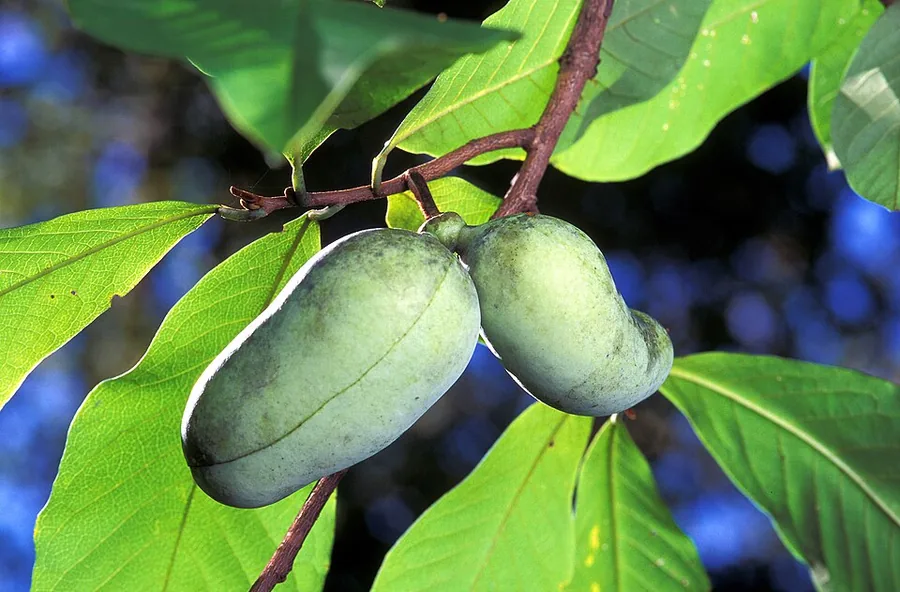
As the largest fruit native to North America, the pawpaw remains oddly absent from cultivation. In the wild it occupies the understory of eastern deciduous forest, ranging from the Gulf states north into Canada, and it produces a soft, green-skinned fruit whose custard-textured flesh carries the combined flavor of banana and mango.
It is a small, slow-growing tree adapted to ripen its crop in the shade of a taller canopy, yet it fruits most heavily once it attains full sun. The maroon flowers open in early spring ahead of leaf-out, and because they attract flies and beetles rather than bees, pollination is the single variable that most often determines fruit set.
Growing a pawpaw means accepting a tree that demands patience early and returns a fruit unavailable in commerce. It requires two unrelated trees for cross-pollination, consistent soil moisture through establishment, and several years to reach bearing age. Once established, it becomes largely self-sufficient.
Care
The short version: provide deep, fertile, moisture-retentive soil with steady water through establishment, shade for the first year or two, then full sun to maximize fruiting, plus a second unrelated tree so the self-incompatible flowers can cross-pollinate.
Light
Young pawpaws require shade for their first year or two, reflecting the woodland understory in which seedlings naturally develop. Once established, the tree fruits best in full sun, since higher light drives flowering and fruit maturation, though it will still grow and bear in partial or full shade.
Water
Pawpaws demand deep, evenly moist soil with adequate drainage, and regular irrigation through the first two years is what allows the shallow-hairless root system to establish. They tolerate moist river-bottom sites because such soils stay moist yet drain, but heavy or permanently waterlogged ground starves the roots of oxygen.
Soil
Provide deep, fertile, well-drained loam with good moisture retention and a slightly acidic pH of 5.5 to 7.0, which suits the plant's woodland origins. Heavy clay and chronically wet ground are the two conditions it will not tolerate, both because they impede drainage.
Temperature
The species is markedly cold hardy, from roughly -20°F to 90°F (-29°C to 32°C), and a genuine winter chill period is needed to break dormancy and set a good crop. Because the flowers open early, a hard late frost can still damage them.
Humidity
Pawpaws suit the moderate to high humidity of their native eastern range, about 50% to 80%, a level that prevails outdoors in those regions without intervention. In practice this is not a figure a gardener needs to manage.
Feeding
During establishment, apply a balanced fertilizer such as 20-20-20 every couple of weeks from spring into early summer to support early vegetative growth. Reduce feeding as the tree matures and its growth rate steadies.
Pruning
Pawpaws need minimal pruning. In late winter or early spring, remove dead, damaged, or crossing branches and shape the framework while the tree is dormant, and cut the root suckers to prevent the clone from expanding into a thicket.
Repotting
Not applicable; grown in the ground as a landscape or orchard tree, not as a container houseplant
Size & spacing
A mature specimen reaches 15 to 30 feet (4.5 to 9 m) in height with a comparable spread, so allow the same 15 to 30 feet (4.5 to 9 m) between plants. Because it propagates vegetatively by suckers, allot additional room for the colony it tends to form.
When to plant
Pawpaw phenology follows the temperate deciduous cycle. Set out containerized trees in spring as new growth resumes, giving the brittle taproot a full season to re-establish, expect the maroon flowers in early to mid spring before leaf-out, and harvest the ripening fruit from late summer into fall.
Northern hemisphere
Southern hemisphere
Typical months for a temperate climate: start earlier in warm zones, later where spring frosts linger.
- Plant: Spring, during new growth, using containerized stock to protect the brittle taproot
- Harvest: Blooms early to mid spring before the leaves emerge; fruit ripens late summer to early fall (about August to October)
Hardiness
USDA hardiness zones: 5–8
Temperature: down to -29°C
Troubleshooting
Because the species is remarkably resistant to pests and pathogens, most problems arise from pollination biology or transplant shock rather than from insects or disease. Identify the symptom below to isolate the cause. Intervening early keeps the remedy straightforward.
Flowers open normally but set little or no fruit
Poor fruit set traces almost entirely to pollination biology. The species is largely self-incompatible, so a flower cannot be fertilized by its own pollen, and because bees ignore the blooms, a solitary tree or two grafts of one cultivar has no viable pollen source. Establish at least two unrelated trees to supply cross-compatible pollen, and hand-pollinate when the natural fly and beetle vectors are scarce.
Fix:
- Plant at least two different cultivars or unrelated seedlings; hand-pollinate flowers if natural fly and beetle activity is low
A newly set tree declines or fails to establish
The failure is rooted in the plant's morphology: pawpaw develops a long, fleshy, brittle taproot carrying almost no fine root hairs, so lifting and moving it severs the very tissue that drives water uptake, which is why wild and bare-root stock so often dies. Because the root system cannot buffer that shock, use container-grown stock and set it out in spring as new growth begins, then shade young seedlings for their first year or two while the roots re-establish.
Fix:
- Use container-grown stock, transplant in spring during new growth, and shade young seedlings for the first one to two years
Flower stalks collapse before fruit can develop
Larvae of the peduncle borer moth tunnel inside the flower stalks, severing the vascular connection so the bloom aborts before fertilization can proceed to fruit. Because infestation is usually light, prune out and destroy the affected stalks and leave the remainder to carry the crop. The plant's natural acetogenins deter most other feeders, keeping it nearly pest-free.
Fix:
- Tolerate minor damage; remove and destroy affected flower stalks; trees are otherwise nearly pest-free due to natural acetogenins
Foliar lesions or grazed new growth
Occasional Phyllosticta leaf spot or flyspeck fungi mark the foliage, and zebra swallowtail larvae, Japanese beetles, or thrips graze the leaves. Because these injuries stay confined to the leaf surface rather than the developing fruit, yield is essentially unaffected, so no fungicide or insecticide is warranted. The zebra swallowtail larvae, whose only larval host is this genus, cause no lasting harm.
Fix:
- Usually cosmetic and not harmful to yield; no treatment normally needed; zebra swallowtail larvae seldom cause permanent damage
Toxicity
The ripe, peeled flesh is genuinely edible and safe for people, but no other part belongs in the diet. The seeds and skin contain acetogenins with emetic action, and the leaves, twigs, and bark hold insecticidal acetogenins. Because no pet-toxicity data has been recorded, treat the seeds, skin, foliage, and prunings as a measured caution around animals and children.
Toxic to
Cats · Dogs · Horses · Rabbits · Livestock · Birds
Safe for
People
Cats Caution
No cat-specific toxicity data exists, so caution is the reasoned default. The seeds, skin, leaves, and twigs contain acetogenins with emetic action, so prevent a curious cat from chewing fallen fruit or prunings.
Dogs Caution
Ingesting seeds, skin, or macerated leaves exposes a dog to acetogenins, which can provoke drooling or gastric upset. The ripe flesh is comparatively benign, but every other tissue is best kept beyond reach.
Horses Caution
No equine grazing data exists, which argues for restraint. The bitter leaves and twigs hold insecticidal compounds, so fencing the tree off is sounder than allowing browsing.
Rabbits Caution
The foliage, seeds, and skin are unsuitable for rabbits, since the acetogenins can irritate the gut. Only a small quantity of ripe pulp warrants any consideration, and even that rarely.
Livestock Caution
Cattle, goats, and sheep instinctively avoid the bitter foliage, and that avoidance is well founded. Keep prunings and fallen seeds clear of pastures to remove any exposure.
Birds Caution
Wild birds and mammals consume the ripe fruit and disperse the seeds, a natural role, but the seeds and skin are not appropriate for a pet bird to ingest. Limit any offering to a little ripe pulp.
People Ripe flesh safe
The ripe, peeled flesh is a custard-sweet, edible portion and safe to consume. The seeds and skin, by contrast, contain emetic acetogenins that induce nausea, and handling the fruit provokes contact dermatitis in some individuals.
Wear gloves when harvesting if you are prone to skin irritation; do not eat or let pets or children chew the seeds, skin, leaves, or twigs.
Helpline numbers

United States
ASPCA Animal Poison Control: (888) 426-4435 (fee applies)
Poison Control: (800) 222-1222



Canada
Poison Centres: 1-844-764-7669
Varieties
Wild pawpaw is highly variable from tree to tree, so breeders have selected superior individuals for fruit size, flavor, and reduced seed load. The named cultivars below are the selections worth acquiring.
Shenandoah
A Peterson Pawpaws release characterized by large, yellow-skinned fruit, butter-colored flesh, a mild sweet flavor, and a low seed count relative to fruit size.
Susquehanna
A second Peterson Pawpaws release valued for very large fruit, thick flesh, few seeds, and a sweet, rich flavor.
Mango
A vigorous selection that bears round fruit with orange-yellow flesh.
Sunflower
A large, late-ripening cultivar that originated in eastern Kansas.
How to propagate
Seed propagation is feasible for the patient grower, but a named cultivar can only be reproduced true to type by grafting.
SeedModerate
Seed propagation demands patience because the embryo requires 90 to 120 days of cold, moist stratification to break dormancy before germination, and the resulting seedlings grow slowly at first. Since seedlings segregate genetically, a seed-raised tree will not reproduce the parent cultivar's traits.
GraftingDemanding
Named cultivars are maintained true to type only by grafting, not by seed, because seedlings do not come true. Growers unite a scion of the selected variety onto seedling rootstock using whip-and-tongue, cleft, bark inlay, or chip budding, a technical operation contingent on correct timing and precise cutwork.
Myths
Pawpaws are pollinated by bees.
The flowers emit a faint, fetid odor that repels rather than attracts bees. Flies and beetles are the true pollinators, drawn by that carrion-like scent, which explains why a planting stays free of bee activity even at peak bloom.
One tree, or two of the same grafted cultivar, will give you a full crop.
Self-incompatibility prevents a flower from being fertilized by its own pollen or by that of a genetically identical clone. Two genetically different trees are required for a meaningful harvest, which means two seedlings or two distinct cultivars, not two propagations of a single clone.
The whole fruit is safe to eat.
Only the ripe pulp is edible. The seeds and skin contain acetogenins with emetic action that can induce nausea, so extract the soft flesh and discard the remainder.