Shrub · Passifloraceae
Passionflower
Passiflora incarnata
Sited in full sun with room to run, the maypop climbs fast, sustains fritillary larvae, and flowers straight through summer.
Full sun
Every 7–14 days
USDA 5–9
6–8 ft · 1.8–2.4 m
Overview
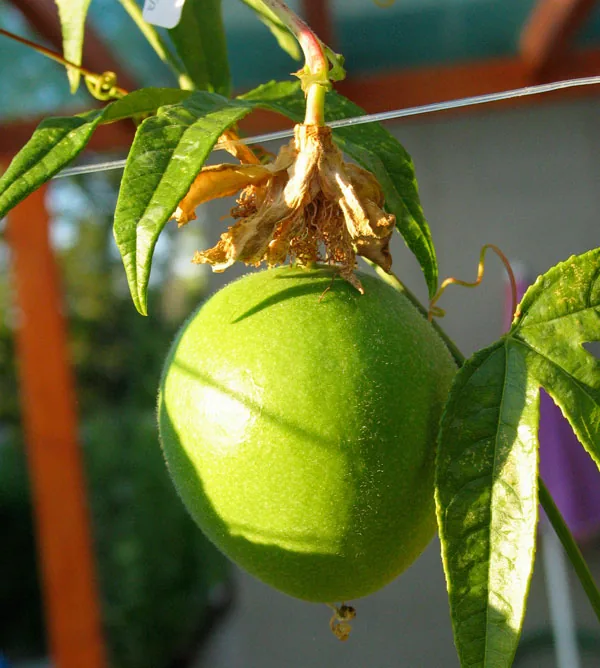
Passionflower, or maypop, is a fast native vine cultivated for its intricate fringed flowers and the egg-shaped fruit that develops after bloom. It ascends by tendrils rather than twining, and in a single season the stems extend 6 to 8 feet (183 to 244 cm), clambering over fences, trellises, and adjacent structures. Bloom runs from July into September, and in regions with a long, warm summer the maypop matures to a soft yellow by fall.
The species is adaptable and low-maintenance once established. It performs in full sun or partial shade, withstands drought, and grows across clay, loam, and sand because its tolerance is broad rather than soil-specific. The single non-negotiable is drainage, since a saturated root zone over winter is the usual cause of loss.
Its ecological value extends well beyond the flowers. As a larval host for fritillary and zebra longwing butterflies, the foliage is meant to be grazed, so summer leaf damage indicates the plant is fulfilling its role. The counterpart to that vigor is a strong suckering habit, which pushes new shoots from lateral roots at a distance from the original planting.
Care
The short version: site it in full sun to part shade, in average soil that drains freely, and water deeply but infrequently once it has established. Provide a substantial support for the tendrils to climb, and either allow room for a vigorous spreader or contain its roots.
Light
Passionflower flowers most freely in full sun, though it tolerates partial shade with reduced output. Because bloom and fruiting scale with light, allot the brightest position available to maximize both.
Water
During establishment, hold the soil at average, medium moisture, watering on roughly a 7 to 14 day interval and allowing the top half of the profile to dry between applications. Once established the plant is drought tolerant and requires little supplemental water. Avoid wet, poorly drained ground, which induces root rot, particularly through winter.
Soil
The vine accepts clay, loam, or sand because its adaptability is broad rather than texture-dependent. What it requires without exception is free drainage, since standing water is the principal limiting factor.
Temperature
Cold hardiness reaches roughly -20°F (-29°C) and heat tolerance extends to 100°F (38°C). Toward the cold end of that range the top growth is killed in winter, after which the roots regenerate shoots in spring.
Humidity
Ambient outdoor humidity is sufficient, and no target figure applies. Airflow and drainage exert far more influence on plant health than atmospheric moisture.
Feeding
Apply a balanced general-purpose fertilizer two or three times over spring and summer, which meets the plant's needs. Over-fertilizing an already vigorous vine drives rank vegetative growth without benefit.
Pruning
Plan on heavy pruning to hold this fast vine to its support and within bounds. In cold zones the top dies to the ground each winter, so remove the dead growth and allow the spring resprouts to succeed it.
Repotting
Container specimens rarely require repotting. Pot up only when roots fill the container, emerge through the drainage holes, or growth slows under confinement.
Size & spacing
A single season carries the vine to 6 to 8 feet (183 to 244 cm) in height with a spread of 3 to 6 feet (91 to 183 cm). Provide a robust trellis or fence and space to extend, or contain the roots where the footprint must stay limited.
When to plant
Passionflower is governed by warm-season phenology and will not break growth until frost has passed. Start seed indoors in late winter to early spring, transplant outdoors in spring once the cold has cleared, and expect flowering from July into September with the maypop maturing through late summer and fall.
Northern hemisphere
Southern hemisphere
Typical months for a temperate climate: start earlier in warm zones, later where spring frosts linger.
- Sow: Late winter to early spring (6 to 8 weeks before last frost)
- Plant: Spring, after danger of frost has passed
- Harvest: Flowers July to September; egg-shaped maypop fruit ripens to yellowish in late summer to fall
Hardiness
USDA hardiness zones: 5–9
Temperature: down to -29°C
Troubleshooting
The majority of passionflower complaints reduce to two underlying causes: a suckering vine that outruns its allotted space, or a root zone held too wet. Read the early indicators below against what the plant is showing. Note that some symptoms, chief among them caterpillar-grazed foliage, are the plant operating exactly as intended.
Collapse and yellow foliage in poorly drained, cool soil
When the root zone stays saturated, oxygen is displaced and root rot follows, which is why the classic trigger is a cool, wet winter with poor drainage. Verify by lifting a section of root, which reads dark, soft, and mushy once compromised. Withhold water until the soil dries, correct the drainage or relocate the plant to a better-drained site, and incorporate organic matter into heavy soils to restore percolation.
Fix:
- Improve drainage or move the plant to a better-drained site
- Stop supplemental watering until soil dries
- Amend heavy soils with organic matter to improve drainage
Roots failing to resprout following a severe winter
At the cold margin of its range, failure to break dormancy points to cold injury, since this species is not reliably hardy through USDA Zone 5 and its crown can be killed outright by a severe winter. Confirm by the absence of resprouting from the roots in late spring, typically where the crown lacked insulating cover. Buffer the crown with a heavy mulch ahead of hard cold, exploit the warmth of a south-facing wall, or grow it in a container that can be moved to shelter where the zone is truly marginal.
Fix:
- Mulch the root zone heavily before winter in cold zones
- Plant in a protected spot sheltered by a wall or structure
- In the coldest zones, grow as a container plant moved to shelter
Sucker shoots emerging at a distance from the crown
Passionflower recruits new stems from root suckers and runners that travel laterally underground, which is why shoots surface at a distance from the crown. Confirm the mechanism by following a stray back to the radiating lateral roots. Sever and lift the suckers before they root deeply, and where containment matters, establish the plant in a bordered bed, a large pot, or behind a root barrier so the runners have nowhere to escape.
Fix:
- Dig out unwanted suckers as they appear
- Install a root barrier or grow in a contained bed or large pot
- Site it where it has room to roam or where mowing controls strays
Skeletonized leaves from fritillary caterpillar feeding
The foliage feeds the larvae of fritillary and zebra longwing butterflies, for which this species functions as a designated larval host. Identify the culprits by the spiny orange caterpillars and the adults nectaring alongside them. No intervention is warranted, because an established vine replaces the lost tissue faster than the larvae remove it, and any insecticide would eliminate the very butterflies the plant is meant to sustain.
Fix:
- Tolerate the feeding, since this plant is intended to feed butterfly larvae
- Healthy established vines outgrow the damage
- Avoid insecticides, which kill the butterflies you are hosting
Toxicity
Passionflower is not listed by the ASPCA as toxic, and the ripe maypop is edible. The caution is narrow and specific: the leaves and unripe green fruit contain small amounts of cyanogenic glycosides, so pets, livestock, and children should be kept from ingesting green growth in quantity.
Toxic to
Cats · Dogs · Horses · Rabbits · Livestock · Birds
Safe for
People
Cats Caution
The species is classed as non-toxic, yet the leaves and unripe green fruit contain small amounts of cyanogenic glycosides. A cat taking a token bite is unlikely to react, whereas a substantial mouthful of foliage supplies enough of the compound to provoke drooling or a mild digestive upset.
Dogs Caution
Because the plant is absent from the toxic lists, a dog can chew a leaf or two without consequence. Monitor any dog that consumes green growth or unripe fruit in volume, where the cyanogenic glycosides can irritate the gut.
Horses Caution
An incidental grazed leaf presents little hazard. The concern rests with foliage and unripe fruit ingested in quantity, whose trace cyanogenic compounds can leave a horse inappetent or nauseated.
Rabbits Caution
Rabbits should be kept off the foliage. The cyanogenic glycosides present in green growth and unripe fruit render the leaves unsuitable, so exclude the plant from the hutch.
Livestock Caution
Cattle, goats, and sheep browsing a stray vine face negligible risk. A bulk feed of leaves or green fruit is the situation to avoid, owing to the trace cyanogenic glycosides they hold.
Birds Caution
Wild birds and poultry favor the ripe maypop, which poses no problem. Discourage sustained feeding on the foliage and unripe fruit, where the cyanogenic compounds are concentrated.
People Ripe fruit safe
The fully ripe maypop is edible, and the aerial parts have a documented history of use in herbal teas. Avoid the unripe green fruit and refrain from eating the leaves in quantity, since both carry small amounts of cyanogenic glycosides.
Only fully ripe fruit is safe to eat. The leaves and unripe (green) fruit contain small amounts of cyanogenic glycosides, so unripe fruit and large quantities of foliage should not be eaten.
Helpline numbers

United States
ASPCA Animal Poison Control: (888) 426-4435 (fee applies)
Poison Control: (800) 222-1222



Canada
Poison Centres: 1-844-764-7669
Varieties
Beyond the native maypop, several related passionflowers enter cultivation for their flowers, fragrance, or fruit. The following are the ones worth distinguishing.
Passiflora caerulea (blue passionflower)
Its blue-and-white flowers and largely evergreen habit give it greater hardiness than the maypop across mild-winter regions.
Passiflora 'Incense'
This hybrid is marked by large, deep violet flowers that carry an intense fragrance.
Passiflora edulis (passion fruit)
Cultivated commercially for edible passion fruit, this tropical species does not match the maypop for cold hardiness.
How to propagate
Passionflower can be increased by three methods, ranging from a patient seed sowing to the near-automatic division of the suckers the plant produces unbidden.
SeedModerate
Sow indoors late winter to early spring, or outdoors after frost · Several weeks to germinate; one to two seasons to flower
Seed propagation rewards patience. Sow indoors in late winter to early spring, or direct sow outdoors once frost has passed, and anticipate slow, erratic germination that may extend across several weeks. A pre-sowing soak improves emergence, and expect a seedling to require one to two seasons of growth before it reaches flowering.
DivisionEasy
Spring · One growing season
The same root-suckering habit that spreads the plant makes division the simplest way to increase it. Lift and separate the suckers in spring, and each division establishes over a single growing season.
Stem cuttingsModerate
Late spring to summer · Several weeks to root
Collect softwood or semi-ripe cuttings from actively growing stems in late spring or summer. Held under warmth and consistent moisture, they root over several weeks into independent plants.
Myths
All tissues of Passiflora incarnata are poisonous, making the vine hazardous around household pets and young children.
Passiflora incarnata is absent from the ASPCA toxic-plant lists, and the ripe maypop is edible. The cyanogenic glycosides are confined to the leaves and unripe green fruit, and only in small amounts, so the risk attaches to ingesting green growth in quantity rather than to cultivating the plant nearby.
Leaf-feeding caterpillars on this vine are damaging pests that warrant insecticide.
This species serves as a larval host for Gulf fritillary and related fritillaries, so a degree of leaf feeding is the intended function of the foliage. An insecticide destroys the butterflies the plant is grown to support, while an established vine regenerates the lost tissue on its own.