Tree · Caricaceae
Papaya
Carica papaya
With full sun, consistent soil moisture, and a frost-free site, Carica papaya progresses from transplant to ripe fruit in under a year.
Full sun
Every 1–4 days
50–95°F · 10–35°C
210–330 days
Overview
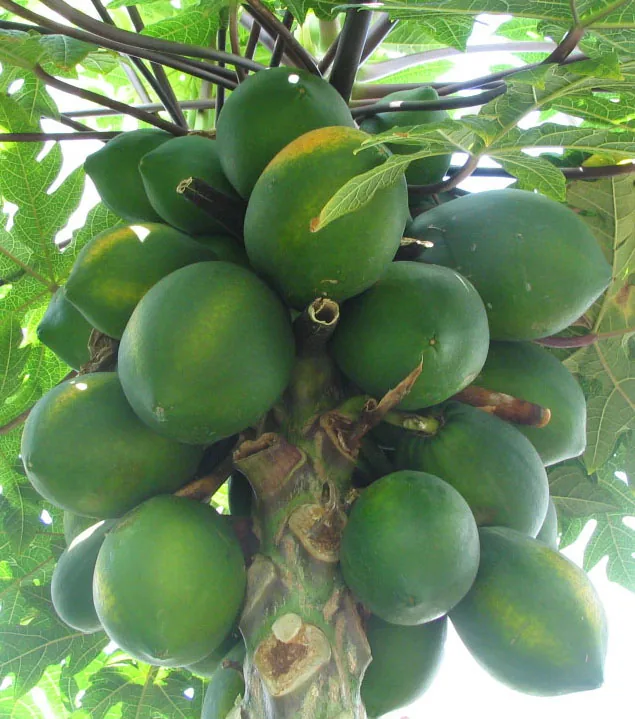
Papaya is a fast-growing tropical tree that progresses from seed to fruiting plant in well under a year. A member of the Caricaceae family, it bears its melon-like fruit on a tall, single, soft trunk crowned with broad, lobed leaves, and in a frost-free site it attains 6 to 20 feet (2 to 6 m) as it matures. That rapid habit is the trait that shapes almost every management decision.
Set against that vigor are two structural limits: the species is short-lived and tender. The trunk contains no true wood, the plant declines within a few years, and a single freezing night kills exposed tissue outright. For those reasons growers manage it as a short-cycle crop, replacing plants every 18 to 24 months to stay ahead of ringspot virus.
Reproduction adds a further constraint worth planning for. Seedlings express as male, female, or bisexual, and the sex is unreadable until bloom, so growers establish several plants together or choose a bisexual cultivar to guarantee fruit set. With warmth, adequate water, and a fertile plant secured, harvest continues nearly year-round in a tropical climate.
Care
The short version: full sun, warmth held above frost, and soil kept evenly moist but never saturated. Feed on a regular schedule through the growing season, allow the tall trunk room to develop, and plan on replacing the plant every couple of years.
Light
Papaya requires full sun in the fullest exposure available. It will tolerate limited partial sun, but bright all-day light is what supports the rapid growth and heavy fruit load characteristic of the species.
Water
Hold the soil evenly moist with frequent irrigation, daily in sandy or rocky substrates during hot, dry spells and every 3 to 4 days in loam. Avoid waterlogging, since saturated soil promotes root rot. Sustained even moisture also matters because drought or fluctuating moisture triggers the plant to shed leaves, flowers, and fruit.
Soil
Grow it in well-drained, organically rich sandy loam, though the species accommodates sandy, loamy, and rocky substrates. It performs across a broad pH span of 4.5 to 8.0, which makes drainage, not reaction, the limiting soil factor.
Temperature
Papaya is adapted to warmth in the range of about 50°F to 95°F (10°C to 35°C) and carries no cold tolerance. Tissue exposed below roughly 31°F (-1°C) is killed, so a single frost event can terminate the plant.
Humidity
The species favors humid air near 60% to 80%, consistent with its tropical origin. That warmth and moisture should be paired with good air movement, since stagnant humid conditions predispose the fruit to fungal disease.
Feeding
As a fast, nutrient-demanding grower, papaya needs a complete NPK feed with micronutrients through the warm season. Supply young plants small amounts about every 14 days, then transition older trees to larger applications every other month.
Pruning
The plant is largely left uncut because its single terminal growing point must never be removed. Confine pruning to dead, damaged, or diseased leaves, and stake any trunk that begins to lean.
Repotting
A container specimen should be potted up into a large tub as it develops. Even under good culture the plant is short-lived, so anticipate replacement every 4 to 5 years, or every 18 to 24 months where ringspot virus is present.
Size & spacing
Papaya reaches 6 to 20 feet (2 to 6 m) in height on a slender single trunk and extends its leafy crown 3 to 10 feet (90 cm to 3 m) across. Provide open spacing and full sun so air moves freely through the canopy.
When to plant
Because papaya depends on heat and has no frost tolerance, all timing is governed by staying warm. Start seed in containers in late winter or early spring, transplant in spring once the soil has warmed and all danger of frost has passed, and expect fruit to ripen year-round wherever the climate remains frost-free.
Northern hemisphere
Southern hemisphere
Typical months for a temperate climate: start earlier in warm zones, later where spring frosts linger.
- Sow: Late winter to early spring, started in containers in a warm, frost-free spot
- Plant: Spring after all danger of frost, when the soil is warm
- Harvest: Flowers about 4 months after planting; fruit ripens roughly 7 to 11 months after transplanting and is harvested year-round in frost-free climates
Hardiness
USDA hardiness zones: 9–11
Temperature: down to -7°C
Troubleshooting
Most papaya disorders trace to one of three drivers: an aphid-vectored virus, saturated soil, or cold. Reading the earliest signs on the leaves, roots, and fruit allows intervention before a problem claims the whole plant. Match the observed symptom below, then respond without delay.
Chlorotic mosaic on young foliage and ring-shaped blemishes marking the peel
These symptoms point to papaya ringspot virus, the single factor that limits the productive span of most plantings. Aphids act as the vector, moving the virus from tree to tree as they feed, and no treatment reverses an established infection. The practical response is to rogue out and destroy infected plants to shrink the virus reservoir, suppress the aphid vectors, and re-establish from virus-free or tolerant stock every 18 to 24 months.
Fix:
- Remove and destroy infected plants to reduce the virus source
- Control aphid vectors
- Replant with virus-free or tolerant stock every 18 to 24 months
Foliage turning yellow with basal trunk collapse in saturated soil
The cause is Phytophthora root and stem rot, a water-mould disease favored by saturated soil. As the substrate stays waterlogged the pathogen colonizes and softens the root system and trunk base, so structural support fails and the plant collapses. Correcting the water regime addresses the mechanism directly: improve drainage, reduce watering to end the standing moisture, and site new plants on raised beds or mounds so excess water drains away.
Fix:
- Improve drainage
- Reduce watering
- Plant on raised beds or mounds
Necrotic, blackened foliage and shoot dieback following a frost event
This is direct frost injury, and it reflects the species' complete lack of cold hardiness. Tissue exposed below about 31°F (-1°C) is killed, which is why the blackening and dieback register immediately after the cold event rather than developing over time. Manage it by conserving heat around the plant with covers or by relocating containers indoors during a cold snap, and defer pruning of the dead tissue until all danger of frost has passed so no fresh growth is exposed.
Fix:
- Protect with covers or move container plants indoors during cold
- Prune out dead tissue only after danger of frost has passed
Water-soaked lesions darkening and sinking into maturing fruit
The lesions are anthracnose, caused by a Colletotrichum fungus whose activity is driven by warm, humid, wet conditions and expressed as the fruit ripens. Because free moisture and inoculum sustain the disease, control works by breaking those conditions: excise and discard affected fruit to remove sporulating tissue, open the canopy so foliage dries faster, and harvest promptly at first color to limit exposure. Withholding overhead irrigation and clearing fallen fruit further deprives the fungus of the moisture and substrate it needs.
Fix:
- Remove and discard affected fruit
- Improve air circulation
- Harvest fruit promptly as it ripens
Toxicity
Ripe papaya is edible and safe for people and pets, so the sweet flesh presents no concern. The unripe green fruit and the leaves are different. They exude a milky latex rich in papain that can irritate skin, eyes, and an animal's mouth, which is why gloves are advised when cutting green fruit and why pets should be kept from the green tissue.
Safe for
People · Cats · Dogs · Horses · Rabbits · Livestock · Birds
Cats Caution
A small portion of ripe flesh is well tolerated by cats. The concern is the milky latex in the unripe fruit and leaves, which carries the enzyme papain and can irritate the mouth and stomach, so restrict access to the green tissue and offer only small pieces of ripe fruit.
Dogs Caution
Ripe papaya in small amounts suits most dogs. The latex from green fruit and stems is the irritant fraction and can provoke drooling or gastric upset, so exposure to the unripe parts should be prevented.
Horses Caution
The ripe fruit poses no hazard to horses. It is the papain-rich latex of unripe fruit and foliage that irritates the digestive tract, so the green tissue should be treated as off-limits.
Rabbits Caution
A small quantity of ripe papaya serves as an occasional treat. The leaves and unripe fruit warrant avoidance, since the latex is harsh on a rabbit's sensitive digestion.
Livestock Caution
Cattle, goats, and sheep tolerate the ripe fruit without incident. The irritant latex is concentrated in the green fruit and leaves, which is the fraction to withhold.
Birds Caution
Ripe papaya and its seeds are readily taken by many birds and are safe in moderation. The green latex can sting the mouth, so only softened, colored fruit should be offered.
People Ripe fruit safe
Ripe papaya is edible raw or cooked, and the seeds are edible though peppery. The latex from unripe fruit and stems can irritate skin and eyes, which is the rationale for wearing gloves when cutting green fruit.
The unripe green fruit and the stems exude a milky latex containing papain, a proteolytic enzyme that can irritate skin and eyes; wear gloves when harvesting or cutting unripe fruit. The seeds are edible but peppery.
Varieties
Home growers concentrate on a small set of proven cultivars selected for reliable fruit, quality flavor, and dependable pollination. The names below are the ones worth knowing.
Red Lady
A dependable, disease-tolerant hybrid whose bisexual plants self-set reliably and produce reddish-orange flesh.
Maradol
A Mexican type recognized for large fruit carrying sweet, salmon-red flesh.
Tainung No. 1
A vigorous Taiwanese hybrid producing medium-sized fruit with red flesh.
Solo
A small, pear-sized Hawaiian type with yellow-orange flesh that is frequently hermaphroditic, allowing a single plant to fruit independently.
How to propagate
Papaya is raised from seed, and it ranks among the more straightforward tropical fruits to grow that way. The single complication is ensuring the resulting plant is capable of fruiting.
SeedEasy
Spring or warm season, started in containers · Seedlings transplant in about 6 to 8 weeks; plants fruit roughly 7 to 11 months after transplanting
Papaya propagates readily from seed, and fresh seed extracted from a ripe fruit gives the best germination. Sow 2 to 4 seeds per 1-gallon container and thin to the most vigorous seedling, then grow 2 to 3 plants together to raise the odds of retaining a fruiting female or bisexual individual, since seedling sex remains undetermined until flowering. The seedlings reach transplant size in about 6 to 8 weeks, and the established plants begin fruiting roughly 7 to 11 months after they are set in the ground.
Myths
Carica papaya and the North American pawpaw are the identical plant under two names.
The shared common name masks a clear botanical distinction. Papaya is a tropical species in the Caricaceae family, whereas the pawpaw is a temperate tree placed in an entirely different family. Their climate requirements diverge accordingly, one demanding frost-free heat and the other adapted to cold-winter woodlands.
Fruit production requires no more than one papaya plant.
Sex expression makes a single seedling an unreliable bet, because seedlings emerge male, female, or bisexual and the sex cannot be determined until flowering. Plant 2 to 3 seedlings together, or select a bisexual cultivar, to secure a plant capable of setting fruit.
Papaya is a long-lived tree.
Rapid growth comes at the cost of longevity. The soft-stemmed trunk lacks true wood and declines within a few years, so most gardeners replace their plants every 18 to 24 months, a cycle that also helps outpace ringspot virus.