Ornamental · Poaceae
Pampas Grass
Cortaderia selloana
Few ornamentals rival a pampas grass clump in full plume, yet those silver feathers are borne on razor-sharp leaves.
Full sun
Every 7–14 days
USDA 7–10
6–12 ft · 1.8–3.7 m
Overview
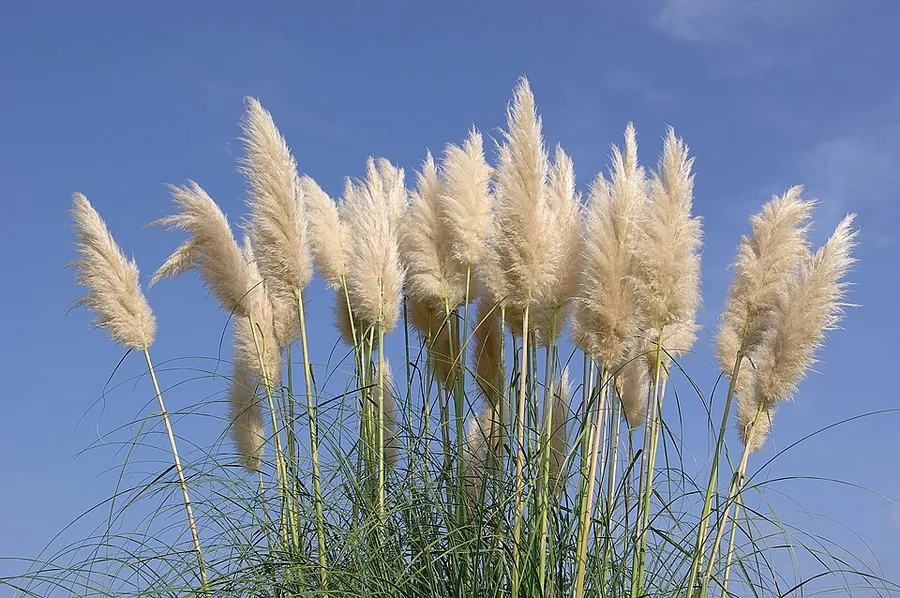
Pampas grass is a large, plume-bearing ornamental grass used to anchor deep borders and screen views. Native to South America and formally Cortaderia selloana of the grass family, it earns its low-maintenance reputation through broad environmental tolerance: an established clump withstands drought, heat, salt spray, and wind with little intervention.
The ornamental value rests on the inflorescence. Each clump raises a fountain of silver-white plumes in late summer that persist in form well into winter, held above arching foliage whose spread can exceed 12 feet. That same foliage explains the principal caution, because every blade is margined with fine, razor-sharp serrations that shear bare skin on contact.
A second consideration precedes any planting decision. In mild-winter regions along the Pacific coast and in Hawaii, pampas grass self-seeds into a serious invasive, displacing native vegetation and adding fuel to wildfire. Within its behaved range it functions as a bold, low-input feature; outside it, the responsible choice is to select an alternative.
Care
The short version: site it in full sun on well-drained ground, irrigate only through establishment, and cut the entire clump back hard each late winter, wearing gloves and long sleeves on every pass.
Light
Pampas grass performs best in full sun, which drives strong plume production and upright, self-supporting growth. It persists in partial sun or light shade, but under reduced light the clump loosens and lodges and the characteristic plumes thin, because the plant cannot fuel dense, rigid tissue.
Water
Irrigate a new plant regularly through its first season to establish a deep root system. Once that system is in place the plant becomes highly drought, heat, salt, and wind tolerant and needs little to no supplemental water. Avoid wet, poorly drained sites, since saturated roots shorten its life and predispose it to winter injury.
Soil
The species accepts almost any well-drained soil, spanning clay, loam, sand, and rocky ground at dry to medium moisture. It also tolerates a broad pH range of roughly 5.5 to 8.5, so soil reaction rarely limits performance and drainage is the variable that matters.
Temperature
It is hardy across a wide thermal range of about 10°F to 100°F (-12°C to 38°C), corresponding to zones 7 through 10. Temperatures below that floor can kill the crown, whereas heat at the upper end poses no problem, consistent with its native climate.
Humidity
Ambient outdoor humidity suffices, which is why the record sets no target figure. Air movement matters more than atmospheric moisture, and an exposed, breezy site suits a grass this wind-tolerant.
Feeding
Apply a balanced general-purpose fertilizer sparingly in spring during the growing season. An established clump has low nutrient demand, and excess nitrogen only forces soft, weak growth that undermines the plant's structural rigidity.
Pruning
Cut the entire clump back hard to about 1 to 2 feet (30 to 60 cm) in late winter, before new growth begins, using hedge shears, loppers, or power pruners. Work only in gloves, a long-sleeve shirt, and eye protection, because the serrated blades cut skin with ease.
Repotting
Pampas grass is seldom repotted and remains productive in one position for years. Relocate or divide it only when it outgrows its allotted space, the clump center dies out into thatch, or the crowded crown begins lifting clear of the soil.
Size & spacing
A mature clump attains roughly 6 to 12 feet (1.8 to 3.7 m) in height and about 4 to 7 feet (120 to 205 cm) in spread. Allow generous open ground, set well clear of paths and play areas, so that no one contacts the sharp foliage in passing.
When to plant
Pampas grass is a warm-region perennial suited to zones 7 to 10, and its schedule tracks its growth cycle. Plant in spring so the root system develops through the growing season, allow the silver plumes to emerge from late summer into fall, then cut the clump to the ground in late winter before new growth breaks.
Northern hemisphere
Southern hemisphere
Typical months for a temperate climate: start earlier in warm zones, later where spring frosts linger.
- Plant: spring
- Harvest: late summer to fall, plumes persist into winter
Hardiness
USDA hardiness zones: 7–10
Temperature: down to -18°C
Troubleshooting
Pest and disease losses in pampas grass are uncommon. Two issues dominate instead, the mechanical cuts the blades inflict and the plant's tendency to spread past its intended bounds, and both are readily diagnosed and forestalled.
Recruitment of new clumps at a distance from the parent planting
These volunteers trace to prolific wind-dispersed self-seeding, the species' most consequential trait. Because a single plume can release well over 100,000 seeds in a year and detached root or rhizome fragments re-root in moist ground, recruitment concentrates downwind and on disturbed, coastal, or open sites where bare soil invites establishment. Interrupt the seed pathway directly: excavate young crowns entire before they consolidate, and cut and bag the plumes before the seed matures rather than composting them or transporting seed-charged soil.
Fix:
- Remove volunteer seedlings while young by digging out the entire crown
- Cut and bag flowering plumes before seeds mature and disperse
- Do not compost plumes or move soil containing seed
Deep, stinging lacerations to hands and arms following contact with the foliage
No pathogen or insect is involved here; the wound is purely mechanical, inflicted by the foliage itself. Every leaf blade is margined with fine, razor-sharp serrations, and drawing a hand across or through them shears the skin, which is why the cuts read thin, clean, and deeper than their width suggests. The remedy follows from the cause: cover exposed skin with thick gloves, a long-sleeve shirt, long pants, and eye protection, and sever the clump with shears or loppers so the blades never slide through a bare grip.
Fix:
- Stop handling bare-skinned and wash and dress any cuts
- Always wear thick gloves, a long-sleeve shirt, long pants, and eye protection
- Cut the clump back with hedge shears, loppers, or power pruners rather than pulling foliage by hand
Toxicity
The verdict divides cleanly into chemistry and mechanics. No part of pampas grass is toxic, and the ASPCA rates it safe for cats, dogs, and horses; the hazard is entirely physical, because the leaf margins are razor-sharp and shear skin like paper, so handle it gloved and keep pets and children from moving through the clump.
Safe for
People · Cats · Dogs · Horses · Rabbits · Livestock · Birds
Cats None
The foliage holds no toxin, so ingestion carries no risk of systemic poisoning in cats. The only exposure that matters is mechanical, as the serrated margin can incise oral tissue, which is reason enough to discourage chewing.
Dogs None
A dog encounters no poisoning hazard from this grass, since the plant carries nothing toxic. Restrict access to the clump nonetheless, because the blade margins can lay a thin laceration across a nose or paw on contact.
Horses None
There is no toxic principle to affect a horse that grazes near or on the plant. Contact still poses a mechanical risk, as the sharp-edged blades can abrade the lips or tongue, so an enclosed clump is the sounder arrangement.
Rabbits Safe
No toxin in the tissue threatens a rabbit that samples it. In practice the stiff, cutting blades are too coarse to serve as forage, so palatability alone keeps consumption low.
Livestock Safe
Cattle, goats, and sheep face no risk of poisoning from grazing this grass. Most reject it regardless, deterred by the harsh, blade-edged foliage that yields little grazing value.
Birds Safe
Birds sustain no chemical harm and commonly use the dense plumes for shelter. The same sharp margins apply, but the risk of contact is minimal, since flying visitors seldom draw across the blades.
People Safe
No part of the plant is poisonous to handle or occupy space beside. The operative hazard is mechanical, because the razor-sharp leaf edges cut skin like paper, so gloves and long sleeves are warranted whenever work brings you close to it.
Not poisonous, but the sharp-edged leaves can inflict deep cuts on skin. Wear gloves, long sleeves, and eye protection when planting, handling, or pruning, and keep pets and children from running through or chewing the foliage to avoid mouth and skin cuts.
Varieties
Pampas grass is offered in several named selections that differ in stature, plume color, and foliar variegation. The following are the forms most often encountered in the trade.
Pumila
A compact dwarf that reaches only about 4 to 6 feet and holds greater cold hardiness, which accounts for its standing as the most widely planted selection.
Rosea
Departs from the typical silvery-white in favor of plumes carrying a soft pink cast.
Sunningdale Silver
A tall, vigorous selection valued for the size and fullness of its silvery-white plumes.
Silver Comet
A variegated form marked with white-and-green striping through the foliage.
Gold Band
A variegated form whose leaves are gold-banded with yellow-and-green striping.
How to propagate
Two propagation routes exist, but only vegetative division preserves the showy plumes true to type. Under either, the serrated foliage makes gloves and long sleeves a requirement rather than a precaution.
DivisionModerate
Late winter to early spring · 1-2 growing seasons
Vegetative division is the preferred method of propagation, performed in late winter to early spring, and it is the only route that preserves the showy female clones true to type, since seed does not. Expect a division to require one to two growing seasons to establish and reach full form. Because the crowns are dense and the blades cut, don gloves and protective clothing before sectioning a clump.
SeedEasy
Spring · 1 growing season to first flowering in favorable climates
The plant self-seeds freely, and under a favorable climate a spring sowing can reach flowering within a single growing season. The limitation is genetic segregation: seedlings vary, and many prove to be plain, less-showy male plants. Forgo seed entirely wherever pampas grass is invasive, since raising it only augments the seed pressure that drives the spread.
Myths
All large, feathery pampas grass is the same plant.
Two distinct species trade under the pampas grass name. The showy ornamental in general cultivation is Cortaderia selloana, whereas jubata grass, also called purple pampas grass, is the separate Cortaderia jubata. Jubata grass is the more aggressive of the pair, since it sets viable seed apomictically without pollination and colonizes coastal and redwood-forest land. Morphologically the two are close and share the same sharp serrated leaves, yet their ranges diverge, because jubata grass is confined to cool, foggy coasts while selloana also tolerates hot, dry inland heat.
Pampas grass is poisonous to pets.
The record contradicts this directly: the ASPCA classifies Cortaderia selloana as non-toxic to cats, dogs, and horses, and the plant contains no poison. The hazard is mechanical injury from the razor-sharp leaf margins, not toxicosis of any kind.