Tree · Araucariaceae
Norfolk Island Pine
Araucaria heterophylla
Bright light, cool air, and even moisture are what let this living conifer hold its neatly whorled tiers indoors through the year.
Bright indirect
55–64°F · 13–18°C
USDA 9–11
3–6 ft · 0.9–1.8 m
Overview
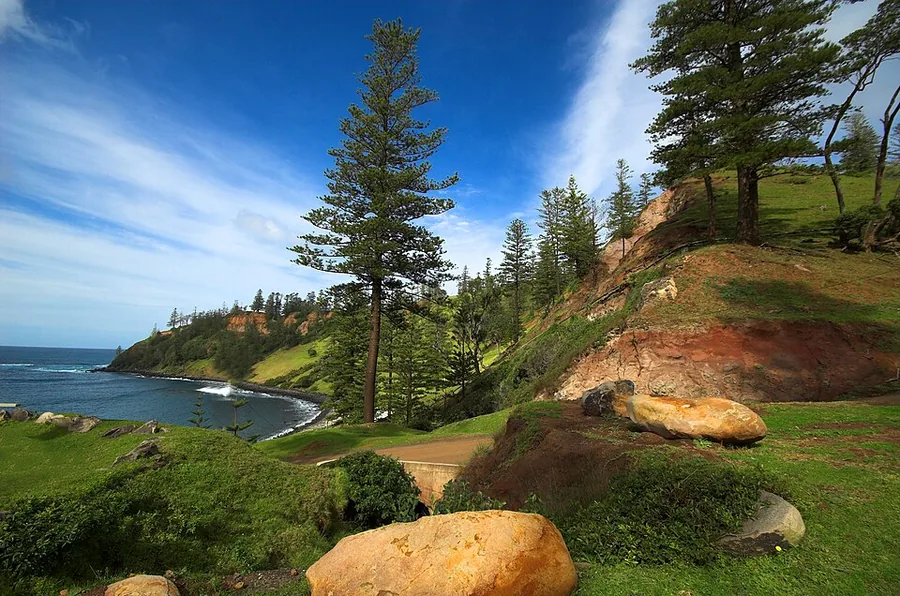
Araucaria heterophylla is a living conifer cultivated indoors for its feathery, tiered evergreen habit. Endemic to Norfolk Island in the South Pacific, it attains the stature of a towering tree in habitat, yet under container culture it holds to a manageable 3 to 6 feet (about 91 to 183 cm). Growers commonly keep it as a small, living alternative to a cut Christmas tree.
Close inspection confirms it is no true pine. It sits in the genus Araucaria, an ancient Southern Hemisphere conifer lineage considerably older than the Pinus species it echoes. The soft, needle-like branches are arranged in regular whorls around a single upright leader, and that symmetrical, tiered architecture is the reason the plant is grown.
It responds well to a cool, bright position and consistent irrigation. The constraint is its slow growth combined with the fact that it will not replace tissue it loses, so a browned and shed branch, or a severed leader, leaves a permanent void. Supply correct light, humidity, and moisture, and the specimen retains its form for years.
Care
The short version: supply bright indirect light, cool rooms near 55°F to 64°F (13°C to 18°C), and a medium kept evenly moist through the growing season and drier in winter. Maintain humidity, prevent the pot from standing in water, and never cut the central leader.
Light
Provide bright, indirect light, ideally at a sunny window where the direct rays are diffused. The plant tolerates some full sun, but a degree of afternoon shade prevents the foliage from bleaching, whereas a dim position gradually thins the lower branches through light starvation.
Water
Maintain the medium evenly moist from spring through autumn, then taper watering through winter. Allow the surface to begin drying between applications, and never leave the pot standing in water. Judge timing by the feel of the soil and the turgor of the foliage rather than a fixed calendar.
Soil
Grow it in a fertile, porous medium rich in sand and peat and held slightly acidic. Sharp drainage is the priority, because the roots of this conifer rot in a medium that remains saturated.
Temperature
Cool conditions suit it best, ideally 55°F to 64°F (13°C to 18°C). Keep it well away from heat vents, and do not allow the temperature to fall below 50°F (10°C) in winter.
Humidity
Average household humidity is adequate, but dry, heated air is its principal indoor stress. In a heated room, mist the foliage or group the pot with other plants to raise the humidity in its immediate microclimate.
Feeding
Apply a dilute liquid fertilizer through spring and summer, roughly every week or two. Withhold feeding in winter, when growth nearly halts and the plant makes little use of nutrients.
Pruning
This is a plant to leave largely untouched. Never top it or sever the central leader, since doing so destroys the whorled form and no replacement leader develops. Restrict cutting to dead or damaged lower branches.
Repotting
Repot only every 2 to 4 years, once the specimen is clearly potbound. It performs best slightly rootbound and resents disturbance, so there is no advantage in moving it up prematurely.
Size & spacing
Indoors it reaches 3 to 6 feet (91 to 183 cm) in height with a spread near 2 to 3 feet (61 to 91 cm). Allow clearance on all sides so the tiers extend evenly and the symmetry is maintained.
Troubleshooting
Most disorders on a Norfolk Island pine originate in the surrounding air and the irrigation regime, and the first evidence appears on the lower branches. Reading these early symptoms allows intervention before the loss becomes permanent. Match the presentation below, then correct the underlying cause while remedy is still possible.
Wilting foliage above waterlogged soil and softened roots
Wilting alongside saturated soil signals root rot, since overwatering or a pot that will not drain deprives the roots of oxygen, and in some cases the mushroom root rot fungus is involved. Reduce irrigation immediately and empty any saucer so the medium never remains standing in water. Where the roots have already turned soft and dark, repot into a porous mix, and note that once this stage is reached the disorder can be fatal.
Fix:
- Reduce watering frequency
- Ensure pot drains freely and empty saucers
- Repot into porous, well-drained mix if rot is present
Sticky black deposit or fine webbing on the foliage
A sticky, black-filmed coating identifies scale insects, because the sooty mold colonizes the sugary honeydew they excrete. Fine stippling paired with webbing instead identifies spider mites, whose populations build fastest in hot, dry rooms. Clean the foliage, apply horticultural oil or insecticidal soap to smother the pests, and raise the humidity, since the drier the air the faster mites reproduce.
Fix:
- Wipe or wash foliage
- Treat with horticultural oil or insecticidal soap
- Increase humidity to discourage mites
Progressive browning and shedding of the lowest tiers
Bare lower tiers point to dry, heated indoor air, and the decline compounds once a specimen has held a dim position for two or three years, since insufficient light starves the shaded lower branches. Relocate it to a bright, cool room and raise the ambient humidity to slow the moisture loss. A shed tier does not regenerate on this species, so intervening early is what preserves the whorled form.
Fix:
- Move to a bright, cool room with indirect light
- Mist foliage or raise ambient humidity in heated rooms
- Keep soil evenly moist but not waterlogged
Toxicity
The species presents a mild concern at most. The ASPCA and NC State both list it as non-toxic to cats, dogs, and horses, though the sap can still produce an upset stomach or minor skin irritation in a pet that ingests it. People are essentially safe, so the practical objective is simply keeping a persistent chewer away from the foliage.
Toxic to
Cats · Dogs
Safe for
People · Horses · Rabbits · Livestock · Birds
Cats Mild
Ingestion of the needle-like foliage by a cat can provoke drooling, vomiting, or a short loss of appetite, and the sap may leave the mouth or skin mildly irritated. The response stays minor and resolves without treatment, though a young specimen is best positioned out of reach of a persistent chewer.
Dogs Mild
A dog that consumes the branches can develop gastric upset, with some drooling or vomiting, while the resinous sap may irritate the skin around the muzzle. The reaction carries no real danger at the quantities a pet ingests, yet redirecting a curious dog from the lower tiers remains sensible.
Horses None
The ASPCA and NC State Extension both classify the species non-toxic to horses, and as an indoor subject it seldom comes within reach of one.
Rabbits Safe
No toxic constituent has been documented in rabbits, and the rigid, resinous foliage offers them little as forage.
Livestock Safe
The species carries no recognized toxicity to livestock, and in container culture it remains entirely removed from grazing stock.
Birds Safe
Pet birds show no documented reaction to the foliage, although the resin may deposit a sticky residue on plumage where a bird alights and pecks.
People Safe
The species is essentially safe around people, and no part of it is cultivated for consumption. Because the sap can leave sensitive skin faintly itchy, rinsing the hands after pruning is a reasonable precaution.
Helpline numbers

United States
ASPCA Animal Poison Control: (888) 426-4435 (fee applies)

United Kingdom
Animal PoisonLine: 01202 509000 (fee applies)

Australia
Animal Poisons Helpline: 1300 869 738
Varieties
No named cultivars are offered for selection here, but one former botanical name continues to accompany this plant through the houseplant trade.
Araucaria excelsa (former name)
As a superseded synonym that persists on plant labels and throughout the houseplant trade, this name designates precisely the species now marketed as Araucaria heterophylla.
How to propagate
A Norfolk Island pine is considerably easier to purchase than to propagate, and the form of any resulting plant is determined entirely by the growth from which it is started.
SeedModerate
Sow when fresh in moist, sandy, peaty soil · Several weeks to germinate; slow to develop into a sizeable plant
Seed remains the principal method of raising this species. Sow it while fresh into a moist, sandy, peaty medium, allowing several weeks for germination and considerably longer for the seedling to reach any substantial size. The advantage of that patience is a plant that develops the proper upright leader and the even, whorled tiers characteristic of the species.
Stem cuttingsDemanding
From terminal (leader) growth · Slow and unreliable
Cuttings succeed only when taken from the upright leader tip, and even so rooting is slow and unreliable. A cutting drawn from a lateral branch will root but retains its plagiotropic habit, growing sideways into a lopsided, distorted plant, which is why it never substitutes adequately for a seedling.
Myths
The Norfolk Island pine is a true pine.
The needle-like branches are misleading, because taxonomically the species belongs to the genus Araucaria in the family Araucariaceae, entirely outside Pinus. It is an ancient Southern Hemisphere conifer endemic to Norfolk Island, of far greater antiquity than the true pines it superficially resembles. The pine in its name reflects appearance, not lineage.
Cats and dogs face serious poisoning from a Norfolk Island pine.
Under its 'Australian Pine' entry the ASPCA classifies Araucaria heterophylla as non-toxic to cats, dogs, and horses, a determination NC State shares, so the prevalent toxic label is a misconception. The genuine hazard is mild, since a pet that ingests the foliage may experience gastric upset or minor skin irritation from the sap, and nothing more serious.