Ornamental · Balsaminaceae
New Guinea Impatiens
Impatiens hawkeri
Provide fertile, consistently moist, well-drained soil and dappled shade, and Impatiens hawkeri flowers from spring to the first frost.
Partial shade
59–81°F · 15–27°C
85–110 days
USDA 10–12
Overview
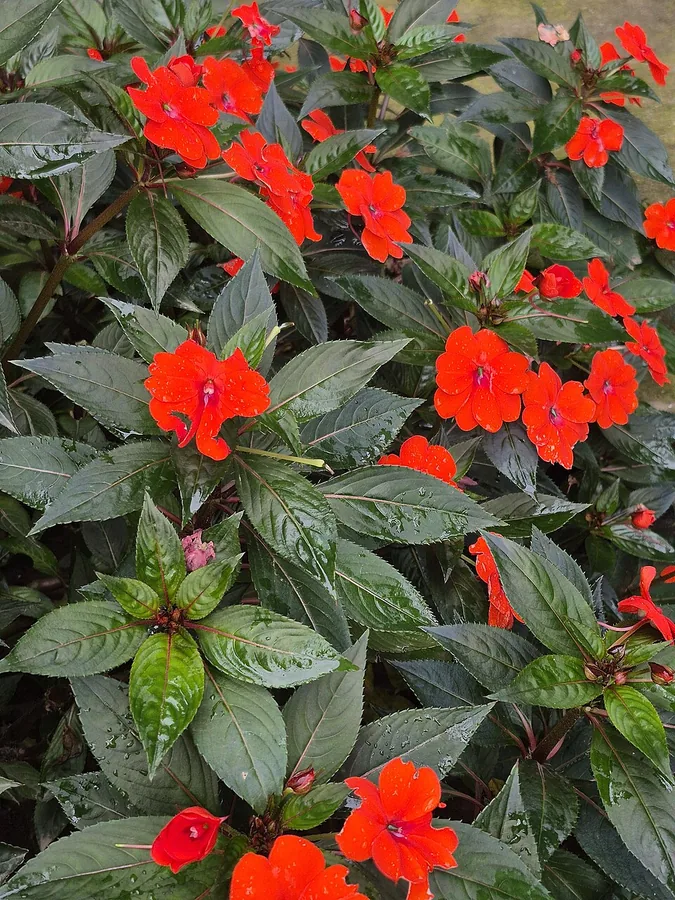
Impatiens hawkeri holds attention through its big, bright flowers carried over deep green or bronze foliage. The species originates in the islands north of Australia and behaves as a tender perennial, though cultivation almost always treats it as a garden annual with fresh planting each spring. Its habit stays neat and mounded, which suits it to beds, borders, or a container by an entryway.
The trait that separates this species from common bedding impatiens is greater durability. It carries more sun, produces larger flowers and leaves, and resists the downy mildew that decimated common impatiens across many gardens. The interspecific SunPatiens hybrids extend that further, holding condition through full sun and sustained summer heat.
Cultural demands stay modest and center on moisture supply. Held damp but never saturated and fed across the season, the plant flowers without interruption from spring until the first frost. Allowed to dry in heat, it responds with leaf stippling and flowers that fade fast, because moisture stress registers first in the foliage and blooms.
Care
The short version: partial shade over rich, well-drained soil held evenly moist, with a balanced feed every couple of weeks and spent blooms removed to sustain flowering.
Light
Site it in partial shade, particularly where summers turn hot. It carries more sun than common impatiens, but bright afternoon exposure without matching water drives stress and the leaf stippling that follows, since transpiration outpaces uptake.
Water
Hold the soil evenly moist throughout, neither saturated nor dried out. Water demand climbs with light, so a plant in full sun or a container draws down faster and needs refilling more often. Good drainage is what keeps that steady moisture from tipping into the anaerobic conditions that cause root rot.
Soil
Grow it in rich, well-drained soil amended with generous organic matter. The medium should retain moisture yet shed excess, because the roots want consistent dampness but suffocate and rot in standing water.
Temperature
Its range runs 59°F to 81°F (15°C to 27°C) with no frost tolerance whatsoever. A freeze kills the tissue outright, which is precisely why cultivation outside the warmest zones treats it as an annual.
Humidity
Ambient humidity is adequate, so no target figure applies. Root-zone moisture governs performance far more than air moisture, and it is dry heat, not low humidity alone, that predisposes the plant to spider mites.
Feeding
The plant ranks among heavy feeders, and container culture raises the demand further as nutrients leach with each watering. Supply a balanced liquid fertilizer every couple of weeks through the growing season to sustain both bloom and foliage.
Pruning
No structural pruning is required. Deadheading spent flowers redirects energy from seed set back into new bloom, and removing damaged or diseased growth on sight limits the spread of problems.
Size & spacing
Mature plants reach 6 to 20 inches (15 to 50 cm) tall and 12 to 24 inches (30 to 60 cm) across in a compact mound. Spacing that keeps the mounds apart lets air move through and dries the foliage after rain, which lowers disease pressure.
When to plant
Because Impatiens hawkeri has no frost tolerance, the whole schedule pivots on temperature. Plant out only once the last frost has passed and night temperatures stay above 50°F (10°C), after which flowering runs from spring through to the first frost in fall.
Northern hemisphere
Southern hemisphere
Typical months for a temperate climate: start earlier in warm zones, later where spring frosts linger.
- Sow: 8 to 10 weeks before last spring frost (seed strains only)
- Plant: After last frost when soil and night temperatures stay above 50°F (10°C)
- Harvest: Spring through fall until frost
Hardiness
USDA hardiness zones: 10–12
Temperature: down to -1°C
Troubleshooting
Most disorders in New Guinea impatiens resolve to moisture and air movement, either excess water held at the roots or a shortfall reaching the foliage under heat. The foliage and flowers register those stresses first, so reading them early lets you intervene before damage spreads. Match the symptom below, then correct the underlying condition while it still yields results.
Wilting to collapse in saturated soil
Wilting in saturated soil signals root rot rather than drought, because waterlogged roots cannot take up water even when it surrounds them. Lift the plant and inspect the roots, which have gone brown and mushy instead of white and firm. Reducing irrigation and correcting the drainage or repotting into a looser mix restores the air roots need, and any plant too far gone should be removed to protect the rest.
Fix:
- Reduce watering frequency
- Improve soil drainage or repot
- Remove severely affected plants
Mottled yellowing leaves veiled in fine webbing
Stippling and faint webbing point to spider mites, which build to damaging numbers when heat and drought stress the plant. Confirm them on the leaf undersides, where the tiny specks and webbing sit, or dislodge them onto white paper to see the dots move. Rinsing knocks the population down, keeping the soil moist removes the stress that favored them, and insecticidal soap or horticultural oil on the undersides finishes the job.
Fix:
- Rinse foliage with water
- Keep soil moist and reduce heat/drought stress
- Apply insecticidal soap or horticultural oil to leaf undersides
Fuzzy gray mold on flowers and leaves
Gray mold, the fungus Botrytis cinerea, colonizes aging blooms first because senescing tissue in cool, damp, stagnant air is its easiest entry point, then advances into healthy growth. Removing the infected flowers and leaves takes out that inoculum. Opening the planting to move air lowers the humidity the fungus needs, and watering at the base keeps the foliage dry so spores have nowhere to germinate.
Fix:
- Remove and discard affected plant parts
- Improve air circulation and spacing
- Water at the base and avoid wetting foliage
Deformed new growth, honeydew-slicked leaves, streaked blooms
Aphids and thrips concentrate on the tender new growth and the flowers because that soft tissue is easiest to pierce and feed on. Inspect the shoot tips and blooms for the insects, and read the silvery streaks and scarring as the signature thrips leave in the flowers. A firm rinse dislodges much of the population, insecticidal soap kills what remains, and cutting out the worst growth removes the feeding sites.
Fix:
- Rinse plants with water
- Apply insecticidal soap
- Remove heavily infested growth
Toxicity
For a planting near pets and children, the record is reassuring: New Guinea impatiens rates non-toxic across every species listed. The ASPCA classifies impatiens as safe for cats, dogs, and horses, and the remaining household animals face no poisoning from an incidental nibble. Site it freely, with no toxicological concern.
Safe for
People · Cats · Dogs · Horses · Rabbits · Livestock · Birds
Cats None
Non-toxic to cats, so a leaf or flower taken in curiosity carries no poisoning risk.
Dogs None
Non-toxic to dogs as well; the ASPCA lists impatiens as safe, so a chewed leaf presents no hazard.
Horses Safe
No toxicity to horses, meaning grazing on the foliage produces no illness.
Rabbits Safe
Rabbits may feed on the leaves and blooms with no toxic effect.
Livestock Safe
Cattle, goats, and sheep encounter nothing harmful in the plant, so it poses no risk to grazing stock.
Birds Safe
Backyard and pet birds are unaffected, and a pecked leaf or flower causes no harm.
People Safe
Safe around children; though not grown as an edible, a leaf taken into a small mouth carries no poisoning risk.
Varieties
New Guinea impatiens reaches gardeners as named series rather than a long roster of standalone cultivars, and a few recur across the trade. The series below are the ones worth recognizing.
'SunPatiens'
Interspecific crosses selected to tolerate high heat and strong sun, pairing vigor with resilience in punishing weather.
'Divine'
A seed-propagated series, atypical for a genus where the vast majority are increased vegetatively from cuttings.
'Celebration'
A vegetatively propagated series notable for sizable blooms spanning a broad color palette.
'Sonic'
A cuttings-derived series recognized for early, uniform bloom on plants of compact, orderly habit.
How to propagate
Propagation of New Guinea impatiens runs most readily through cuttings, with a small number of seed strains available to growers who prefer to start from seed.
Stem cuttingsEasy
Spring to summer during active growth · 2 to 4 weeks to root
Vegetative propagation from tip cuttings is the standard route, taken in spring or summer during active growth so the tissue roots readily in about 2 to 4 weeks. Note that many named cultivars are patented, which can make home propagation illegal.
SeedModerate
Indoors 8 to 10 weeks before last frost · 10 to 14 days to germinate
Seed propagation is limited to the few strains bred for it, such as the Divine series. Sow indoors 8 to 10 weeks before the last frost, leave the seed on the surface because it germinates in response to light, and hold it near 70°F to 75°F (21°C to 24°C) until emergence in 10 to 14 days.
Myths
New Guinea impatiens performs in full sun across any site, no different from an ordinary sun annual.
Their tolerance for sun exceeds that of common impatiens, but the demand for steady moisture rises with light, so afternoon shade earns its keep where summers run hot. The interspecific SunPatiens types are the ones bred for real sun and heat tolerance.
New Guinea impatiens are killed by the downy mildew that devastated common impatiens.
Impatiens hawkeri and the SunPatiens hybrids carry resistance to impatiens downy mildew, the disease that collapsed plantings of the old bedding impatiens. They are the recommended stand-in for the susceptible Impatiens walleriana.