Ornamental · Balsaminaceae
Impatiens
Impatiens walleriana
Given shade and even moisture, impatiens holds a low-light border in continuous bloom all season.
Partial shade
59–75°F · 15–24°C
60–90 days
USDA 10–11
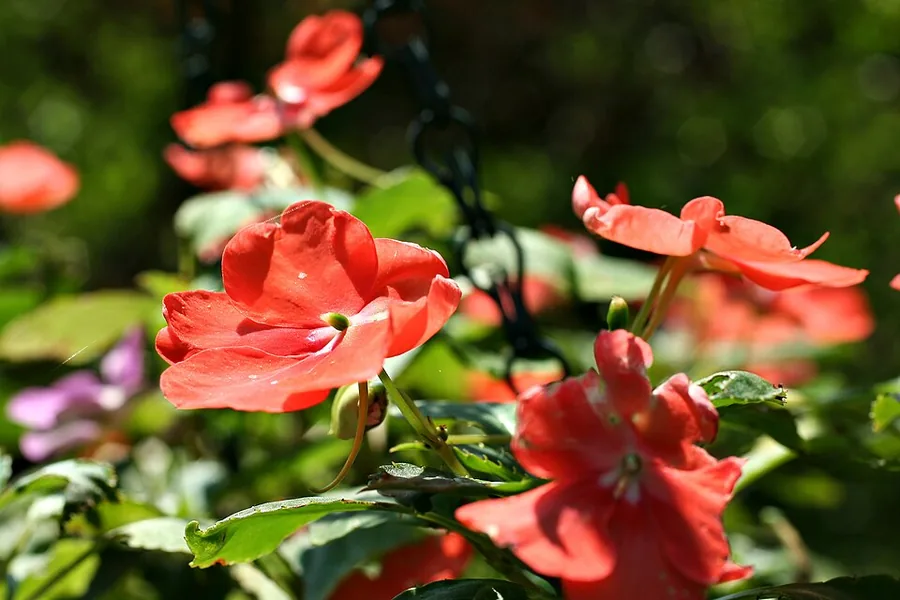
Overview
For color in shade, few bedding plants perform like impatiens. A tender perennial native to East Africa, it is grown almost everywhere as a warm season annual, carrying beds, borders, and containers into bloom from late spring until the first frost. Its advantage lies in a genuine tolerance for partial to full shade, the low-light siting beneath trees and along a north wall where most flowering annuals refuse to bloom.
The nickname Busy Lizzie reflects a long, near-continuous bloom achieved on modest inputs, essentially even soil moisture and protection from hot afternoon sun. Growth is fast and the habit low and mounded, from 6 and 24 inches (15 to 61 cm) in both height and spread, so closely set plants soon merge into continuous cover.
One serious limitation governs the classic seed strains: downy mildew, a disease that moved through gardens and rendered the traditional selections unreliable. The practical answer is to plant newer resistant cultivars, and this is precisely why a selection such as Beacon carries weight at the point of purchase.
Care
The short version: site impatiens in partial to full shade, maintain evenly moist soil, feed monthly, and deadhead spent blooms to sustain flowering.
Light
Impatiens are shade plants by physiology, flowering fully in partial to full shade where excess radiation does not overload the foliage. Hot, direct sun scorches the leaves and pushes the plant into wilt, so site it in the dappled light beneath trees or in a north-facing position where light is moderated.
Water
Hold the soil consistently moist, because these plants wilt rapidly on drying, though they generally recover once rewatered in time. Direct water to the base rather than the canopy, since foliage that stays wet favors the downy mildew and gray mold that plague the species. In heavy, poorly drained soil, moderate the watering, as saturated roots invite rot.
Soil
Grow impatiens in fertile, organically rich soil that retains moisture yet drains freely. Incorporated compost supplies both the nutrition and the steady, even moisture the shallow root system relies on.
Temperature
Impatiens perform in the mild band between 59°F and 75°F (15°C to 24°C). Being frost-tender, they are killed by cold, so plants should not go outside until warm, settled weather has arrived.
Humidity
Ambient outdoor humidity is adequate, so there is no target figure to meet. What governs disease is air movement, because crowded, stagnant plantings retain the surface moisture that downy mildew and gray mold require to establish.
Feeding
Feed monthly through the growing season with a balanced fertilizer, or apply a more dilute liquid feed at shorter intervals, remembering that container plants exhaust nutrients faster. Restrain the nitrogen, since an excess produces the soft growth on which aphids concentrate.
Pruning
Deadhead spent flowers to redirect energy into new buds, and cut out any damaged or diseased tissue as it appears. This routine sustains flowering and, by thinning growth, keeps air moving through the plant.
Size & spacing
Mature plants reach 6 to 24 inches (15 to 61 cm) in height with a comparable spread. Allow each one room to develop so that air circulates between them, which is a direct control on disease pressure.
When to plant
Impatiens are frost-tender and should not go out until the risk of cold has fully passed. Sow indoors in late winter, transplant only after the last frost once the soil has warmed, and expect bloom from late spring through to the first fall frost.
Northern hemisphere
Southern hemisphere
Typical months for a temperate climate: start earlier in warm zones, later where spring frosts linger.
- Sow: 8 to 10 weeks before the last spring frost
- Plant: After the last spring frost once soil has warmed
- Harvest: Late spring to the first fall frost
Hardiness
USDA hardiness zones: 10–11
Temperature: down to -1°C
Troubleshooting
The leaves are where most impatiens disorders declare themselves, disease under damp conditions and pests under dry heat. Reading the early signs lets you intervene before a localized problem spreads through the planting. Match the presentation below, then act while intervention still changes the outcome.
Chlorotic, downcurled foliage collapsing to defoliated stems
These symptoms indicate impatiens downy mildew, the disease responsible for collapsing bedding impatiens across much of the country. Foliage yellows and curls downward, white sporulation coats the undersides, and defoliation follows within days, leaving only bare stems. No treatment recovers an infected plant, so remove it, bag it, and keep it out of the compost.
Fix:
- Remove and bag infected plants including fallen leaves and do not compost them
- Note that fungicides cannot cure infected plants and only protectant fungicides slow spread
- Replant with resistant types such as Beacon or Imara XDR, New Guinea impatiens or SunPatiens, or switch to begonia, coleus, or caladium
Fine stippling and bronzing with webbing in hot, dry air
Fine stippling and a bronze cast come from spider mites, whose populations build under the hot, dry conditions that favor them. Tapping a leaf over white paper reveals the moving specks that confirm the diagnosis. Rinsing the foliage and raising humidity work against them, backed by insecticidal soap or horticultural oil applied on the label schedule.
Fix:
- Rinse foliage and raise humidity
- Apply insecticidal soap or horticultural oil, repeating as directed
Gray sporulation on spent blooms under cool, damp conditions
Botrytis blight, or gray mold, colonizes spent flowers and soft tissue when cool, damp weather keeps moisture on the plant. A light gray, cobweb-like fuzz advances from dying blooms onto leaves and stems. Removing faded flowers and rotted tissue, opening the planting for airflow, and keeping water off the foliage all remove the free moisture the fungus needs.
Fix:
- Remove spent flowers and affected tissue
- Improve air circulation and avoid wetting foliage
Colonies of small insects and honeydew on tender shoots
Colonies gathered on the tender shoots are aphids, and the sticky film is the honeydew they excrete as they feed. Their feeding distorts young leaves but seldom causes lasting damage. A firm jet of water dislodges most of them, and insecticidal soap or horticultural oil handles any that persist.
Fix:
- Dislodge them with a strong jet of water
- Apply insecticidal soap or horticultural oil as needed
Toxicity
For households with pets or children, impatiens presents a clean record: it is safe. The ASPCA lists it as non-toxic to cats, dogs, and horses, and it carries no poisoning risk for the other common household animals or for people. It can be sited where pets graze and children play without concern.
Safe for
People · Cats · Dogs · Horses · Rabbits · Livestock · Birds
Cats None
Non-toxic to cats, so an exploratory nibble on the leaves or flowers carries no risk of poisoning.
Dogs None
Non-toxic to dogs as well. Chewing a stem may bring on a mild, self-limiting stomach upset, the same response any plant material can provoke.
Horses None
Listed as non-toxic to horses, so a grazing animal is at no risk from the plant.
Rabbits Safe
Rabbits browse the foliage without adverse effect, and some keepers offer impatiens as a safe green.
Livestock Safe
Goats, sheep, and cattle face no poisoning risk from the plant.
Birds Safe
Pet and backyard birds encounter no hazard from the plant or its flowers.
People Safe
Non-toxic to people, and the flowers are occasionally used as an edible garnish. The plant is nonetheless ornamental rather than a food crop, so it should not be eaten in quantity.
Varieties
Countless impatiens have passed through the trade, but a handful of names remain worth knowing, chief among them the selections bred to withstand downy mildew.
Super Elfin
An early, compact seed series across a broad color range, valued for uniformity but, like most older Impatiens walleriana, highly susceptible to downy mildew.
Beacon
Selected for strong resistance to impatiens downy mildew, which is why seed impatiens can once again perform in beds where the pathogen has become established.
Double-flowered (rosebud) types
Distinguished by full, rose-like double blooms rather than the flat, five-petaled single flower that is typical of the species.
How to propagate
Impatiens propagate readily by two routes, from seed started indoors in late winter or from cuttings taken off an established plant, the latter reproducing a chosen clone exactly.
SeedModerate
Sow indoors 8 to 10 weeks before the last spring frost · Germinates in about 1 to 3 weeks; flowers roughly 10 to 13 weeks after sowing
Sow indoors 8 to 10 weeks before the last spring frost so transplants reach flowering size on schedule. Because the seed requires light to germinate, press it onto the surface and leave it uncovered, holding the medium warm at around 75°F (24°C) and humid to drive even emergence. Germination follows in 1 to 3 weeks, and first bloom comes roughly 10 to 13 weeks after sowing.
Stem cuttingsEasy
Spring through summer · Roots in about 1 to 2 weeks
Tip cuttings taken spring through summer root readily, forming roots in 1 to 2 weeks in water or a moist medium because impatiens stems produce adventitious roots with ease. This is the dependable method for overwintering a chosen clone indoors and preserving its exact traits. Take cuttings only from healthy stock free of any downy mildew symptoms, since the pathogen moves with propagating material.
Myths
Impatiens need full sun to bloom well.
The requirement runs the opposite way. Impatiens walleriana is a shade plant that flowers best in partial to full shade, and hot, direct sun scorches the foliage and drives the plant into wilt.
Fungicide applications can cure an impatiens plant already infected with downy mildew.
A fungicide acts only as a protectant on tissue that is still healthy and cannot cure a plant once infected, so the infected plant must be removed. The sound response is to replant with resistant varieties.