Tree · Meliaceae
Neem Tree
Azadirachta indica
Give it heat, sun, and free-draining soil, and the neem tree withstands drought and poor ground for decades.
Full sun
Every 7–21 days
USDA 10–12
50–75 ft · 15.2–22.9 m
Overview
Neem is a fast-growing evergreen in the mahogany family, Meliaceae, native to south Asia and now established across the warmer parts of Asia and Africa. Given room, it develops into a broad, shade-casting tree, and it does so at pace. Its long record of human use spans chewing the twigs and pressing the seeds for oil.
The trait that defines neem in cultivation is its seed oil. The seeds concentrate azadirachtin, a limonoid that deters insect feeding and disrupts the hormones governing insect growth and reproduction, which is the basis for turning neem into a botanical pesticide. The leaves hold a separate, long-standing medicinal use and are considerably milder than the concentrated oil.
Once established, neem is undemanding. It withstands heat to 113°F (45°C), endures drought, and grows on poor, rocky, and mildly saline ground. Its single limiting factor is cold, because frost cuts it back and a hard freeze can kill it, which confines it outdoors to the warmest zones.
Care
The short version: full sun and warmth, deep well-drained soil, and a deep soak for young trees during dry spells while the surface is allowed to dry between waterings. Once established it manages drought and poor ground on its own, but it has no frost tolerance.
Light
Neem is a full sun species and makes its fastest growth in the open, though it accepts partial sun or light shade. The more direct light it receives, the denser and stronger the crown it forms.
Water
Water young trees deeply through dry spells, then let the top half of the soil dry before the next application, which falls roughly every 7 to 21 days. An established neem tolerates genuine drought, and the sole intolerance is waterlogged ground, which suffocates the roots.
Soil
Plant in deep, well-drained sandy or loamy soil. Fertility is not the constraint, since neem tolerates poor, rocky, and mildly saline ground across a broad pH span of 6.0 to 8.0. Drainage is decisive, because the roots rot in soil that stays wet.
Temperature
This tropical to subtropical tree is at ease in heat to 113°F (45°C). The limiting threshold is at the cold end, near 41°F (5°C), below which frost scorches the foliage and a freeze can kill a young tree.
Humidity
Average humidity of 40% to 70% suits it, and it copes well with the dry air of semiarid regions. Supplementary misting or humidity management is unnecessary.
Feeding
Feed through spring and summer with a balanced slow-release fertilizer or compost, once per season. Neem performs well in lean soil, and overfeeding is counterproductive because it forces soft, sappy growth that favors pests.
Pruning
Prune in late winter to early spring to shape the crown and remove dead, damaged, or crossing branches. Neem accepts hard pruning and even pollarding, which makes it well suited to a clipped hedge.
Repotting
A container-grown neem needs repotting every 2 to 3 years while young, before the roots circle and bind the pot. In a frost-free climate, planting directly into the ground is the sounder long-term option.
Size & spacing
A mature neem is a large tree, reaching 50 to 75 feet (15 to 23 m) in height with a broad canopy spreading 40 to 60 feet (12 to 18 m) across. Allow generous open space and keep it well clear of buildings, paving, and smaller plantings.
When to plant
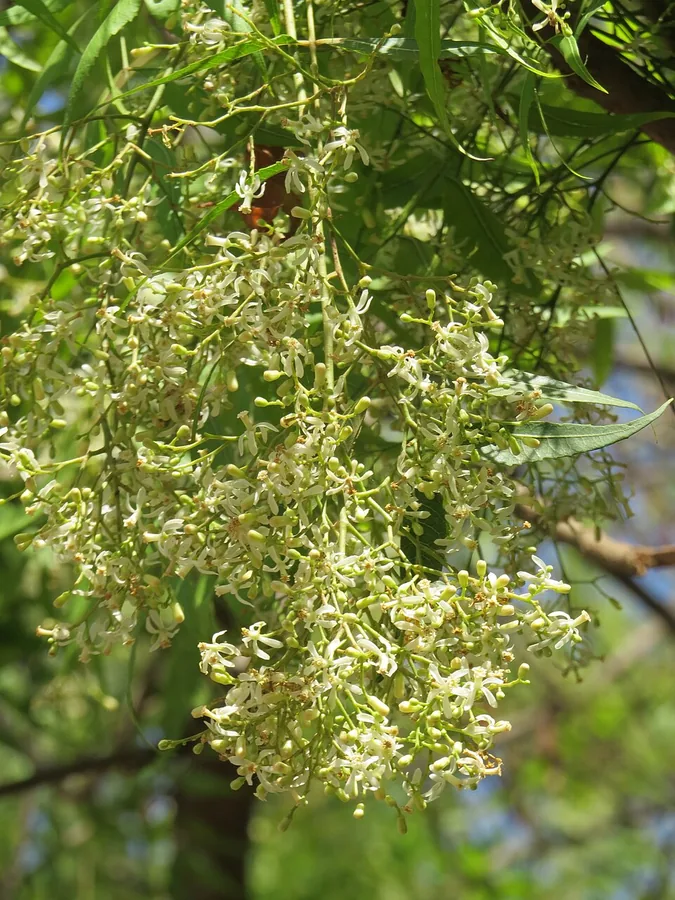
Neem is governed by warmth and has no frost tolerance. Sow fresh seed under cover in late winter or early spring, transplant young trees in spring once the soil has warmed and frost has passed, and expect fragrant white flowers in spring followed by olive-like drupes ripening from summer into early fall.
Northern hemisphere
Southern hemisphere
Typical months for a temperate climate: start earlier in warm zones, later where spring frosts linger.
- Sow: Late winter to early spring in frost-free warmth; sow fresh seed because viability is short
- Plant: Spring after all danger of frost, once soil is warm
- Harvest: White fragrant flowers in spring; olive-like drupes ripen summer to early fall
Hardiness
USDA hardiness zones: 10–12
Temperature: down to -1°C
Troubleshooting
In a suitable climate neem is largely trouble-free, so most complaints trace to cold, waterlogged soil, or sap-sucking pests. Reading the early signals on the foliage and roots allows intervention before the problem advances. Match the symptom below and act while a response still helps.
Wilt and chlorosis alongside soft, darkened roots
Wilting and yellowing on a neem standing in saturated soil point to root rot, because waterlogging starves the roots of oxygen and lets decay set in. The diagnostic sign is underground: healthy firm pale roots give way to brown, mushy tissue. No treatment reverses established rot, so the response is to halt overwatering, correct the drainage, and reset the plant into deep, sandy soil whose surface dries between waterings.
Fix:
- Improve drainage and stop overwatering
- Remove affected plant material
- Replant in deep, sandy, well-drained soil
Foliage scorch and twig dieback from cold exposure
As a tropical species, neem carries no frost hardiness, so exposed outer foliage takes the injury first once temperatures fall below about 41°F (5°C) and the branch tips die back behind it. Its safe range runs only through zones 10 to 12. Delay pruning until the frost danger has passed, then remove the dead wood, and either shelter young trees under cover or grow them in containers you can relocate indoors ahead of a cold spell.
Fix:
- Prune out dead wood after the danger of frost has passed
- Protect young trees with frost cloth or grow in containers that can be moved indoors
- Site in a warm, sheltered location
Sticky black deposit and dark film over the leaf surface
The dark surface layer is sooty mold, a fungus that colonizes the sugary honeydew excreted by scale, whitefly, or aphids feeding above it, which is why the film and the stickiness appear together. Since the mold only lives on that honeydew and does not infect the leaf, it wipes off freely, and the real target is the sap-sucking insects on the shoot tips and leaf undersides. Rinse the foliage, treat the insects with horticultural soap or oil, and conserve the natural predators that keep them in check.
Fix:
- Rinse foliage and wipe off mold
- Control the sap-sucking insects with horticultural soap or oil
- Encourage natural predators
Toxicity
The leaves are low in toxicity with a long medicinal history, so an incidental nibble rarely warrants concern. The genuine hazard lies in the concentrated neem oil and the seeds, which are rich in azadirachtin and can sicken pets and people if ingested in quantity. Cats are the most sensitive, so store the oil and seed products well out of reach.
Toxic to
Cats · Dogs · People
Safe for
Horses · Rabbits · Livestock · Birds
Cats Mild
The foliage rates low in toxicity, yet cats show the sharpest sensitivity to concentrated neem oil of any household animal. Ingestion of the undiluted oil, or topical treatment with it, has produced drooling, vomiting, and lethargy, and documented cases extend to tremors, twitching, and convulsions. On that basis, keep the seed oil and extracts entirely out of a cat's reach.
Dogs Mild
A single nibbled leaf seldom has consequences. The hazard is the concentrated oil, which can provoke vomiting, drooling, and marked sluggishness when swallowed or applied too heavily. Dogs tolerate diluted topical neem more readily than cats do.
People Caution
The leaves have a long record of medicinal use and low toxicity, but the concentrated oil and the seeds carry a materially higher risk. Ingestion in quantity can cause vomiting and more serious effects, with small children most vulnerable, so store neem oil and seed products securely.
Horses Safe
Grazing on the foliage presents little hazard to a horse. The concentrated neem oil and seed products are the exception and belong in storage beyond a horse's reach.
Rabbits Safe
For rabbits, browsed leaves fall in the low-toxicity range. The concentrated oil or a quantity of crushed seed would be the only real hazard, and neither should be within a rabbit's access.
Livestock Safe
Cattle, goats, and sheep browse neem foliage at low risk, and in parts of its range the leaves are used as fodder. The seed oil is the one exception and should not be fed.
Birds Safe
At the leaf or fruit, neem holds no particular hazard for birds. The precaution is simply to keep them away from any concentrated oil or extract.
Keep concentrated neem oil and neem seed products away from pets; never apply undiluted neem oil to a cat or dog or allow them to ingest it.
Helpline numbers

United States
ASPCA Animal Poison Control: (888) 426-4435 (fee applies)
Poison Control: (800) 222-1222



Canada
Poison Centres: 1-844-764-7669
Varieties
Neem is grown in two principal forms, one selected for culinary use and one for its potent seed oil. These are the varieties worth distinguishing.
Azadirachta indica var. siamensis (Thai neem)
This Southeast Asian variety produces young leaves and flowers mild enough to be eaten as a vegetable, whereas the common type is too bitter for the purpose.
Common neem (typical var. indica)
The widely cultivated South Asian type is valued for its azadirachtin-rich seed oil, the basis of the botanical biopesticide gardeners press from it.
Companions
Neem earns its keep near vegetable and fruit crops, where its leaf and seed extracts deter many garden pests, but its dense shade, hungry roots, and allelopathic leaves make poor company for small plants growing right beneath it.
Plant near
Vegetable and fruit crops: Neem leaf and seed extracts are used as a botanical biopesticide that deters many garden pests.
Keep apart
Shallow-rooted understory plants: Its dense shade, vigorous roots and allelopathic leaf compounds suppress small plants growing directly beneath it.
How to propagate
Neem propagates readily, almost always from seed, with cuttings held in reserve for when fresh seed is unavailable or a specific tree is to be reproduced.
SeedEasy
Sow fresh seed in spring in warm conditions · Germinates in 1 to 3 weeks; transplant after a few months
Seed is the standard means of raising neem, and viability is the governing factor. Because the seed loses its viability quickly, sow it soon after the fruit ripens, under spring warmth. Germination follows in 1 to 3 weeks, and the seedlings are ready to transplant after a few months.
Stem cuttingsModerate
Warm season from semi-hardwood cuttings · Roots in several weeks under warmth and humidity
Where fresh seed is unavailable, or the aim is to reproduce a specific tree, take semi-hardwood cuttings during the warm season. Held under warmth and humidity, they root over several weeks.
Myths
A naturally sourced substance like neem oil carries no danger to pets at all.
Natural origin is no guarantee of safety, because the active compound azadirachtin can induce drooling, vomiting, and tremors, and concentrated neem oil has sickened and in some reported cases killed cats. Confine use to heavily diluted oil and keep the concentrate away from animals.
Neem destroys any insect the instant it lands on it.
Its mode of action is largely to deter feeding and disrupt insect growth and reproduction, so control develops over days rather than seconds. The result is a gradual decline in the pest population rather than a contact knockdown.