Tree · Rosaceae
Nectarine
Prunus persica var. nucipersica
A nectarine is a fuzzless peach, and it converts full sun and disciplined annual pruning into sweet, smooth-skinned fruit.
Full sun
Every 7–14 days
USDA 5–9
10–20 ft · 3–6 m
Overview
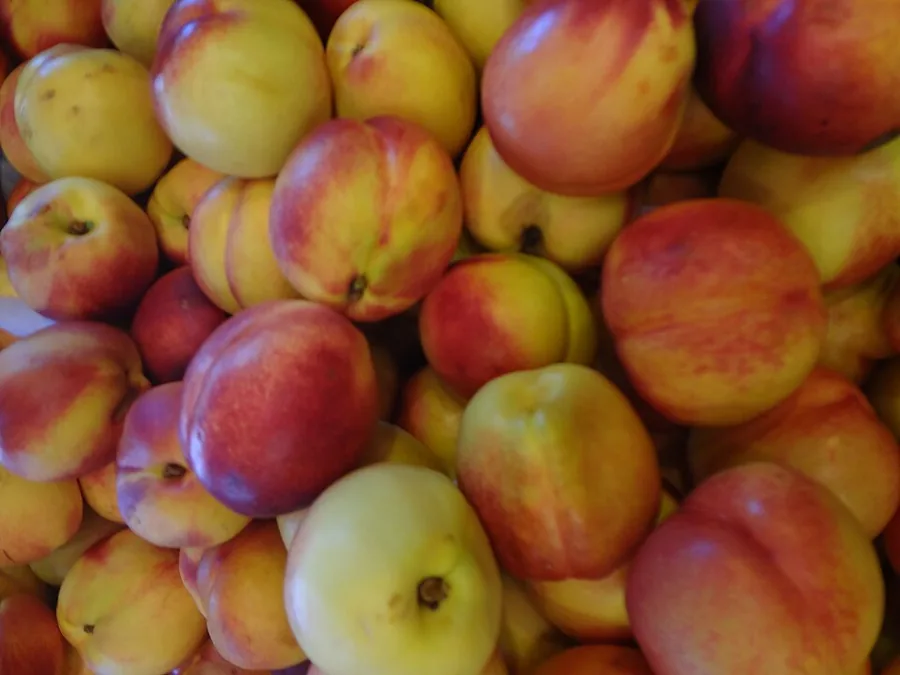
A nectarine is genetically the same tree as a peach, separated by one gene that governs the fuzz. It sits within the rose family with cherries, plums, and apricots, and the smooth skin is the only reliable trait distinguishing it from its fuzzy counterpart. Managed correctly it yields firm, sweet fruit on a tree scaled to a backyard rather than a commercial orchard.
The demanding classification is earned. The tree requires full sun for photosynthate and sugar accumulation, deep well-drained soil to keep the roots aerated, and a disciplined winter prune, and the exposed smooth skin scars and rots more readily than a peach's protected surface. That management repays the grower with fruit picked at full ripeness, a stage rarely reached in commercial handling.
Most trees arrive grafted onto a rootstock, so establishment begins with a young whip trained deliberately from planting. The species crops through zones 5 through 9, and because it flowers early the bloom is exposed to late frost, with fruit maturing across midsummer.
Care
The short version: full sun to drive sugar, deep well-drained soil held on the dry side once the root system is established, an open-center prune each late winter, and a dormant fungicide to preempt leaf curl and brown rot.
Light
A nectarine requires full sun, the maximum available, because both fruit quality and sugar accumulation depend directly on photosynthetic light. In shade the tree grows leggy, sets little fruit, and retains a damp leaf canopy that favors disease.
Water
Irrigate deeply through active growth and fruit sizing, then allow the top half of the soil to dry before the next application so the roots are not held in saturated conditions. An established tree tolerates a short dry spell, and keeping water off the foliage denies leaf pathogens the surface moisture they need.
Soil
Plant into deep, well-drained sandy loam, since waterlogged roots asphyxiate and kill a nectarine faster than almost any other stress. Hold the pH slightly acidic, between 6.0 and 6.5, to keep nutrients available, and correct drainage before planting on any site that holds water.
Temperature
The tree is hardy across a broad range, from roughly -9°F to 95°F (-23°C to 35°C). The vulnerability lies in the early bloom, since a late frost can kill an entire season's flowers before fruit set occurs.
Humidity
Average humidity in the 40% to 70% band suits it. The real hazard is damp, still air, which prolongs leaf wetness and drives brown rot and leaf curl, so an open canopy that admits moving air is the corrective.
Feeding
Fertilize from early spring into midsummer with a balanced complete fertilizer such as 10-10-10, then follow with calcium nitrate. Cease feeding by late summer so late-season shoots can harden off before the onset of winter cold.
Pruning
Train the young tree to an open-center, vase shape and prune firmly each late winter. Removing water sprouts and thinning the canopy annually admits the light and air that ripen fruit and dry foliage, which is the single most consequential operation the tree demands.
Repotting
As a field-grown tree rather than a container subject, it involves no repotting in the conventional sense. Select the site carefully at planting, because a nectarine responds poorly to transplanting once its root system is established.
Size & spacing
Unpruned, a nectarine attains 10 to 20 feet (3 to 6 m) in height with a comparable spread. Annual pruning holds it lower and within reach for harvest, but allot the full 10 to 20 feet (3 to 6 m) of width so air circulates through the canopy.
When to plant
Set a bare-root nectarine while it is dormant, in late winter or early spring, so root establishment precedes the flush of top growth. Early flowering exposes the blossoms to a late cold snap, since bloom precedes the last frost date in many sites, and fruit matures from mid-June into September according to cultivar.
Northern hemisphere
Southern hemisphere
Typical months for a temperate climate: start earlier in warm zones, later where spring frosts linger.
- Plant: late winter to early spring while dormant (bare-root)
- Harvest: blooms early spring; fruit ripens mid-June to mid-September by cultivar
Hardiness
USDA hardiness zones: 5–9
Temperature: down to -29°C
Troubleshooting
Because a nectarine's smooth epidermis lacks the fuzz that masks minor injury on a peach, symptoms register early and concentrate on the fruit and the expanding leaves. Reading those early signs lets you intervene before a fungus or a borer compromises the tree. Match the description below, then act within the window that still allows a response.
Fruit rotting on the branch beneath fuzzy gray-brown sporulation
The fuzzy gray-brown patches are brown rot, a disease of Monilinia fungi whose spores germinate and spread quickest under warm, humid conditions, and nectarines prove more susceptible than most stone fruit. Because mummified fruit and infected twigs carry the inoculum into the next season, removing them cuts the disease cycle at its source. Opening the canopy speeds drying so spores find less of the moisture they need, and a fungicide at bloom and again before harvest protects the two most vulnerable windows.
Fix:
- Remove mummified fruit and infected twigs, prune for airflow, and apply fungicide at bloom and before harvest
Exuded gum and frass resembling sawdust at the trunk's base
Gumming and frass at the crown signal peachtree borers, clearwing moth larvae that mine the lower trunk and can sever the vascular tissue, girdling a young tree outright. A vigorous tree compartmentalizes and walls off wounds more effectively, which is why maintaining growth is the first line of defense. Excising larvae removes the active feeders, and timing trunk sprays to adult moth flight targets the pest before eggs are laid and larvae bore in.
Fix:
- Keep trees vigorous, remove larvae, and time trunk sprays to moth flight
Emerging foliage distorted, thickened, and reddened after budbreak
That deformation is peach leaf curl, caused by Taphrina deformans, which infects the swelling buds during cool, wet spring weather when the emerging tissue is unprotected. Once a leaf has distorted the fungus is already inside it, so no in-season treatment restores it. Control therefore hinges on a dormant fungicide applied in late winter before bud swell, when the coating still reaches the bud surfaces the fungus would otherwise colonize.
Fix:
- Apply a dormant fungicide spray in late winter before bud swell
Silvered scarring and coarse patches over the fruit's surface
The scarring traces to western flower thrips, which rasp at the developing fruit surface as it expands, and a nectarine's smooth, unprotected skin registers that feeding damage far more visibly than a fuzzy peach's. The injury remains confined to the epidermis, so the flesh underneath is unaffected and edible. Monitoring at bloom and petal fall catches the window when feeding does the most cosmetic harm, and treatment is warranted only once populations exceed the threshold.
Fix:
- Monitor at bloom and petal fall and treat if thresholds are exceeded
Toxicity
The ripe flesh is safe to eat, but the remainder of the tree is not. The pits, leaves, twigs, and bark contain cyanogenic glycosides that liberate cyanide on digestion, and wilting raises the releasable dose, which makes wilted leaves especially dangerous to grazing animals. Keep prunings and fallen pits clear of pets and livestock, and never allow ingestion of the pit.
Toxic to
Cats · Dogs · Horses · Rabbits · Livestock · Birds
Safe for
People
Cats Toxic
A cat that chews leaf or stem tissue may drool, vomit, or refuse food as the digestive tract reacts. The graver hazard is the cyanide released from the pit and foliage, which can produce dilated pupils, labored breathing, and a racing heart as it blocks cellular oxygen use.
Dogs Toxic
A dog that reaches the leaves or a fallen pit may vomit, develop diarrhea, and pant heavily. A swallowed pit can obstruct the gut mechanically, while a large volume of plant material delivers enough cyanogenic compound to cause cyanide poisoning.
Horses Toxic
Horses face acute risk, and wilted leaves carried into the paddock are the greatest hazard because wilting raises the concentration of releasable cyanide. Poisoning presents as brick-red gums, rapid breathing, staggering weakness, and sudden collapse.
Rabbits Toxic
The leaves, twigs, and pits carry cyanogenic glycosides at a dose a rabbit's small body cannot detoxify, so none of that material belongs near the hutch. Only a bite or two of ripe, pitted flesh falls within a safe margin to offer.
Livestock Toxic
Cattle, goats, and sheep are most exposed to wilted prunings discarded over a fence, where wilting concentrates the cyanide. Poisoning develops rapidly, marked by respiratory distress, trembling, and collapse.
Birds Caution
Birds should be kept from the pits, leaves, and bark, since the cyanogenic glycosides pose the same risk to them. A small amount of ripe flesh is acceptable, but the seed within should never be provided.
People Ripe flesh safe
The ripe flesh is a safe summer fruit to eat. The pit should not be cracked or swallowed, because the kernel contains the same cyanide-releasing compounds found in the leaves.
Keep pits and pruned leaves and stems away from pets and livestock; ripe flesh in moderation is not a concern.
Helpline numbers

United States
ASPCA Animal Poison Control: (888) 426-4435 (fee applies)
Poison Control: (800) 222-1222



Canada
Poison Centres: 1-844-764-7669
Varieties
Nectarines number in the dozens of named cultivars, but a small set of freestones recurs in recommendations for consistent flavor and reliable cropping. The three below merit particular attention.
Fantasia
A large freestone carrying firm yellow flesh and strong color, it rates among the highest quality nectarines available to the grower.
Redgold
A large yellow-fleshed freestone valued both for eating quality and for the broad regional adaptability that lets it perform across differing climates.
Independence
A red-skinned, yellow-fleshed freestone that is self-fruitful, so a single tree sets a crop without a second pollinizer in range.
How to propagate
Two propagation routes exist, and only one preserves the cultivar you intend to grow. Grafting reproduces a known selection faithfully, whereas a seedling from a pit segregates into something new.
GraftingDemanding
Named nectarines are budded or grafted onto peach or plum rootstock, the method by which nurseries hold a cultivar true to type by propagating it vegetatively. The technique demands a steady hand and practiced timing, which is why most growers acquire a grafted tree rather than raise their own.
SeedModerate
A pit germinates only after a period of cold, moist stratification satisfies its dormancy requirement. Because the seed recombines its parents' genetics, the resulting seedling will not come true, yielding a distinct tree rather than a replica of the original fruit.
Myths
The nectarine originated as a peach-plum hybrid.
No interspecific cross is involved. A nectarine is a smooth, fuzzless peach of the identical species Prunus persica, and the sole distinction is a single recessive gene that suppresses the trichomes responsible for fuzz.
Nectarines constitute a distinct species from the peach.
Both are one species, and a nectarine is a peach expressing a smooth skin. The fuzzless phenotype recurs from the same single-gene mutation, which is precisely why the two trees require identical culture and succumb to the same pests.