Ornamental · Poaceae
Pink Muhly Grass
Muhlenbergia capillaris
Site it in full sun and lean, dry ground and pink muhly grass resolves into a rose-pink haze each autumn.
Full sun
Every 7–14 days
USDA 6–10
2–3 ft · 0.6–0.9 m
Overview
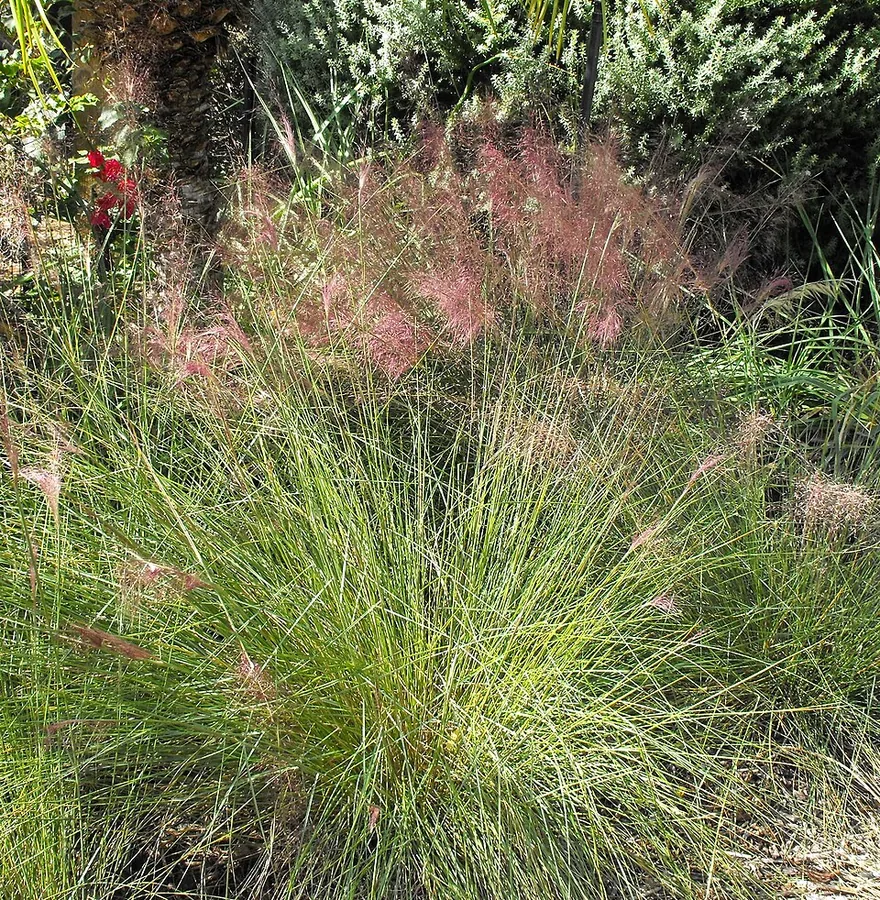
Pink muhly grass is a warm-season, clump-forming perennial native to the eastern and southern United States and grown almost entirely for its autumn inflorescence. Through most of the season it reads as a fountain of fine green blades, and then in fall it produces an airy cloud of rose-pink plumes that scatters low-angle light and appears to glow. It sits within the grass family, and its cultural needs are minimal.
Its reputation for ease rests on tolerance. Once established, the deep, fibrous root system carries it through heat, salt exposure, and extended drought, and it escapes most of the pests and pathogens that trouble more demanding ornamentals. The single real requirement is siting, meaning full sun and lean, fast-draining soil. Rich, moisture-retentive ground promotes soft vegetative growth and lodging.
Massed, the autumn display resolves at a distance into a broad drift of pink that persists for weeks before senescing to tan for winter. Because the species increases by clump rather than by running rhizomes, it stays contained within a bed, and a single late-winter cut-back accounts for nearly all of the seasonal maintenance.
Care
The short version: full sun, lean and well-drained soil, and minimal irrigation once established. Omit fertilizer, leave the foliage standing through winter for protection, and cut it back hard in late winter before growth resumes.
Light
Provide full sun, 6 or more hours a day. Adequate insolation drives the dense, upright clump and the heavy pink inflorescence, and it is the dominant determinant of ornamental quality. Under shade the culms elongate and weaken, the plumes thin, and the crown splays open.
Water
Irrigate regularly through the first season to establish the root system, after which supplemental water becomes largely unnecessary. Established plants are highly drought tolerant and subsist on rainfall across most sites. The greater hazard is the opposite, since saturated soil induces crown rot.
Soil
The species performs in lean, dry, well-drained soil, the sandy or rocky substrates that frustrate more demanding plants. It accepts any pH from 5.5 to 8.0 and tolerates clay provided drainage remains sharp. Avoid rich, amended beds, which encourage lodging.
Temperature
This is a hardy, wide-amplitude grass, functional across roughly -9°F to 104°F (-23°C to 40°C). It withstands summer heat without stress and overwinters to zone 6.
Humidity
Ambient outdoor humidity is sufficient, with no target range to manage. Far more consequential is drainage and air circulation at the crown, since prolonged wetness is the plant's principal vulnerability.
Feeding
Withhold fertilizer. This native is adapted to lean, low-fertility soil, and supplemental nutrition is counterproductive, promoting soft, leafy growth and reduced flowering. Lean culture sustains the upright, floriferous habit.
Pruning
One operation suffices each year. Cut the entire clump back to roughly 6 to 8 inches (15 to 20 cm) in late winter or early spring, ahead of new growth. Retain the standing foliage through winter for crown insulation and winter interest.
Repotting
Division or repotting is seldom required. Over many years an aging clump may die out at the center, producing a bare ring with diminished vigor and fewer plumes, which is the signal to lift and divide rather than repot.
Size & spacing
Mature plants attain about 2 to 3 feet (61 to 91 cm) in height with an equal spread. Space them at approximately that interval, around 2 to 3 feet (61 to 91 cm), allowing each clump to develop its rounded form with adequate air movement.
When to plant
Pink muhly grass follows a warm-season phenology, breaking dormancy in spring and reserving its display for autumn. Sow seed indoors from late winter to early spring and transplant after the last frost, and the pink inflorescences develop from September into November.
Northern hemisphere
Southern hemisphere
Typical months for a temperate climate: start earlier in warm zones, later where spring frosts linger.
- Sow: Late winter to early spring
- Plant: Spring after last frost
- Harvest: September to November
Hardiness
USDA hardiness zones: 6–10
Temperature: down to -23°C
Troubleshooting
As a durable native grass, it presents few problems, and the ones that arise almost always trace to siting rather than disease. Diagnostic clues concentrate in the inflorescence, the crown, and the culm bases. Match the symptom below, then correct the underlying condition.
The plant rots or fades in soggy ground
Decline in a wet site is root and crown rot, driven by heavy, poorly drained soil that keeps the root zone saturated and starves the roots of oxygen. The crown softens and the clump hollows from the center outward. Correct it with sharp drainage in sandy or rocky soil, elevate the crown on a raised mound where the native ground is clay, and allow the profile to dry between waterings.
Fix:
- Plant in well-drained sandy or rocky soil, or amend heavy soil and plant on a raised mound or berm
- Reduce irrigation; allow soil to dry between waterings
- Remove dead rotted portions and replant healthy divisions in a drier, well-drained site
White cottony clusters at the base of a stressed plant
Waxy white colonies at the leaf bases and crown are muhly grass mealybug, effectively the only pest of consequence on this otherwise trouble-free grass. Feeding at the culm bases saps the plant and leaves it stunted and off-color. Remove and destroy infested foliage during the late-winter cut-back, avoid the fertilizer that flushes the succulent tissue the insect prefers, and rely on natural predators to suppress the population.
Fix:
- Cut back and remove heavily infested foliage in late winter
- Encourage natural predators and avoid excess fertilizer that flushes soft growth
Few or no pink plumes, and the clump flops open
A shortfall of plumes and an open, splayed habit point to insufficient light or excess fertility. Below roughly 6 hours of direct sun the plant cannot fuel dense culms or set a full inflorescence, so stems weaken and bloom drops off, while high nitrogen and frequent moisture drive vegetative growth that outcompetes flowering and lodges the clump. Restore full sun, withhold fertilizer, and reduce irrigation so the plant grows lean, stiff, and floriferous.
Fix:
- Relocate or plant in full sun (6 or more hours of direct sun) for the best plume color, density, and upright form
- Stop fertilizing and reduce watering; grow in lean, dry, well-drained soil
- Cut back in late winter so vigorous new growth emerges in the right conditions
Toxicity
For households with pets, the verdict is clear: pink muhly grass is non-toxic throughout. It contains no compounds harmful to cats, dogs, horses, rabbits, livestock, or people, and it does not appear on the ASPCA roster of toxic plants. The only qualification is its heavy autumn pollen, which can aggravate seasonal allergies in sensitive individuals.
Safe for
People · Cats · Dogs · Horses · Rabbits · Livestock · Birds
Cats None
The foliage and inflorescences contain no compounds toxic to cats. A cat that consumes a large mouthful may regurgitate it, a mechanical response common to grasses, and nothing beyond that.
Dogs None
No constituent of this grass poses a hazard to dogs. In a persistent chewer the only likely effect is transient vomiting, which any ingested grass can provoke.
Horses None
Horses may graze in its vicinity without risk, as the species holds no known toxins.
Rabbits None
Rabbits can browse the foliage safely; it is an innocuous, non-toxic grass.
Livestock None
Cattle, goats, and sheep incur no toxic risk from this native grass and may graze it without concern.
Birds None
Birds are unaffected by it, and many forage the mature seed heads through fall and winter.
People None
It is safe to handle and to plant. The sole caveat is the copious autumn pollen, which can provoke seasonal allergies in sensitive individuals.
Not poisonous, but pets that nibble large amounts of grass may vomit, and the abundant fall pollen can aggravate seasonal allergies in sensitive people.
Varieties
The straight species, grown for its pink autumn display, predominates in gardens, though several named selections and closely allied species merit attention.
White Cloud
A named selection bearing white to cream inflorescences rather than the typical pink, with notably stronger resistance to tar spot than the species.
Pink Flamingos
A taller natural hybrid between M. capillaris and M. lindheimeri that attains 3 to 4 feet, its bright pink plumes maturing to silvery-gray.
Lindheimer's muhly (Muhlenbergia lindheimeri)
A related, larger species of central Texas, a 2 to 5 foot silvery-plumed clumping bunchgrass frequently used as a tall specimen.
Bamboo muhly (Muhlenbergia dumosa)
A related species distinguished by arching, semi-woody bamboo-like culms and lacy pale-green foliage forming a fountain 5 feet tall and wide.
How to propagate
Pink muhly grass propagates readily by two routes, the division of an existing clump or sowing from seed.
DivisionEasy
Spring · One growing season
The most reliable method is to divide an established clump in early spring, as growth resumes. Lift the entire crown, separate it into vigorous sections each with roots and shoots, and replant. A division re-establishes over one growing season and returns as a full clump.
SeedEasy
Spring (sow indoors late winter to early spring)
Seed propagation is equally straightforward and carries no risk of invasion, since the species increases by clump rather than spreading rhizomes. Sow indoors in late winter to early spring and transplant the seedlings out after the last frost. Expect one to two growing seasons for them to reach flowering size.
Myths
Muhly grass needs rich, fertilized, frequently watered soil to bloom well.
The horticulture runs the other way. Flowering and upright habit are maximized in full sun and lean, dry, well-drained soil, whereas rich, wet, fertilized conditions favor vegetative growth over inflorescences, lodge the clump, and predispose the crown to rot. Lean culture produces the best bloom.
Sources
- USDA NRCS PLANTS Database
- NC State Extension Gardener Plant Toolbox
- Missouri Botanical Garden
- University of Florida IFAS Gardening Solutions
- Texas A&M AgriLife Extension (Texas Superstar)
- NC State Extension Gardener Newsletter
- ASPCA Animal Poison Control
- NC State Extension Gardener Plant Toolbox
- NC State Extension Gardener Plant Toolbox