Houseplant · Araceae
Swiss Cheese Plant
Monstera deliciosa
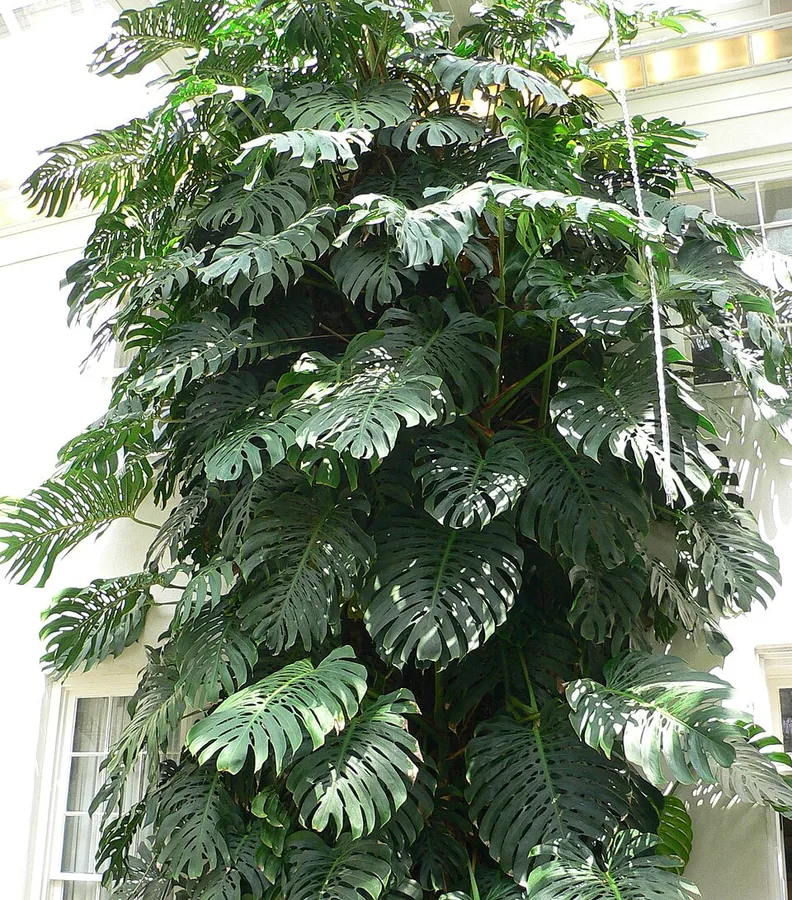
Grown in bright indirect light on a climbing support, the Swiss cheese plant develops the large, fenestrated leaves it is known for.
Bright indirect
Every 7–14 days
61–84°F · 16–29°C
USDA 10–12
Overview
The Swiss cheese plant ranks among the most recognizable of houseplants. A hemiepiphyte from the rainforests of Central America, it ascends tree trunks toward the light in habitat, and that climbing habit explains much of its indoor behavior. As it climbs and matures, the large leaves open into the holes and ribbons that give the plant its name. It sits within the arum family alongside philodendrons and peace lilies, and it shares their tolerant, undemanding nature.
Leaf form shifts with the plant's development. Juvenile growth produces entire, heart-shaped blades, and only with maturity and adequate light do the characteristic fenestrations develop. Those perforations are thought to let the leaves shed heavy rainfall and permit light to filter to the foliage beneath, both useful adaptations for a plant growing under a dense forest canopy where light is scarce.
A fast growth rate paired with a forgiving constitution makes it well suited to a first-time grower. Sited in bright indirect light and given a moss pole to climb, it can reach 6 to 10 feet (1.8 to 3 m) indoors, since vertical support lets it express its natural climbing form. Note that every part except the ripe fruit is an irritant, so position it beyond the reach of pets and small children.
Care
The short version: provide bright indirect light, a moss pole for climbing, and water only after the top of the soil has dried. Hold it warm and humid, and feed through the spring and summer growing season.
Light
Provide bright, indirect light near a window but shielded from harsh midday sun, whose intensity scorches the foliage. It tolerates medium light and partial shade, yet dim positions starve the plant of the light it needs to fenestrate, leaving small, entire leaves.
Water
Allow the top inch or so of soil to dry before rewatering, generally every 7 to 14 days. Reduce the frequency through fall and winter as growth slows and uptake falls. Because saturated soil starves the roots of oxygen and invites rot, it is safer to err dry.
Soil
Grow it in a rich, well-drained mix built on peat with ample structure, so water passes through rather than pooling. A pH between 5.5 and 7.0 keeps nutrients available, and the open texture keeps the roots aerated rather than waterlogged.
Temperature
Maintain 61°F to 84°F (16°C to 29°C), the warm band of a typical interior. It resents cold drafts and has no frost tolerance, so relocate it away from chilly winter glazing.
Humidity
As a rainforest species it favors high humidity, and dry indoor air draws moisture from the leaf margins until they brown and crisp. Grouping plants, running a humidifier, or using a pebble tray all raise the local moisture the foliage draws on.
Feeding
Supply a balanced liquid fertilizer monthly through spring and summer while the plant is in active growth and can use the nutrients. Withhold feed in fall and winter during rest, since a dormant plant cannot take it up and the residue accumulates as salt in the soil.
Pruning
Prune in spring, when the plant enters active growth and recovers fastest, to shape it or reduce its size. The aerial roots may be trained onto a moss pole, directed into the soil, or cut cleanly, according to the form you want.
Repotting
Repot every 1 to 2 years in spring, advancing one pot size once roots circle the base or emerge from the drainage holes. Slowed growth and water that runs straight through both indicate a rootbound plant that has exhausted its container.
Size & spacing
Indoors it climbs to 6 to 10 feet (1.8 to 3 m) tall and spreads 3 to 8 feet (90 to 250 cm) wide, so allow genuine room. A sturdy moss pole supports that mass and keeps the heavy stems from breaking under their own weight.
Troubleshooting
Most monstera complaints resolve to a fault in watering or light, and the foliage signals the problem early. Read the leaf symptom below, identify the underlying cause, and correct it before it progresses.
Wilting plant with dark, mushy roots
A monstera that wilts over wet soil is expressing root rot, the result of overwatering or a mix that retains too much water and excludes oxygen. Remove the plant, excise the soft, blackened roots, and repot into fresh, free-draining medium. Watering less thereafter gives the remaining roots the aeration they need to recover.
Fix:
- Unpot and trim rotten roots
- Repot in fresh draining mix
- Reduce watering
Lower leaves turning yellow
When several older, lower leaves yellow together over soggy soil, the cause is almost always overwatering or a substrate that drains too slowly to admit air. Let the surface dry before rewatering, and confirm the pot drains freely. A plant standing in saturated soil is on a path to root rot, so intervene early.
Fix:
- Reduce watering frequency
- Let top soil dry
- Ensure pot drains freely
Fine webbing and speckled leaves
Faint webbing and a stippled, dust-flecked surface indicate spider mites, which build up under hot, dry conditions that favor rapid breeding. Rinse the foliage, raise the humidity to make the plant an unfavorable host, and apply insecticidal soap if they persist. Routine inspection of the leaf undersides detects them before the colony explodes.
Fix:
- Rinse foliage
- Raise humidity
- Apply insecticidal soap
Immobile brown nodules and honeydew deposits on stems
Small brown bumps fixed to the stems, typically over a sticky film of honeydew, are scale insects drawing sap. Scrape or wipe them off, then apply horticultural oil to smother any that remain. Because most infestations arrive on new stock, inspect every incoming plant before it joins the collection.
Fix:
- Wipe off scale
- Apply horticultural oil
Horizontal stem growth in place of vertical climbing
A monstera climbs in habitat, so indoors it flops and sprawls when it has no support to attach to. Install a moss pole or trellis and train the aerial roots onto it. Doing so early keeps the stems vertical and prevents them from snapping under their accumulating weight.
Fix:
- Add moss pole or trellis
- Train aerial roots onto support
White woolly deposits or honeydew on the foliage
White cottony deposits or a sticky residue signal mealybugs, aphids, or thrips established on the plant. Wipe the leaves clean and follow with insecticidal soap, repeating until the population clears. Isolating new plants for a couple of weeks and inspecting them forestalls most infestations, since that is their usual point of entry.
Fix:
- Wipe leaves
- Apply insecticidal soap
Foliage remains entire, with no fenestration developing
Two factors account for entire leaves, and the first is simply immaturity. Juvenile monsteras produce solid, heart-shaped blades and begin fenestrating only after they mature, so time alone resolves it. The second is insufficient light, which fails to trigger fenestration, so move the plant into bright indirect light and give it a support to climb, since vertical growth accelerates the change.
Fix:
- Move to bright indirect light
- Allow plant to mature
- Add climbing support
Brown, crispy edges along the leaves
Dry indoor air is the usual driver, and low humidity pulls moisture from the margins until they turn brittle and brown. Accumulated fertilizer salt produces the same edge burn. Raise the ambient humidity, and periodically flush the pot with plain water to leach those salts from the root zone.
Fix:
- Raise humidity
- Flush soil to leach salts
Toxicity
Site this plant beyond reach. Every part except the fully ripe fruit contains insoluble calcium oxalate crystals, needle-like raphides that penetrate soft tissue and burn the mouth and throat on chewing. That mechanism harms pets, livestock, and children alike, and the sap can irritate skin and eyes on contact, so wash your hands after handling it.
Toxic to
Cats · Dogs · Horses · Rabbits · Livestock · Birds · People
Cats Moderate
A cat that bites a leaf meets an immediate, painful burning in the mouth as the raphides embed, followed by drooling, face-pawing, and possible vomiting. The tongue and lips may swell enough to impede swallowing.
Dogs Moderate
Drooling, pawing at the mouth, and retching follow a chew within minutes, since the crystals irritate on contact. Swelling of the lips and tongue can develop afterward.
Horses Moderate
The same crystals irritate a horse's mouth and gut, producing excess salivation and discomfort. Most horses reject the bitter foliage after a mouthful, limiting the dose.
Rabbits Moderate
The sharp oxalate crystals make this a hazardous browse for a rabbit, causing oral pain and subsequent refusal to feed. Keep it well beyond reach.
Livestock Moderate
Grazing animals that mouth the foliage sustain the burning irritation and the salivation that accompanies it. The harsh taste usually deters them after one bite.
Birds Caution
A pet bird chewing the leaves can suffer the same oral irritation, so the plant should be treated as off-limits. Keep cages and perches clear of it.
People Caution
Every part except the fully ripe fruit burns the mouth and throat when chewed, and unripe fruit does the same. Only the ripe fruit is safe to eat, so keep foliage and green fruit away from children.
Sap may irritate skin and eyes; wash hands after handling
Helpline numbers

United States
ASPCA Animal Poison Control: (888) 426-4435 (fee applies)
Poison Control: (800) 222-1222



Canada
Poison Centres: 1-844-764-7669
Varieties
Beyond the standard green species, several prized variegated selections circulate among collectors. The forms below are the ones worth distinguishing.
'Thai Constellation'
Propagated by tissue culture to fix its creamy white streaking, this cultivar marks deep green leaves with constellation-like flecks and grows somewhat slower than the plain species.
'Albo-Variegata'
Its bold white and cream sectors arise from an unstable chimera, so the markings vary from leaf to leaf and the foliage runs slightly smaller than the species.
'Variegata'
A catch-all designation for variegated forms, it bears patterned foliage on leaves that remain somewhat smaller than those of the species.
var. borsigiana
A smaller, more compact form that botanists now regard as merely another name for Monstera deliciosa rather than a distinct taxon.
How to propagate
Monstera propagates readily, and one healthy stock plant can yield several new specimens at no cost. Two techniques cover nearly every situation.
Stem cuttingsEasy
Spring to summer · 4-8 weeks to root
Stem cuttings are the most reliable route to new plants, taken in spring through summer while growth is active. Cut a section bearing at least one node, ideally just below an aerial root that will feed the new roots, then set it in water or insert it into a moist mix. Rooting takes 4 to 8 weeks.
Air layeringModerate
Growing season · 6-8 weeks
Air-layering demands more patience but succeeds well during the growing season. Pack moist sphagnum moss around a node that carries an aerial root and keep it damp until roots advance into the moss, a process of about 6 to 8 weeks. Once rooted, sever the layered section and pot it up.
Myths
The monstera is a kind of philodendron.
The trade name split-leaf philodendron persists, but it is inaccurate. Monstera deliciosa belongs to the genus Monstera, not Philodendron, although both are placed in the arum family Araceae and resemble one another superficially.
Misting the leaves makes them split.
Misting the foliage has no bearing on fenestration. Those splits, called fenestrations, develop with age and adequate light as the plant matures, and no amount of misting induces them.
Aerial roots should always be cut off.
The thick roots issuing from the stem are normal structures the plant uses to climb and anchor. Train them onto a moss pole or direct them into the soil, or cut them back if you prefer, since their removal does the plant no harm.
Monstera fruit is poisonous.
The claim is partly correct, which accounts for the confusion. Only the unripe fruit irritates the mouth, owing to its calcium oxalate crystals, whereas the fully ripe fruit is safe and carries a banana-and-pineapple flavor.
Fenestration count is a direct measure of plant health.
Fenestration reflects age and light exposure, not nutritional status. A well-fed plant held in dim light can remain entire-leaved, so assess vigor by overall growth and color rather than by counting splits.
Variegated cultivars require no cultural adjustments compared with the green species.
The white sectors of a variegated leaf lack chlorophyll, leaving less photosynthetic tissue to power the plant. Give it brighter light and expect slower growth, because it cannot generate energy at the rate of an all-green plant.
Sources
- ASPCA Animal Poison Control
- NC State Extension Plant Toolbox
- Missouri Botanical Garden Plant Finder
- Wisconsin Horticulture, UW-Madison Extension
- University of Florida IFAS Extension
- Hawaii-Pacific Weed Risk Assessment (CGAPS / Invasive Species Committees)
- Royal Horticultural Society
- Royal Horticultural Society