Ornamental · Mazaceae
Creeping Mazus
Mazus reptans
A low, moisture-loving carpet that roots between pavers and produces purple-blue bloom in early summer.
Full sun
Every 3–7 days
USDA 5–8
1–3 in · 3–8 cm
Overview
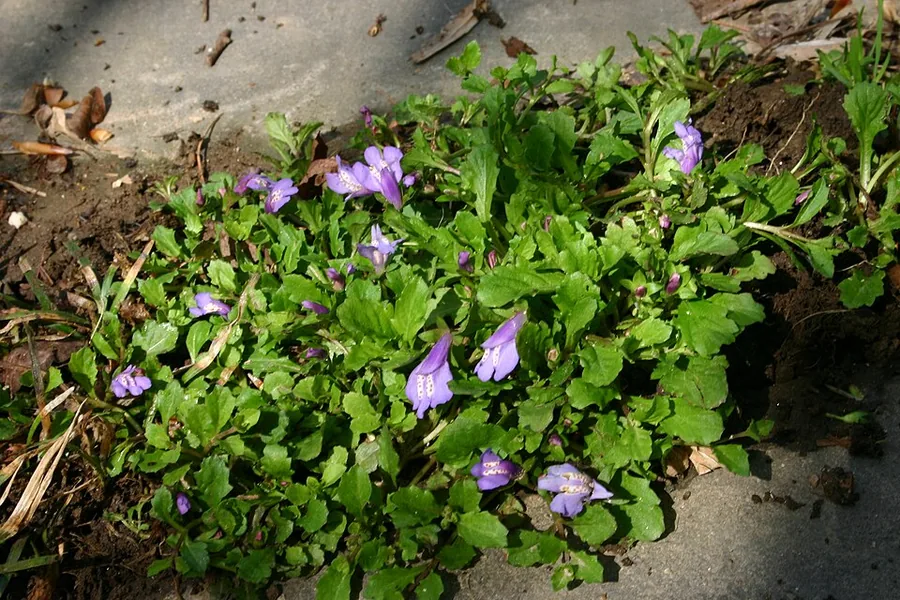
Creeping mazus is a fast-establishing groundcover that forms a dense mat held to just 1 to 3 inches (3 to 8 cm) in height. Placed in the family Mazaceae, it spreads by prostrate stems that root at each node, so a modest planting achieves full coverage in a single season. That habit recommends it as a lawn substitute and as a resilient filler between stepping stones, where it withstands light foot traffic.
Flowering follows in early summer, when the mat produces small, two-lipped blooms resembling miniature snapdragons. The typical form is purplish-blue with white and yellow throats, while the 'Albus' selection flowers white. Unlike drought-adapted groundcovers, mazus is moisture-dependent and performs best in rich ground, responding to those conditions with denser cover and heavier bloom.
Its low maintenance is offset by the vigor of the same stems that make it useful, which will colonize adjacent turf if left unchecked. Several northern states record it as an invasive weed, so a defined edge or a contained bed is the standard precaution. Reserve it for situations where continuous lateral spread is the intended effect.
Care
The short version: site it in full sun to part shade, hold the soil consistently moist rather than letting it dry out, and edge or contain the planting to prevent encroachment into turf.
Light
Mazus performs across full sun to partial shade, with flowering favored by several hours of direct sun. In hot, dry summer climates, afternoon shade reduces the transpirational load and limits the heat-driven browning of the mat.
Water
Moisture is the plant's one exacting requirement. Maintain consistently moist soil and avoid drying it out, particularly in hot weather, because water demand here exceeds that of typical groundcovers. Irrigate every 3 to 7 days, increasing the frequency during heat waves.
Soil
Grow it in moist, humus-rich, well-drained soil. It is indifferent to texture, accepting clay, loam, or sandy substrates as well as medium to wet sites, and it tolerates a broad pH span from 5.5 to 7.5.
Temperature
Hardy across USDA zones 5 to 8, mazus withstands winter minima near -20°F (-29°C) and summer maxima around 86°F (30°C). At the lower end of that hardiness range, some winter dieback should be anticipated.
Humidity
Ambient outdoor humidity is sufficient, so no target range applies. The more consequential variables are soil moisture and airflow, since a waterlogged, stagnant site favors slug activity.
Feeding
Fertility requirements are low. Where vigor is deficient, a light spring topdressing of compost or balanced fertilizer suffices, though most plantings need no supplementary feeding at all.
Pruning
Maintenance is minimal. An occasional mow or trim restores the mat's appearance and it tolerates light foot traffic, but the essential task is edging to prevent encroachment into lawns and beds.
Repotting
not applicable as an in-ground groundcover
Size & spacing
Individual plants remain low at 1 to 3 inches (3 to 8 cm) and spread 6 to 12 inches (15 to 30 cm) across. Space transplants so the stolons converge into a continuous mat within one season.
When to plant
Mazus is a cold-hardy perennial rated for zones 5 to 8. Establish transplants in spring after the last frost, and they will coalesce over the season and flower from roughly June into July.
Northern hemisphere
Southern hemisphere
Typical months for a temperate climate: start earlier in warm zones, later where spring frosts linger.
- Plant: spring after the last frost
- Harvest: late spring to early summer (roughly June to July)
Hardiness
USDA hardiness zones: 5–8
Temperature: down to -29°C
Troubleshooting
Mazus is undemanding, and nearly every problem reduces to inadequate moisture or excessive spread. Reading the mat early lets you intervene before a small thinning develops into open ground. Identify the pattern below, then apply the corrective measure.
Heat-driven scorch and thinning through summer
Browning of this kind is drought stress, and mazus registers it earlier than hardier groundcovers precisely because its physiology depends on steady soil moisture. Water demand climbs under full afternoon sun, and once the root zone dries the foliage scorches and the mat opens up. Restore the moisture balance by watering deeply, insulate the root zone with a thin mulch, and reduce the evaporative load by moving it into part shade in hot climates.
Fix:
- Water deeply and consistently to keep the soil evenly moist
- Site in part shade in hot climates to reduce heat stress
- Mulch lightly around the planting to conserve soil moisture
Runners advancing into turf and adjacent beds
The spread traces to rooting stems that establish new crowns at each node, and the process accelerates in the rich, moist ground the plant prefers. Because every rooted node becomes an independent anchor, unchecked runners advance into turf and neighboring plantings, and some northern states classify it as an invasive weed. Interrupt the advance with edging, remove escaping stems by hand or mower, or direct that same vigor into a paved gap where lateral spread is an asset.
Fix:
- Install edging to contain the planting
- Pull or mow back stems that escape the bounds
- Site it where vigorous spread is desirable, such as between pavers
Winter attrition at the cold margin of its range
Toward the cold limit of its hardiness, mazus behaves as a semi-evergreen to deciduous plant and can lose crowns to a severe freeze. The attrition concentrates in the coldest reach of zones 5 to 8 and on exposed, poorly drained sites where the crown has least protection. Buffer the crowns with a light winter mulch, favor a sheltered and well-drained position, and reset the stand by replanting the thinned areas in spring.
Fix:
- Apply a light winter mulch in marginal zones for protection
- Replant thinned areas in spring
- Grow in a sheltered, well-drained spot
Rasped foliage and mucus trails from slugs
The damp, shaded conditions mazus enjoys also suit slugs, which rasp irregular holes in the foliage and leave the telltale mucus trails. The injury is cosmetic and intensifies after wet weather, when slug activity peaks. Reduce the population by hand-collecting at dusk, moderate the excess surface moisture where the site permits, and apply iron-phosphate bait under heavy pressure. Beyond slugs, the plant faces essentially no serious pest problems.
Fix:
- Hand-pick slugs in the evening
- Reduce excess moisture and improve air movement
- Use iron-phosphate slug bait if pressure is heavy
Toxicity
For households that keep animals, the verdict is clear: creeping mazus is not listed as toxic and can be grown safely around pets, livestock, and children. Ingestion of the foliage would cause at most a brief, mild gastric upset. No special handling is warranted.
Safe for
People · Cats · Dogs · Horses · Rabbits · Livestock · Birds
Cats Safe
Absence from the ASPCA toxic list means a cat can browse the foliage without toxicological risk. A large quantity might provoke transient gastric upset, but nothing beyond that.
Dogs Safe
Dogs face no toxin here, whether they brush against or ingest the leaves. Even substantial ingestion produces at most a self-limiting bout of gastrointestinal upset.
Horses Safe
The species carries no compounds of equine concern, so a horse can graze or tread the mat with no toxic consequence.
Rabbits Safe
Rabbits may graze the leaves without restriction, as the plant contains no constituents toxic to them.
Livestock Safe
Cattle, goats, and sheep can graze it safely, since the foliage carries no documented toxic compounds.
Birds Safe
Poultry and other birds can peck at the plant without hazard, because no part of it is toxic to them.
People Safe
Handling and weeding present no toxic or dermal risk, and no irritation is reported. It is not cultivated as an edible, so there is no part intended for consumption.
Not poisonous; pets that nibble foliage may at most have mild, temporary stomach upset.
Varieties
The plant is offered in only a couple of forms, separated chiefly by flower color. Their growth habit and cultural needs are identical.
Species form (purple/blue)
The species form bears small, two-lipped, snapdragon-like corollas in purplish-blue, each throat marked with white and yellow.
'Albus'
'Albus' is a white-flowered selection identical to the species in habit and culture, differing only in floral pigmentation.
How to propagate
Propagation is straightforward, since the plant is already spreading and self-rooting in place. The process is simply accelerated by lifting and dividing the established mat.
DivisionEasy
Spring · A few weeks to a season
Division is the most reliable method: lift the rooted mat in spring and separate it into pieces. Because each division already carries roots, transplants reestablish within a few weeks and close the gap over the growing season.
LayeringEasy
Spring to summer · A few weeks
The plant layers naturally, so much of the propagation is done for you. Through spring and summer the creeping stems root at every node in contact with the soil, and those rooted sections can be severed and relocated after a few weeks.
Myths
Mazus is merely creeping thyme under another name.
The two are taxonomically distinct, mazus falling within the family Mazaceae rather than among the thymes. Their cultural requirements diverge accordingly: thyme is adapted to dry, sun-baked ground, whereas mazus needs steady moisture and rich soil. Mazus is further distinguished by its small snapdragon-like flowers in purple-blue or white with spotted throats, a floral form thyme does not produce.