Ornamental · Poaceae
Maiden Grass
Miscanthus sinensis
Sited in full sun and lean soil, maiden grass raises tall, silvery plumes that persist through winter.
Full sun
Every 7–14 days
USDA 5–9
4–12 ft · 1.2–3.7 m
Overview
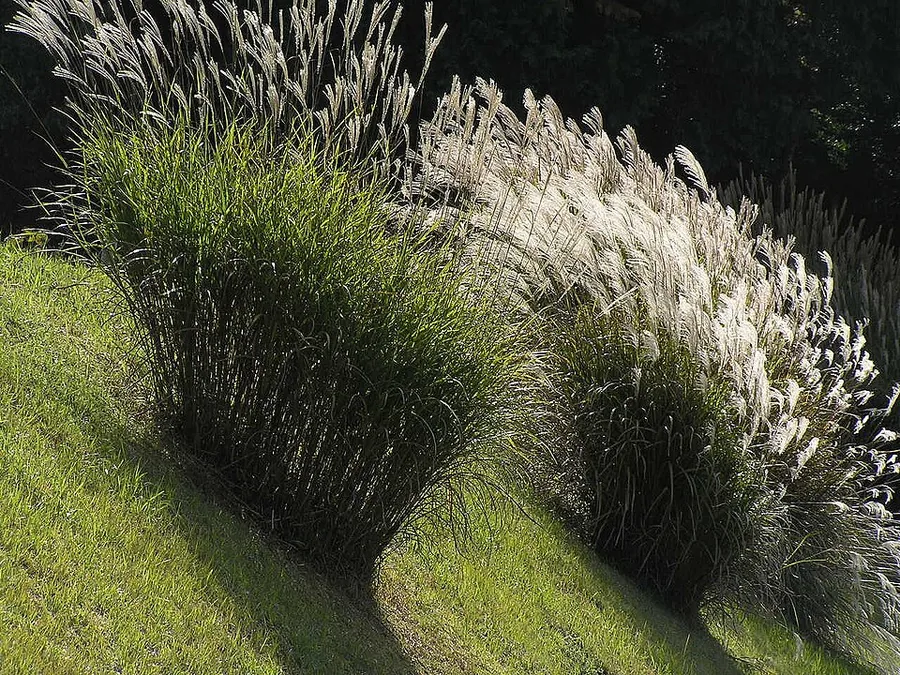
Maiden grass is a large, fountain-form ornamental grass of East Asian origin, grown for its movement and for the silvery inflorescences it raises in late summer. A member of the grass family, it forms an expanding clump that gains stature each season and clears head height by autumn. Left standing through winter, the bleached blades and seed heads carry structural interest across the dormant months.
It ranks among the easier ornamentals to establish. Full sun and average, lean soil meet nearly all of its requirements, and once the root system is established the plant withstands drought and a broad temperature range. Maintenance reduces to a single hard cut-back in late winter and periodic division of the clump.
One significant caveat applies. Many older, fertile cultivars set wind-dispersed seed that recruits into wild ground, and the species is listed as invasive across much of the eastern and central US. Selecting a sterile or low-seed cultivar and removing the plumes before ripening delivers the ornamental effect without seeding beyond the garden.
Care
The short version: full sun, average well-drained soil kept on the lean side, and once established a deep irrigation only during dry spells. Cut the entire clump down in late winter and divide it every 3 to 4 years.
Light
Site maiden grass in full sun, the exposure that supports upright stature and reliable flowering. It tolerates some afternoon shade, but reduced light produces soft growth that flops open from the center, so the brighter the position the stronger the plant.
Water
Hold a new plant evenly moist while the roots establish. Thereafter the grass is genuinely drought tolerant, and a deep soak every 7 to 14 days during a dry stretch suffices, since the roots resent standing water far more than a dry interval.
Soil
The plant is undemanding as to soil, performing in loam, clay, or sand provided drainage is adequate. It accepts a pH from 5.5 to 7.5, and average, medium-moisture ground serves it better than rich soil, which promotes the soft growth that flops.
Temperature
This is a cold-hardy grass rated to roughly -20°F to 100°F (-29°C to 38°C). It dies back to ground level over winter and regenerates from the crown once soil temperatures rise in spring.
Humidity
Ambient outdoor humidity is adequate, so no target level applies. Air movement is the operative factor, because a congested, damp clump favors the onset of blight and rust.
Feeding
Feed sparingly. A balanced fertilizer or compost in spring covers its needs, and excess nitrogen softens the stems and induces flopping across the clump, which is why lean soil is preferable here.
Pruning
A single annual operation applies: cut the entire clump back to a few inches above the ground in late winter or early spring, immediately before new growth begins. Retain the old foliage over winter for its appearance and for crown protection.
Repotting
In the ground the equivalent task is division rather than repotting. Divide the clump every 3 to 4 years, or sooner if the center declines, lifting in early spring and replanting the vigorous outer sections.
Size & spacing
A mature clump attains 4 to 12 feet (1.2 to 3.7 m) in height and spreads 3 to 6 feet (91 to 183 cm) across, so allocate space accordingly. Set plants at a spacing that admits air movement between them and prevents the blades from crowding.
When to plant
Maiden grass is a hardy perennial across zones 5 through 9 that returns with greater stature each year. Establish new plants in spring, allow the clump to bulk through summer, and the inflorescences open from late summer into fall before drying to a persistent winter silhouette.
Northern hemisphere
Southern hemisphere
Typical months for a temperate climate: start earlier in warm zones, later where spring frosts linger.
- Plant: spring
- Harvest: late summer to fall
Hardiness
USDA hardiness zones: 5–9
Temperature: down to -29°C
Troubleshooting
Most complaints with maiden grass trace to siting and clump age rather than to disease. A clump that flops, hollows at the center, or recruits seedlings around it is signaling a straightforward cultural cause. Match the symptom below, then correct it while intervention remains simple.
Seedlings establishing well beyond the parent clump
Fertile forms of this grass produce abundant wind-dispersed seed, and because that seed travels on air currents it germinates well off-site in roadsides, fields, and wild ground, which is the mechanism behind its invasive status through much of the eastern and central US. Removing the flower plumes before the seed matures cuts off that dispersal at the source. For a durable solution, plant a proven sterile or low-seed selection, or a native grass, particularly where beds sit near natural areas.
Fix:
- Deadhead flower plumes before seed matures
- Remove volunteer seedlings promptly
- Replace fertile cultivars with proven sterile or low-seed selections or native grasses
Clump center dying out inside a vigorous outer ring
This pattern reflects the natural aging of an undivided clump rather than any pathogen. Growth stays concentrated at the vigorous outer ring while the older crown at the middle declines, starves, and collapses. Lift the clump in early spring, cull the exhausted center, and reset the planting from the healthy outer divisions.
Fix:
- Dig and divide the clump in early spring
- Discard the dead center and replant healthy outer divisions
Poor vigor with leaf spotting, streaking, or rust pustules
Three distinct agents present with similar foliar symptoms. Miscanthus mealybug feeds concealed within the leaf sheaths and distorts emerging growth, Miscanthus blight lesions the blades and sheaths, and leaf rust raises orange pustules across the foliage. Excise and destroy affected tissue, open the clump to improve air circulation so leaf surfaces dry faster, and specify disease-resistant cultivars going forward.
Fix:
- Remove and destroy affected foliage
- Improve air circulation and avoid overhead watering
- Choose disease-resistant cultivars
Lax, splaying stems that open the clump from the center
Both shade and overly fertile soil drive soft, weak stem growth that cannot hold itself upright, so the clump opens from the center and flowering drops off. The plant reads the deficit in light and the excess in nutrients the same way, with elongated, lax tissue. Relocate it to full sun and withhold nitrogen, and the new stems return to a firm, upright habit.
Fix:
- Move or plant in full sun
- Avoid high-nitrogen fertilizer and rich soil
Toxicity
For households with pets or children, the record is reassuring: maiden grass is not toxic to cats, dogs, horses, or people, and it does not appear on the ASPCA's poison lists. The sole concern is mechanical rather than chemical, since the blade margins are sharp enough to cut skin, so wear gloves before cutting it back.
Safe for
People · Cats · Dogs · Horses · Rabbits · Livestock · Birds
Cats None
The species carries no toxins, so a cat that samples a blade might drool briefly or regurgitate it, which is mechanical rather than a poisoning response.
Dogs None
There is no toxic principle to act on, so a dog that chews the foliage risks only a mild, self-limiting digestive upset, not systemic poisoning.
Horses None
The foliage contains nothing toxic, so grazing horses take no harm from it.
Rabbits None
With no toxic compound present, rabbits can browse the leaves without any poisoning risk.
Livestock None
Cattle, goats, and sheep can graze the grass freely, since it holds no constituent that would sicken them.
Birds None
The plant presents no poisoning hazard to birds feeding on the seed heads or roosting within the clump.
People None
The grass is non-toxic to people. The only genuine hazard is physical: the blade margins are sharp enough to inflict a paper-cut, so wear gloves during cut-back.
Leaf edges and blades can be sharp and may cause minor skin cuts, so wear gloves when handling or cutting back. Grass pollen may aggravate seasonal allergies.
Varieties
Dozens of maiden grass cultivars are in commerce, differing in leaf width, banding, mature size, and seed fertility. The selections below are the ones most often encountered, and the final group carries the greatest weight where the species is regarded as invasive.
Gracillimus
A fine-textured selection identified by very narrow, weeping medium-green leaves that carry a white midrib.
Morning Light
A fine-leaved, white-variegated form valued in horticulture because it sets little to no viable seed.
Zebrinus
Marketed as zebra grass for the horizontal yellow banding transverse across its leaf blades.
Strictus
Porcupine grass, a strongly upright form that expresses the same transverse yellow banding.
Adagio
A compact, narrow-leaved selection with a reduced mature size that reaches anthesis earlier than most.
My Fair Maiden / Bandwidth
NC State triploid selections bred for sterility or low fertility so they neither self-seed nor become invasive.
How to propagate
Maiden grass is propagated almost entirely by division, which preserves cultivar identity and renews an aging clump in a single operation. Seed is possible but carries a serious drawback.
DivisionEasy
Early spring before new growth · 1 to 2 growing seasons
Division is the dependable method of increase and simultaneously rejuvenates a declining clump. Lift it in early spring before growth resumes and cut it into sections with a sharp spade or saw. Replant the vigorous outer divisions, discard the spent center, and expect them to establish over 1 to 2 growing seasons.
SeedModerate
Spring · 1 to 2 growing seasons
Seed propagation is best avoided. Seed-grown plants do not come true to the parent cultivar and can prove highly fertile, the very trait that drives this grass's invasiveness, so it is unsuitable wherever the species escapes cultivation. Even spring-sown, seedlings require 1 to 2 growing seasons to reach full size.
Myths
Miscanthus sinensis never sets viable seed, so any cultivar can be planted without risk.
In practice many Miscanthus sinensis cultivars produce viable, wind-blown seed and recruit into wild ground, where they displace native vegetation. Specify proven sterile or low-fertility cultivars in at-risk regions, and deadhead the plumes so no seed escapes.