Ornamental · Nelumbonaceae
Sacred Lotus
Nelumbo nucifera
Provide calm, unmoving water, unbroken sun, and a wide container, and Nelumbo answers with blooms carried on tall stalks above the surface.
Full sun
USDA 4–10
3–6 ft · 0.9–1.8 m
Overview
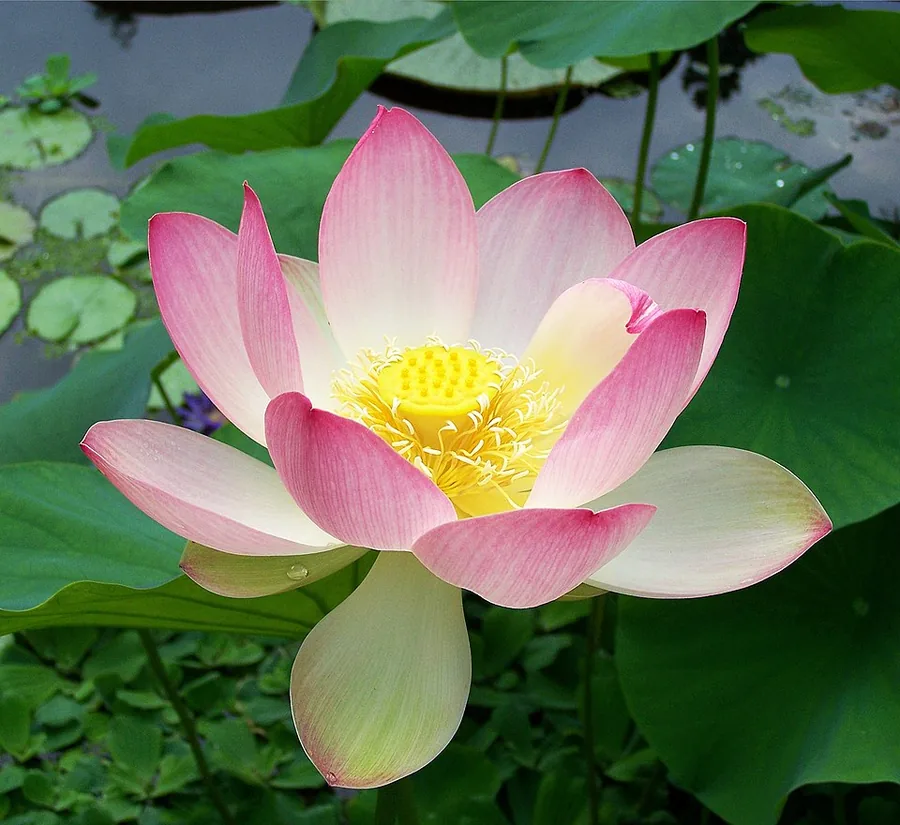
Sacred lotus is an emergent aquatic that carries its leaves and flowers above the water surface rather than floating them, a habit that sets it apart at a glance. The plant grows from a creeping rhizome anchored in soft pond-bottom substrate, from which it produces round, water-shedding peltate leaves and fragrant flowers borne on tall stalks. Each flower persists only about three days before shedding its petals to expose the woody, showerhead-shaped seed pod that identifies the genus.
As an aquatic perennial it is hardy across USDA zones 4 to 10, the key requirement being that the rhizome overwinter below the freeze line. The species has a long record of cultivation across Asia for both food and ornament, where the rhizomes, seeds, and young leaves enter the kitchen. In garden practice it is grown in a wide, sturdy container sunk into a pond or half-barrel, which restrains its vigorous rhizomes.
Lotus responds to patience more than to intervention. A freshly divided plant often devotes its first season to root establishment and withholds flowering until the second year. Supplied with heat, full sun, and still water, it develops into one of the most striking plants available for water culture.
Care
The short version: full sun over still, warm water and a wide container of heavy clay loam, with the rhizome held below the freeze line through winter and divided every year or two to keep it within its container.
Light
Lotus requires full sun, a minimum of 6 hours daily and preferably more, because flower initiation depends on that light. Under insufficient light the plant produces healthy foliage but few or no flowers, so give it the brightest, most open position available.
Water
Culture it in still, calm water over a wide container of heavy clay loam. Set the crown about 6 inches deep at establishment, then allow the water to reach 18 to 24 inches over the rhizome as growth advances. Because the rhizome must not freeze, keep it below the freeze line, moving shallow containers to deeper water or indoors ahead of a hard freeze.
Soil
Use heavy, organically rich clay loam, the mucky pond-bottom type of substrate, which anchors the rhizome. Light, fluffy potting mixes float free and fail to hold it, so pack the container with dense, weighty soil and cap it with sand or gravel to keep the medium in place.
Temperature
This warmth-driven species performs best in summer heat and tolerates temperatures to about 100°F (38°C). The dormant rhizome is markedly more cold-hardy than the top growth and withstands cold to roughly -29°F (-34°C), provided it remains below the freeze line.
Humidity
Grown in open water, lotus occupies a high-humidity setting by default, so no figure needs managing. The pond supplies the moisture, and the foliage is never short of it.
Feeding
Fertilize through the summer growing season with aquatic fertilizer tablets inserted into the container substrate, about monthly. Discontinue feeding as growth slows toward autumn and the plant enters dormancy.
Pruning
No structural pruning is required. Cut away yellowing or dead leaves and spent flower stalks to maintain water quality, and thin or divide crowded rhizomes as the plant begins to outgrow its confines.
Repotting
Divide and repot every 1 to 2 years in spring, because the rhizome fills its container quickly and can fracture the walls. Rhizomes circling the pot, a deformed container, or reduced, crowded leaves indicate the plant needs dividing.
Size & spacing
A mature lotus reaches 3 to 6 feet (91 to 183 cm) in height and spreads 3 to 4 feet (91 to 122 cm). Allocate each plant its own wide container so the running rhizome has room and the foliage is not competing for light.
When to plant
Lotus is warmth-driven and remains dormant until the water temperature rises. Plant rhizome divisions in spring to early summer once the cold has passed, and expect flowers held high above the water from June into July.
Northern hemisphere
Southern hemisphere
Typical months for a temperate climate: start earlier in warm zones, later where spring frosts linger.
- Sow: Not typically started indoors; usually grown from rhizome divisions planted in spring
- Plant: Spring to early summer once water has warmed
- Harvest: Summer (June to July); flowers held high above the water, each bloom lasting about three days
Hardiness
USDA hardiness zones: 4–10
Temperature: down to -34°C
Troubleshooting
Most difficulties with lotus resolve to three causes: insufficient sun, a rhizome outgrowing its container, or the ordinary senescence of old leaves. Reading the early signs below lets you address a minor issue before it advances. Identify what you observe, then act while intervention still helps.
Plenty of leaves but few or no flowers
Flower initiation in lotus depends on full sun and sustained warmth, so foliage can look fine while shade or a short, cool season denies the plant the light and heat it needs to bloom. A recently divided or first-year rhizome commonly directs its energy into establishment rather than flowering, which explains a bare first season. Correct the siting to a sunny position, provide a wide container of heavy loam for root run, and allow a complete warm season, and bloom follows.
Fix:
- Site the container in full sun with 6 or more hours of direct light
- Allow a full warm season; do not expect bloom from a freshly divided or first-year plant
- Move to a larger, wider container of heavy loam so the rhizome can run
- Handle rhizomes gently when dividing or planting to avoid breakage
Rhizome growth breaching its container or splitting the walls
The creeping rhizomes advance rapidly through soft substrate, and an unconfined lotus can colonize a shallow pond within a season or two once it reaches the pond bottom. Confined to a container that has grown too small, the same rhizome pressure works against the walls until they crack. Grow it in a wide, sturdy submerged container, divide the rhizome every year or two to relieve that pressure, and remove any escaped section before it establishes in the pond substrate.
Fix:
- Confine plants to wide, sturdy submerged containers rather than open pond mud
- Divide and thin rhizomes every 1-2 years
- Remove escaped rhizomes promptly to keep them from rooting into the pond bottom
Distorted young growth with a sticky coating and dense insect colonies
Soft-bodied aphids feed on tender stems and leaves, and their feeding leaves the tissue sticky and distorted, while spider mites appear under hot, dry conditions and produce fine webbing and pale stippling as they draw sap. A strong jet of water dislodges most of the population, and a pond holding fish suppresses their numbers through predation. Chemical sprays are counterproductive here because they kill the fish and beneficial insects that keep the pests in check.
Fix:
- Spray pests off with a strong jet of water
- Encourage fish and natural predators in the pond to control populations
- Avoid chemical pesticides that harm pond life and beneficial insects
Yellowing restricted to mature foliage while young leaves remain sound
Yellowing limited to the oldest leaves reflects normal senescence, which intensifies late in the season as the plant transitions toward dormancy. Remove the failing leaves so they don't decompose in the water and degrade its quality, and taper feeding as growth slows. Held below the freeze line, the rhizome overwinters and resumes growth in spring.
Fix:
- Remove yellow or dead leaves to keep the water clean
- Allow normal seasonal dieback; reduce feeding as growth slows
Toxicity
Sacred lotus is thoroughly safe. It does not appear on the ASPCA toxic-plant list, and rather than presenting any hazard, its rhizomes, seeds, and young leaves serve as food across Asia. Despite the common name, it is not a true lily and carries none of the risk that group poses to cats.
Safe for
People · Cats · Dogs · Horses · Rabbits · Livestock · Birds
Cats None
No toxic principle is present, so a cat that samples a leaf faces no reaction. Nelumbo is absent from the ASPCA toxic-plant list.
Dogs None
Non-toxic to dogs. Ingesting foliage or a fallen seed pod at most yields a loose stool from the fiber load, not poisoning.
Horses Safe
Because the plant contains no toxin, horses that graze the marginal leaves are unaffected.
Rabbits Safe
Harmless to rabbits. The young leaves are palatable and safe, though better fed as an occasional green than as a dietary staple.
Livestock Safe
Cattle, goats, and sheep can browse pond-margin lotus with no toxic consequence.
Birds Safe
The seeds are a documented wild food for waterfowl and other birds, which consume them without risk.
People Safe
The plant is a food crop. Its rhizomes, seeds, and young leaves are eaten throughout Asia and are entirely safe to prepare and consume.
Edible and food-safe; the rhizomes, seeds, and leaves are used in cooking. No special handling precautions for pet households.
Varieties
Several named lotus merit recognition, ranging from color-changing hybrids to dwarfs suited to a half-barrel. These are the selections worth knowing.
Mrs. Perry D. Slocum
A widely grown hybrid of sacred and American lotus whose color-changing flowers open pink and shift toward yellow with age.
Momo Botan
A dwarf that tops out at 1 to 2 feet tall and carries double, strongly fragrant rose-pink flowers to about 5 inches across, well suited to half-barrels and small water gardens.
Chawan Basu
A dwarf cultivar proportioned for small containers and tub gardens.
American lotus (Nelumbo lutea)
The North American native species, distinguished by pale-yellow flowers and cold-hardiness extending to USDA zone 4.
How to propagate
Lotus is propagated by two routes, division of an established rhizome or germination of the hard seeds, and the choice determines how soon flowering follows.
DivisionModerate
Spring, as growth resumes · One full growing season; bloom often does not occur until the second year
Division is the dependable method for propagating lotus, carried out in spring as growth resumes and the rhizome is active. Sever a segment of the creeping rhizome, lay it horizontally near the edge of a wide container of heavy loam, cover it with sand or gravel, and submerge it. Because damage to the growing tips checks establishment, handle the rhizome carefully, then allow a full season to settle, since flowering typically waits until the second year.
SeedModerate
Spring to summer in warm water · Slower to flowering than division; may take more than one season
Seed propagation is viable but slow. The hard, impermeable seed coat must be scarified before the seed will imbibe and germinate in warm water, and the resulting plants can take more than one season to reach flowering. Seed-raised plants of named cultivars will not come true, so propagate those by division to preserve their traits.
Myths
Nelumbo and the water lily are one and the same species.
The two occupy different families, and their growth habit makes the distinction plain. Lotus elevates its large peltate leaves and flowers above the water on tall stalks and matures a woody, showerhead-shaped seed pod, whereas a water lily rests its leaves and blooms on the surface and forms no such pod. The lotus leaves and seeds are edible, while the water lily's are not.