Ornamental · Gentianaceae
Lisianthus
Eustoma grandiflorum
A slow crop with a cool requirement at the start, lisianthus repays a precise, patient beginning with rose-like blooms through summer.
Full sun
Every 3–7 days
50–75°F · 10–24°C
60–75 days
Overview
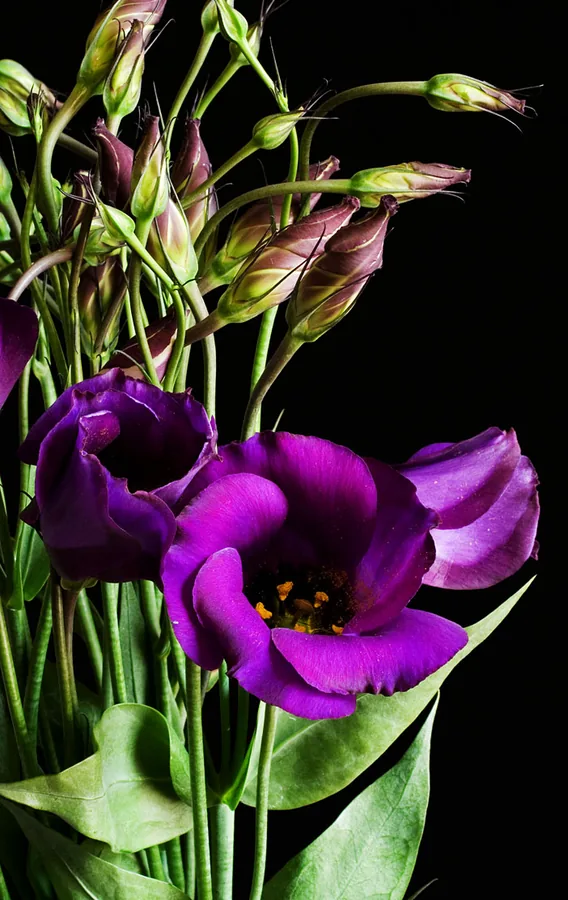
Eustoma grandiflorum, known as lisianthus, prairie gentian, or Texas bluebell, is a prairie native distributed across the southern plains. Its flowers resemble roses closely enough that the florist trade grows it heavily for cutting, yet they are borne on tall, slender stems that give the plant its own habit. In garden culture it behaves as a tender perennial grown as an annual, flowering from summer into fall.
Its reputation as a demanding plant rests almost entirely on establishment. The seed is dust-fine, growth is slow, and the species carries a temperature-sensitive trait: heat during the juvenile phase locks the plant into a flat, non-flowering rosette. Once it clears that cool, controlled start, it becomes undemanding and flowers for months.
Culturally it wants full sun, soil kept evenly moist yet free of saturation, and feeding through active growth. Pinching young plants induces branching and more flowering stems, and removing spent blooms sustains flower production, yielding cut blooms that hold for two weeks in the vase.
Care
The short version: full sun with a cool establishment phase, soil kept evenly moist but well drained, light feeding every couple of weeks, and patience through a slow first few months.
Light
Full sun drives the strongest flowering in lisianthus, though the plant tolerates light afternoon shade where summer heat is severe. Under excess shade, stems weaken and flower numbers drop sharply.
Water
Maintain the soil evenly moist but never waterlogged, irrigating roughly every 3 to 7 days as the surface dries. Saturated soil deprives roots of oxygen and favors the stem and root rots the species is prone to, so drainage is as important as the moisture itself.
Soil
Grow it in fertile, well-drained loam at a pH of 6.0 to 7.0. Free-draining ground is the primary cultural defense against the crown and root rots that trouble this plant.
Temperature
The plant performs within 50°F and 75°F (10°C to 24°C), and cool conditions during establishment set the plant up to flower. If seedlings exceed about 72°F (22°C), the shoot rosettes rather than bolts, so hold them cooler until they are well developed.
Humidity
Ambient garden humidity is adequate, so no target is needed. Air movement is the deciding factor, because still, damp air within crowded plantings raises the leaf wetness that stem pathogens exploit.
Feeding
Apply a balanced water-soluble fertilizer at low to moderate rates about every two weeks through the growing season. Measured feeding outperforms heavy dosing, which drives soft vegetative growth at the expense of flowers.
Pruning
Pinching young plants releases lateral buds and multiplies the flowering stems. Removing spent blooms through the season keeps the plant initiating fresh flowers.
Size & spacing
Mature plants reach 1 to 3 feet (30 to 91 cm) tall with a narrow spread of 9 to 12 inches (23 to 30 cm). Spacing that allows free air movement lowers the humidity that fuels stem disease.
When to plant
Lisianthus follows a long developmental clock and is heat-sensitive at establishment, so timing matters. Sow indoors in late winter and hold the seedlings cool, transplant once frost risk has passed, and expect flowering from midsummer until cold ends the season.
Northern hemisphere
Southern hemisphere
Typical months for a temperate climate: start earlier in warm zones, later where spring frosts linger.
- Sow: Start indoors 10 to 12 weeks before last frost; surface sow tiny seed and do not bury.
- Plant: Transplant after danger of frost has passed in spring.
- Harvest: Blooms summer to frost; allow 60 to 75 days from transplant to flowering.
Hardiness
USDA hardiness zones: 8–10
Temperature: down to -12°C
Troubleshooting
Once established, lisianthus presents few disorders, and most of what does appear originates at the seedling stage or in saturated, crowded soil. The entries below pair each early symptom with its cause so intervention comes before loss. Identify the sign, then act while correction is still possible.
Growth stalls in a flat rosette with no bolting
What you are seeing is rosetting, a heat-induced dormancy set during the seedling phase rather than a later care error. When young plants experience temperatures above about 72°F (22°C), the shoot stays compressed and stem elongation shuts down. Holding early growth at 50°F to 65°F (10°C to 18°C) until the plants pass their fifth leaf pair keeps the meristem primed to bolt, and normal stems follow.
Fix:
- Grow seedlings at 50 to 65°F until well past the fifth leaf pair
- Avoid heat stress on young plants
Basal wilting and cankering at the stem
Sunken lesions at the crown identify stem canker and the soilborne fungi behind it, pathogens favored by saturated soil and dense plantings that hold moisture against the tissue. A stem girdled by rot cannot recover, so the affected plant should be removed and discarded. Wider spacing, base watering in place of overhead irrigation, and free-draining soil all cut the leaf wetness and humidity these fungi need to establish.
Fix:
- Remove and discard affected plants
- Improve air circulation and avoid overhead watering
Mosaic mottling with distortion and stunting
Persistent mottling, streaking, or leaf distortion signals a viral infection, a systemic condition that no adjustment to irrigation or feeding can reverse. Because the pathogen is systemic, an infected plant stays a reservoir and should be rogued and destroyed. Aphids and thrips move these viruses from plant to plant, so clean transplants and suppression of those vectors break the transmission cycle.
Fix:
- Remove and destroy infected plants
- Control insect vectors such as aphids and thrips
Toxicity
For households with animals, lisianthus is safe. The ASPCA lists it as non-toxic to cats and dogs, and no compound in the plant is known to harm other animals or people. As with any non-food plant, a very large ingested volume may cause a brief stomach upset, but there is no toxic principle to poison a pet or child.
Safe for
People · Cats · Dogs · Horses · Rabbits · Livestock · Birds
Cats None
Eustoma grandiflorum appears on the ASPCA's safe list for cats, so ingestion carries no toxic risk. Any non-food plant taken in quantity can still provoke mild mechanical irritation, seen as brief drooling or a passing digestive upset.
Dogs None
The species is classed as non-toxic to dogs, so cohabitation poses no poisoning risk. A dog that consumes a large volume of foliage may show transient gastrointestinal upset, the standard response to bulk non-food plant matter.
Horses Safe
No toxin in lisianthus is known to affect horses. It is absent from equine poison references, so incidental grazing warrants no concern.
Rabbits Safe
Lisianthus holds no compounds toxic to rabbits, making it safe as a companion planting. Sound husbandry still favors a gradual transition to any new forage.
Livestock Safe
Cattle, goats, and sheep face no toxic hazard from this species. It does not feature among the plants documented to poison grazing livestock.
Birds Safe
The plant carries no avian toxin in any of its tissues. Pet birds can be housed alongside it without risk.
People Safe
Handling and cultivation present no toxic hazard to adults or children. It is not a food crop, so nothing is meant for consumption, but an incidental taste will not cause poisoning.
Varieties
The lisianthus in commerce are bred chiefly for cut-flower production and are grouped by single or double flower form. The selections below are the ones worth knowing.
Echo series
A widely grown cut-flower series that produces large, fully double blooms on tall, robust stems suited to the vase.
Arena
A double-flowered type favored under glass for cutting, valued for straight, self-supporting stems and dependable vase life.
Cadence Yellow
A single-flowered cutting selection distinguished by clean, open blooms in a soft yellow.
How to propagate
Lisianthus is propagated almost exclusively from seed, and it requires more patience during establishment than nearly any other annual.
SeedDemanding
Surface sow indoors 10 to 12 weeks before last frost; germinate at 70 to 75°F. · About 5 months from sowing to first bloom
Seed is the standard means of propagation for lisianthus, though it demands patience through a long juvenile phase. Because the seed is dust-fine and needs light, it is surface sown and left uncovered, then germinated at 70°F to 75°F (21°C to 24°C) with sowing timed 10 to 12 weeks before last frost. Expect roughly five months from sowing to the first flower, which is why many growers opt for pelleted seed or purchased plugs to shorten the handling.
Myths
Lisianthus is easy to grow from seed at home like most annuals.
The seed is dust-fine and slow to germinate, and the crop requires roughly five months from sowing to first bloom. That protracted juvenile phase is precisely why most growers bypass seed and establish from plugs or transplants.
Lisianthus is dangerous and toxic to pets.
The ASPCA classifies lisianthus as pet-safe and non-toxic to cats and dogs. As with any non-food plant, a large ingested volume may produce short-lived stomach upset, but there is no toxic principle to cause true poisoning.