Tree · Cupressaceae
Leyland Cypress
Cupressus × leylandii
Sited with room to breathe and steady water, this fast evergreen throws up a privacy wall in just a few years.
Full sun
Every 7–14 days
USDA 6–10
40–70 ft · 12.2–21.3 m
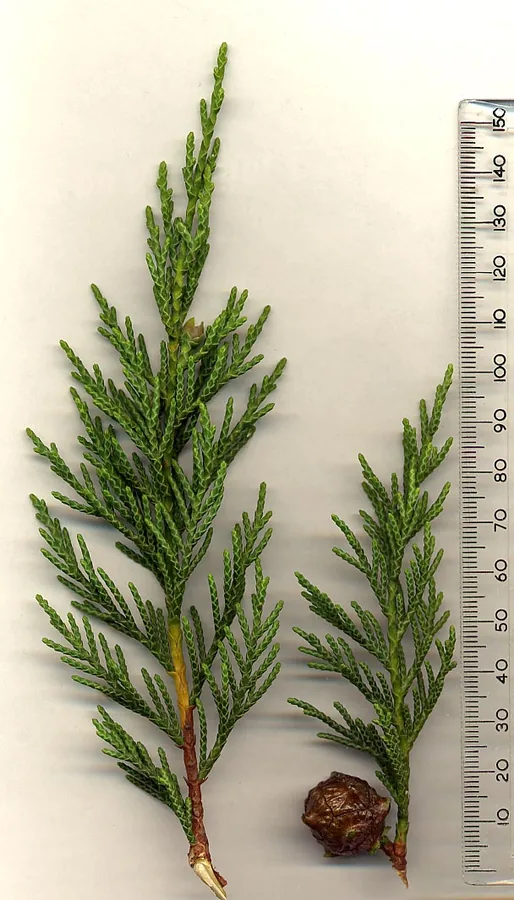
Overview
Leyland cypress is the default choice wherever a screen is needed quickly. It is a fast-growing evergreen, an intergeneric hybrid of Monterey cypress and Nootka cypress that adds several feet of height per year and fills into a dense, feathery column. That growth rate is its principal virtue, and it is also the origin of most of its cultural problems.
The complication is that this is a short-lived, disease-prone tree, and the conventional planting scheme aggravates its weaknesses. Installed as a tight single-species row, the trees compete, canopy airflow collapses, and canker and root rot establish. Given genuine spacing, an individual specimen persists far longer than a crowded, neglected screen.
Managed as a proper landscape tree rather than a stopgap, it performs well. It tolerates a broad range of soils, accepts shearing into a formal outline, and demands little maintenance once established. Spacing, drainage, and reliable irrigation during dry spells are the variables that decide whether the screen thrives or thins.
Care
The short version: full sun, well-drained soil, and generous spacing between plants. Irrigate deeply during dry spells, confine pruning to dry weather, and resist installing the trees at close spacing.
Light
Leyland cypress performs best in full sun, which sustains a dense, uniform canopy. It tolerates partial sun or light shade, but a shaded aspect thins and browns earlier, and that same low-light, poorly ventilated position is precisely where needle blight initiates.
Water
The tree tolerates drought once established, yet drought stress is the trigger for lethal canker, so the root zone should not be allowed to run bone dry. During dry periods, irrigate deeply every 7 to 14 days, with particular attention to young trees and to any specimen that is crowded or already stressed.
Soil
It adapts to loam, clay, or sand across a broad pH of 5.0 to 8.0. The single intolerance is poor drainage, since saturated soil favors root rot, so heavy clay should be amended before planting to improve percolation.
Temperature
The species is both cold-hardy and heat-tolerant, functioning from roughly -9°F to 100°F (-23°C to 38°C). That envelope spans many climates, though ice and freeze injury can fissure the bark and create the entry wounds that canker fungi exploit.
Humidity
Ambient outdoor humidity is adequate, so no level requires management. The governing factor is air movement through the canopy, because stagnant, humid air around crowded plants is what drives the foliar diseases.
Feeding
Apply a balanced complete fertilizer lightly in spring, if at all. Established trees seldom require feeding, and forcing soft, rapid growth with excess nitrogen offers the tree no benefit.
Pruning
Prune only in dry weather, since moisture on fresh cuts favors disease transmission, and the tree accepts shearing well for a formal screen. When removing cankered or diseased branches, cut several inches below the damage and disinfect tools with 10 percent bleach or alcohol between cuts.
Repotting
As a landscape tree rather than a container subject, it is rarely potted on. A young specimen held in a nursery pot should be moved before roots begin to circle and growth stalls, then planted directly into the ground.
Size & spacing
At maturity it reaches 40 to 70 feet (12 to 21 m) in height with a spread of 10 to 20 feet (3 to 6 m). Those dimensions are the reason spacing is decisive: allow each tree ample distance from its neighbor so air circulates and disease pressure stays low.
When to plant
Season is not critical, since you establish a nursery-grown tree rather than sow seed. Set it out in spring or fall while the soil is workable and temperatures are moderate, allowing the root system to establish before the next period of heat or hard cold.
Northern hemisphere
Southern hemisphere
Typical months for a temperate climate: start earlier in warm zones, later where spring frosts linger.
- Plant: spring or fall
Hardiness
USDA hardiness zones: 6–10
Temperature: down to -23°C
Troubleshooting
Nearly every disorder in this species traces to one condition: trees installed too close on an unsuitable site. Inspect the lower and inner branches first, where canker, blight, and root rot express earliest. Diagnose from the descriptions below, then intervene promptly, because the serious diseases admit no cure once they have spread.
Individual branches flagging rust-brown above sunken, resin-oozing bark lesions
Branch flagging paired with sunken bark lesions indicates Seiridium or Botryosphaeria canker, the leading cause of death in this species. The pathogens colonize through bark wounds, and drought or crowding stress lowers the tree's resistance and accelerates the infection. Because no fungicide eradicates an established canker, management is entirely cultural: excise the wood well below each lesion, sanitize between cuts, and relieve stress through irrigation and adequate spacing.
Fix:
- Prune out infected branches several inches below the canker and destroy them
- Disinfect pruning tools with 10 percent bleach or alcohol between every cut
- Reduce stress by deep watering during drought and mulching beyond the lowest limbs
- Remove severely declined trees as there is no chemical cure
General decline with off-color foliage above rotting roots in saturated soil
Sparse, off-color foliage in yellow, purple, or tan tones over decaying roots signals Phytophthora root rot, a water mold that thrives in compacted, poorly drained soil. Young trees, with less established root systems, decline most severely. The rot is irreversible once the root system fails, so remove and destroy the tree, correct the drainage, and select a different site rather than replanting Leyland cypress in the same ground.
Fix:
- Remove and destroy infected plants and do not replant Leyland cypress in the same spot
- Improve drainage and amend heavy clay with organic matter
- Avoid overwatering and waterlogged sites
Interior, lower browning that advances outward while tips remain green
Browning that originates low and inside the canopy while the tips hold their color is the signature of Passalora needle blight. The pathogen disperses in splashing rain and requires sustained leaf wetness to infect, which explains why crowded, shaded stands with poor air movement decline first. Correcting the microclimate does most of the work: thin for airflow, irrigate at the soil rather than overhead, and remove the most affected branches.
Fix:
- Space and thin plantings to improve airflow and reduce leaf wetness
- Switch to drip irrigation or water early in the morning, avoiding overhead watering
- Prune out and destroy diseased branches
- Apply a labeled fungicide (e.g., thiophanate-methyl or myclobutanil) preventively from late spring through summer if needed
Spindle-shaped silk cases suspended among defoliating branches
The 1 to 2 inch (2.5 to 5 cm) spindle-shaped cases camouflaged with foliage fragments are the shelters of bagworms, whose larvae defoliate branches from within the bag. Because the insect overwinters as eggs inside these cases, hand-removal through winter and early spring interrupts the cycle before hatch. A Bacillus thuringiensis application controls the larvae while they remain small and actively feeding.
Fix:
- Hand-pick and destroy bags in winter and early spring
- Apply Bacillus thuringiensis (Bt) when larvae are small in spring
- Use a labeled contact insecticide for heavy mature infestations
Fine yellow stippling and bronzing beneath light webbing
Fine yellow stippling that progresses to a bronze cast, sometimes with light webbing, is feeding injury from spruce spider mites. This is a cool-season species that peaks in spring and fall rather than midsummer, so scouting should track those windows. Dislodge colonies with a forceful water spray or treat with insecticidal soap or horticultural oil, and avoid broad-spectrum insecticides, which remove the predatory mites that suppress the population.
Fix:
- Spray plants forcefully with water to dislodge mites
- Apply insecticidal soap, horticultural oil, or neem oil
- Avoid broad-spectrum insecticides that kill predatory mites
Toxicity
For households with pets or children, Leyland cypress is not toxic. No part of the tree poisons cats, dogs, horses, or people, so it suits a yard shared with animals and children. The sole caution concerns the skin rather than ingestion, since the foliage can irritate on contact, so wear gloves when pruning.
Safe for
People · Cats · Dogs · Horses · Rabbits · Livestock · Birds
Cats Safe
Leyland cypress is not toxic to cats, and a curious nibble of foliage carries no risk of poisoning. As with nearly any plant, a cat that ingests a large volume may regurgitate it or show a brief, self-limiting gastrointestinal upset.
Dogs Safe
The species contains no known toxin, so dogs may share its company without hazard. The only consideration is a dog that chews and swallows substantial woody foliage, which can produce mild, transient digestive discomfort.
Horses Safe
Horses grazing near Leyland cypress face no toxic risk. In contrast to certain genuinely poisonous evergreens, this hybrid carries no compound that harms equines.
Rabbits Safe
The foliage is safe for rabbits, and an incidental bite causes no injury. It holds no forage value for them, so they seldom feed on it in any case.
Livestock Safe
Cattle, goats, and sheep may occupy a pasture edge planted with this tree, which presents no poison to ruminants. Grazing animals generally reject the resinous foliage and select grass instead.
Birds Safe
Birds nesting and sheltering in the dense canopy encounter no hazard whatsoever. Neither the foliage nor the bark they probe contains anything injurious.
People Safe
No part of the tree is poisonous by ingestion, so it is safe to grow around children. The relevant exposure is dermal rather than oral: contact with the foliage can provoke contact dermatitis in sensitive individuals, so wear gloves when pruning.
Wear gloves when pruning or handling foliage to avoid skin irritation.
Varieties
Most Leyland cypress marketed for screening belongs to one of a few named clones, differentiated chiefly by foliage color and habit. The following are the selections you are most likely to encounter at the nursery.
Leighton Green
The long-established benchmark selection, a tall, dense, columnar form with dark green foliage that southern growers favor for rapid screening and homegrown Christmas trees.
Castlewellan
A more compact clone whose gold-tipped foliage reaches its most saturated yellow across the fall, winter, and spring months.
Naylor's Blue
A looser, more openly branched column bearing blue-gray foliage on a comparatively slower-growing frame.
Murray
A vigorous dark green clone cultivated much like the benchmark for establishing rapid privacy screening.
How to propagate
Because it is a sterile hybrid, the tree cannot be raised true from seed, so every new plant is propagated vegetatively as a clone of an existing one.
Stem cuttingsModerate
Late summer to fall (semi-hardwood cuttings) · Several weeks to months to root
As a sterile hybrid, the tree does not reproduce true from seed, which makes vegetative cuttings the standard method for clonal fidelity. Collect semi-hardwood cuttings from late summer into fall, and allow for several weeks to a few months of rooting time, since these conifers callus and root slowly.
GraftingDemanding
Dormant season · Weeks to months
Grafting is performed in the dormant season, with the graft union knitting over weeks to months. The technique is demanding and sees far less use than rooted cuttings in the production of landscape stock.
Myths
Leyland cypress is a maintenance-free, plant-it-and-forget-it instant hedge.
The species grows rapidly, but it is short-lived and disease-prone, and it declines most when installed as a tightly packed single-species wall. Crowding and drought stress predispose it to Seiridium and Botryosphaeria cankers, needle blight, and root rot, while its shallow root system leaves large specimens vulnerable to windthrow. Adequate spacing and consistent water are the conditions that keep it a low-input screen rather than a high-maintenance one.
Cankers and needle blight can be eradicated by spraying the tree with fungicide.
An established canker cannot be cured by any fungicide. Effective control is strictly cultural: excise the diseased wood, reduce the tree's stress load, provide correct spacing, and sanitize tools between cuts.