Tree · Cupressaceae
Eastern Red Cedar
Juniperus virginiana
A drought-hardened native conifer whose deep adaptability and long life make it a workhorse of difficult sites.
Full sun
Every 10–21 days
USDA 2–9
30–39 ft · 9–12 m
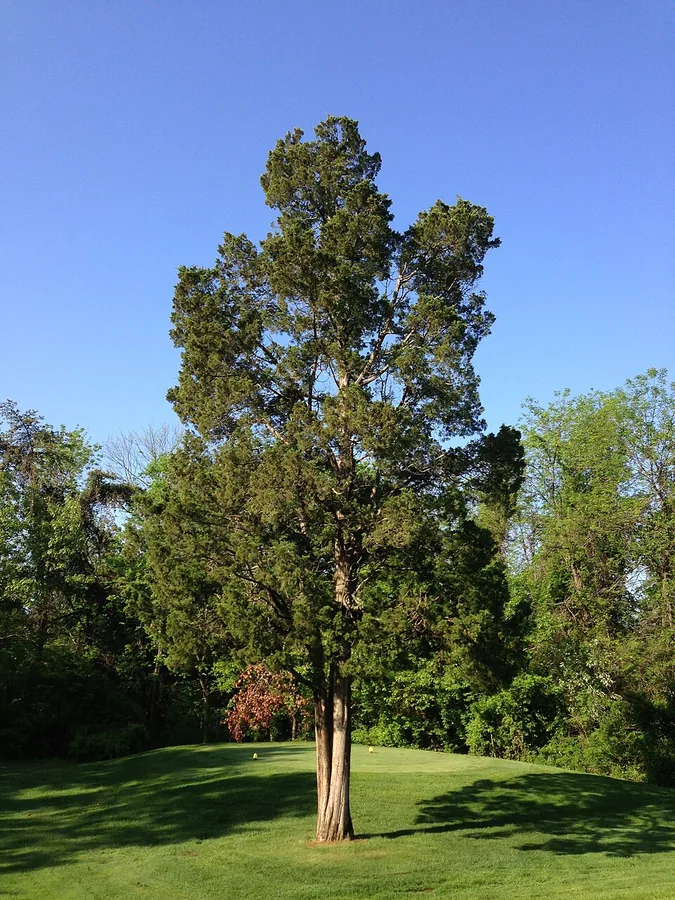
Overview
Eastern red cedar ranks among the most resilient evergreens available to growers. Taxonomically it is a juniper rather than a true cedar, and it has colonized much of the eastern United States on sites that exclude less tolerant trees. Given full sun, it establishes on clay, sand, rock, or dry alkaline substrates with little difficulty.
Its landscape value lies in service as a screen, windbreak, or wildlife tree. Because the species is dioecious, only female plants bear the frosty blue berry-like cones that sustain waxwings, robins, and other birds through winter, while the dense canopy supplies cover and nesting habitat. The reddish, aromatic heartwood is the familiar cedar of lined closets and durable fence posts.
This is a slow-growing, long-lived species capable of persisting for centuries, but two traits warrant management. It encroaches aggressively into open grassland once fire ceases to suppress it, and it functions as the alternate host for cedar-apple rust, which dictates strict separation from apples and hawthorns.
Care
The short version: site it in full sun on any well-drained soil and water only until the root system takes hold. Because mature trees draw on exceptional drought resistance, they need no feeding on ordinary ground and minimal pruning, provided you keep them clear of apple and hawthorn hosts.
Light
Site it in full sun, where photosynthetic capacity supports the densest, healthiest growth. It will persist in light shade, but reduced light produces a thin, open canopy that forfeits the compact form prized for screening.
Water
Once the roots establish, the species ranks as one of the most drought-tolerant conifers native to the eastern U.S. and seldom requires irrigation. Water new plantings through the first season to develop that root system, then allow the soil to dry between waterings, since the tree's tolerance is rooted in its access to deeper moisture.
Soil
Soil adaptability is among this tree's defining traits. It performs on average, dry to medium, well-drained ground and accommodates clay, sand, shallow rock, and poor or dry alkaline sites across a pH range of 4.7 to 8.0. The one consistent limit is waterlogging, which the roots will not tolerate.
Temperature
Cold hardiness spans -40°F to 104°F (-40°C to 40°C), an unusually wide range that removes frost from the list of concerns. The same constitution lets it withstand high heat and exposed, windy positions without injury.
Humidity
Ambient humidity is immaterial to an established tree outdoors. Air circulation governs foliar health far more than atmospheric moisture, because dense, persistently wet foliage creates the microclimate that favors the tip blights.
Feeding
On typical sites the tree requires no supplemental nutrition. Where growth is genuinely deficient, a balanced slow-release fertilizer in spring corrects it, but an established specimen on ordinary ground meets its own demands.
Pruning
Pruning needs are minimal, though the species responds well to shearing for screens and hedges. Time the work for late winter to early spring, and remove brown galls and dying twig tips at the same pass to interrupt the cedar-apple rust cycle before sporulation.
Repotting
Not applicable; grown as a landscape tree, not a houseplant
Size & spacing
A mature tree attains roughly 30 to 40 feet (9 to 12 m) in height and spreads 10 to 20 feet (3 to 6 m). Allow adequate spacing for full development, recognizing that the growth rate is moderate rather than rapid.
When to plant
A tree of this hardiness has no sowing schedule to track. Establish new plants in spring or fall so the root system can develop before summer heat or winter cold imposes stress, and note that female trees ripen their blue cones from fall into winter.
Northern hemisphere
Southern hemisphere
Typical months for a temperate climate: start earlier in warm zones, later where spring frosts linger.
- Plant: Spring or fall
- Harvest: Non-flowering; female trees bear frosty blue-green berry-like cones that ripen fall to winter (Sep-Feb)
Hardiness
USDA hardiness zones: 2–9
Temperature: down to -46°C
Troubleshooting
An established eastern red cedar is largely self-sufficient, yet a predictable set of pests and foliar fungi recur on the twigs and needles. Most of these injure appearance more than vigor. Identify the agent from the descriptions below, then intervene at the right point in its cycle.
Brown branch galls extruding bright orange gelatinous horns after rain
This is cedar-apple rust and allied fungi, heteroecious pathogens that alternate between the cedar and apples, crabapples, or hawthorns. On the cedar the injury is slight, limited to galls and minor twig dieback. Excise the brown galls in late winter before the telial horns develop, and maintain the widest practical separation from rose-family hosts.
Fix:
- Prune out and destroy galls and infected branch tips in late winter to early spring before horns form
- Do not plant near apples, crabapples, hawthorns, quince, or serviceberry
- Apply a myclobutanil fungicide in early spring on high-value plants before infection (copper and sulfur are less effective)
Spindle-shaped silk bags cloaked in needles hanging from twigs
The camouflaged bags are constructed by bagworm caterpillars, which defoliate needles and thin the crown as they feed. Each case is assembled from the host's own foliage, which conceals it against the branches. Handpick the bags from fall through early spring to eliminate the overwintering eggs, then apply Bt while the larvae remain small in late spring.
Fix:
- Handpick and destroy bags in fall through early spring to remove overwintering eggs
- Apply Bacillus thuringiensis or an approved insecticide while larvae are small in late spring to early summer
Stippled, discolored foliage bearing encrusted specks over stems and needles
The fixed encrustations are juniper scale, while the fine stippling can equally indicate spider mites. Both are sap feeders that deplete the foliage and dull its color, occasionally with sticky honeydew or sooty mold. Smother overwintering scale with horticultural oil, target the crawlers as they emerge in late spring, and remove any branch that is heavily infested.
Fix:
- Apply horticultural oil to smother overwintering scale
- Treat crawlers with horticultural oil or an approved insecticide at the crawler stage
- Prune out and destroy heavily infested branches
Twig tips browning back with black pinpoint specks on the deadwood
Dead tips bearing minute black fruiting bodies indicate Phomopsis or Kabatina tip blight, fungi that colonize after wet conditions. On a vigorous tree the effect is largely cosmetic. Prune the affected twigs during dry weather, avoid overhead irrigation, and open the canopy so foliage dries quickly and denies the fungi a foothold.
Fix:
- Prune out dead and dying twigs during dry weather
- Avoid overhead watering and improve air circulation
- Apply an approved fungicide to new growth on high-value plants if needed
Toxicity
From a toxicology standpoint, eastern red cedar poses no real poisoning risk. The genus Juniperus is absent from the ASPCA toxic lists, and people, pets, and livestock tolerate it. The only documented concerns are minor: a mild gastrointestinal upset when an animal consumes a large amount of the oily foliage or cones, and dermal irritation from the prickly juvenile growth and aromatic volatile oils.
Safe for
People · Cats · Dogs · Horses · Rabbits · Livestock · Birds
Cats Mild
Cats face no real hazard, as the genus is absent from the ASPCA poison lists. A cat that ingests a quantity of foliage or berries may show a transient loose stomach, and the aromatic oils tend to deter consumption in any case.
Dogs Mild
Dogs are safe in casual contact, though one that consumes a large quantity of the blue berries or foliage may develop mild diarrhea. The reaction is not serious, but monitor the animal if a substantial amount is eaten.
Horses Mild
Horses graze in its vicinity without harm. Ingesting a considerable volume of the oily foliage or cones can provoke a passing digestive upset, so it is not a dependable forage, though it carries no poisoning risk.
Rabbits Safe
Rabbits browse juniper foliage in the wild and tolerate it without issue. No toxin is present to cause concern.
Livestock Safe
Cattle, sheep, and goats browse eastern red cedar with no risk of poisoning. Heavy consumption of the foliage is more apt to disturb the rumen than to injure the animal.
Birds Safe
The berry-like cones are a winter staple for cedar waxwings, robins, and numerous other birds, which disperse the seed as they feed.
People Safe
There is no poisoning hazard for people. The prickly juvenile foliage and aromatic sap can irritate skin, so wear gloves when pruning, and do not regard the berries as food.
Not a poisoning hazard, but foliage and the blue berry-like cones can cause mild gastrointestinal upset (such as diarrhea) if eaten in quantity, and the aromatic volatile oils are mildly irritating. Sap and prickly young foliage may irritate skin; wear gloves when pruning.
Varieties
Selection within the species spans a wide habit range, from strictly fastigiate columns to prostrate shrubs. A few cultivars recur in cultivation for their reliable form and foliage.
'Canaertii'
A long-standing ornamental selection valued for its dense, narrow pyramid of rich dark green foliage set with frosty blue cones.
'Brodie'
An upright columnar form whose soft blue-green foliage suits a clean, narrow screen or vertical accent.
'Taylor'
A strictly fastigiate column reaching about 20 to 25 feet in height yet only 3 to 4 feet across, well suited to a confined upright accent.
'Grey Owl'
A low, spreading shrub bearing silvery gray foliage, departing from the species' typical upright tree habit.
How to propagate
Three methods apply, each suited to a different goal. Seed carries strong dormancy and is slow and erratic, while cuttings and grafting preserve a cultivar's genotype and are the standard route for named selections.
SeedDemanding
Sow stratified seed in fall or spring · Months to over a year; seed has dormancy requiring cold stratification and can be slow and erratic to germinate
The species self-seeds readily in the wild, yet deliberate seed propagation is demanding. Collect cones from a female tree in fall or winter, remove the pulp, and subject the seed to extended cold stratification to overcome its dormancy. Even so, germination is slow and irregular, ranging from a few months to more than a year.
Stem cuttingsModerate
Take semi-hardwood cuttings in late summer to fall · Several months to root
Cuttings are the conventional means of reproducing a named cultivar with its form and foliage color intact. Take semi-hardwood cuttings in late summer to fall, and allow several months for rooting. The process is slower than rooting a houseplant but considerably more dependable than seed for true-to-type plants.
GraftingDemanding
Dormant season · One season
Grafting is primarily a nursery technique, establishing a selected cultivar on seedling rootstock. The operation is performed in the dormant season, and a successful union consolidates over a single growing season. Because it demands skill, the method is generally left to commercial growers.
Myths
Eastern red cedar is a true cedar.
The common name is misleading, since this species is a juniper in the cypress family rather than a cedar. True cedars belong to the genus Cedrus in the pine family. The vernacular name persists as a long-standing misnomer with no botanical basis.
Cedar-apple rust is highly destructive to the cedar host.
On the cedar the rust produces only galls and occasional twig dieback, sparing the tree's vigor. The serious harm lands on nearby apples, crabapples, and hawthorns, where the fungus completes the destructive phase of a life cycle for which the cedar is merely the alternate host.