Tree · Cupressaceae
Japanese Cedar
Cryptomeria japonica
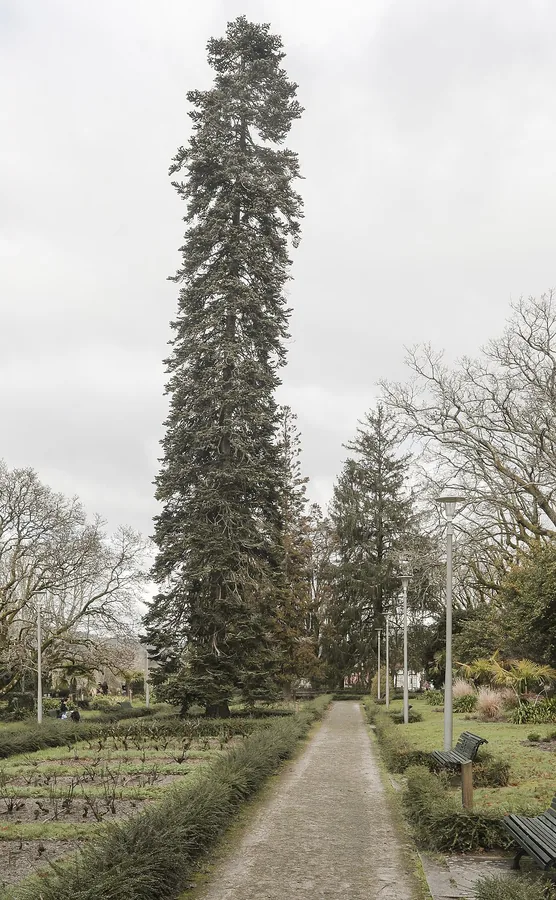
Supply rich, moist soil and shelter from drying winter wind, and Japanese cedar develops into a towering evergreen spire.
Full sun
Every 7–14 days
USDA 5–9
50–70 ft · 15.2–21.3 m
Overview
Japanese cedar serves as the national tree of Japan, where it is called sugi and planted in tall, formal rows across temple grounds. Its common name misleads on classification. The species sits within the cypress and redwood family rather than among the true cedars, and it is monotypic, standing alone in its own genus. In cultivation it presents as a soft, feathery evergreen conifer whose awl-shaped needles spiral around the shoots.
This is a tree of substantial scale. Grown unrestricted, it reaches 50 to 70 feet (15 to 21 m) with a broad pyramidal crown, and the reddish-brown bark exfoliates in long, shaggy strips that give the trunk its distinctive character. Cold hardiness extends to -20°F (-29°C), placing it across USDA zones 5 to 9.
Named cultivars are chosen far more often than the straight species, and for good reason. Certain selections hold as compact dwarf globes suited to a small bed, while full-size forms establish quickly into dense screens. Across that range the requirements are constant: steady soil moisture and shelter from the harshest wind, after which the tree is largely self-sufficient.
Care
The short version: site it in full sun to light shade, in rich, moist, acidic, well-drained soil kept from drying out, and shelter it from harsh, drying winter wind.
Light
Japanese cedar performs best in full sun, which sustains a dense, evenly developed canopy. It tolerates partial sun and light shade, but reduced light yields thinner, looser growth as the foliage stretches for illumination.
Water
Maintain consistently moist soil, most critically during establishment, and avoid drying out. Irrigation every 7 to 14 days suits most situations; an established specimen withstands a brief dry interval, but the species resents true drought and should not be pushed to it.
Soil
Grow it in rich, deep, moist, well-drained loam that is acidic, ideally a pH of 5.0 to 6.5. The soil must retain moisture while draining freely, since waterlogging excludes oxygen from the roots, so amend heavy or thin ground with organic matter.
Temperature
The species is hardy across -20°F to 100°F (-29°C to 38°C) and USDA zones 5 to 9. It tolerates both summer heat and severe winter cold; the greater hazard in winter is desiccating wind, which removes foliar moisture faster than frozen roots can restore it.
Humidity
Average outdoor humidity is sufficient, so no target value applies. Soil moisture is the governing factor, and it matters considerably more to the tree than ambient humidity.
Feeding
Apply a balanced or acid-forming slow-release fertilizer formulated for evergreens in spring. A single seasonal feeding meets the needs of a healthy tree; excess nitrogen only forces soft, weak growth that is more prone to damage.
Pruning
The species requires little pruning. Remove dead, damaged, or winter-burned shoots in spring, which is generally the extent of the work. It also responds well to shearing, which is why it functions effectively as a clipped screen or hedge.
Repotting
Most specimens are grown in the ground and never require repotting. A container-grown tree should be repotted rarely; treat roots circling the pot, water passing through too quickly, or stalled new growth as indicators that it is due.
Size & spacing
Allow for a mature tree of 50 to 70 feet (15 to 21 m) in height with a spread of 20 to 30 feet (6 to 9 m). Provide that clearance from structures and neighboring trees, or substitute a dwarf cultivar where the available space is limited.
When to plant
As an evergreen conifer, Japanese cedar has no sowing window or harvest date to work around. Plant in spring or early fall, when the soil is warm and moisture dependable, so the root system can extend through a full run of mild weather before it meets summer heat or hard cold.
Northern hemisphere
Southern hemisphere
Typical months for a temperate climate: start earlier in warm zones, later where spring frosts linger.
- Plant: Spring or early fall
- Harvest: Non-flowering; grown for evergreen foliage and form (cones mature in fall)
Hardiness
USDA hardiness zones: 5–9
Temperature: down to -29°C
Troubleshooting
Japanese cedar is an easy, low-maintenance tree, and the few disorders it develops are expressed in the foliage. Most are cosmetic and resolve with the season. Match the symptom against the entries below before deciding whether intervention is warranted.
Bronzed, scorched foliage during the cold months
In most cases the cause is winter bronzing, a pigment-driven seasonal color change that many cultivars express under cold and then reverse as they resume growth in spring. Damage concentrates on the windward side because drying wind draws transpirational moisture from the needles faster than roots in frozen soil can replace it. Reduce wind exposure at the site, enter winter with adequately moist soil to buffer that water loss, and prune out only the shoots that fail to recover their color.
Fix:
- Site plants where they are sheltered from harsh, drying winter winds
- Keep soil adequately moist going into winter
- Prune out shoots that fail to green up in spring
Needle spotting and blight with twig dieback
The usual agents are leaf spot and leaf blight fungi, among them Cercospora and Pestalotiopsis, which establish on lower, interior branches where stagnant, humid air favors infection. Because these fungi exploit weakened tissue, a tree under stress from a poor site or drought is the one that succumbs. Excise the infected twigs, open the canopy to move air across the foliage and dry it faster, and sustain vigor through siting, water, and nutrition, since the disorder is aesthetic rather than lethal.
Fix:
- Prune out and dispose of affected twigs and foliage
- Improve air circulation and avoid overhead wetting of foliage
- Maintain plant vigor with proper siting, water, and nutrition
Toxicity
For pet owners the assessment is reassuring: Japanese cedar is not toxic. It appears on no poison list, and animals can occupy the same space without risk. The one physical consideration is the foliage, because the needles are stiff and sharply pointed.
Safe for
People · Cats · Dogs · Horses · Rabbits · Livestock · Birds
Cats None
No toxin has been documented in this species, so cats face no chemical hazard from it. Ingested foliage acts only as mechanical roughage, which may provoke transient drooling or mild gastrointestinal upset.
Dogs None
The tree carries no compound harmful to dogs and appears on no poison list. A chewed sprig should produce at most a brief, self-limiting bout of mild digestive upset.
Horses Safe
Cryptomeria presents no toxic risk to horses. Its stiff, awl-shaped needles are unpalatable, so browsing is uncommon in any case.
Rabbits Safe
No harmful constituent has been recorded in this conifer, so rabbits are not at risk. The prickly foliage further deters feeding, making ingestion unlikely.
Livestock Safe
Cattle, goats, and sheep can graze in its vicinity without danger of poisoning. The sharp, resinous needles are unappealing forage, so consumption seldom occurs.
Birds Safe
Nothing in the foliage or cones is toxic to birds, which take no harm from the tree. The dense evergreen structure is often used as shelter and roosting cover.
People Safe
The species is safe to plant and handle, though the sharply pointed needles can prick unprotected skin. It bears no edible part and is cultivated for shade and screening rather than for food.
Foliage is harmless to handle, though needles are sharply pointed and awl-shaped.
Varieties
The straight species attains considerable size, so most gardeners select a cultivar scaled to the site. The forms below are the ones encountered most often in the trade.
Yoshino
A vigorous, fast-growing selection to roughly 30 to 40 feet whose blue-green foliage retains color through winter with markedly reduced bronzing.
Black Dragon
A dwarf carrying very dark green foliage on an upright, dense, slightly ragged pyramidal habit.
Globosa Nana
A slow, rounded dwarf shrub of about 2 to 4 feet whose bluish-green needles develop a rusty-red winter cast.
Sekkan-sugi
Selected for creamy-yellow new growth that brightens the branch tips through the flush.
Radicans
A fast, narrowly pyramidal form with rich blue-green foliage that suits it well to screening.
How to propagate
Japanese cedar can be raised from seed, stem cuttings, or layering, and the appropriate method depends on whether the goal is a true copy of a named cultivar or simply additional plants.
SeedModerate
Sow in fall or spring after cold stratification · Several months to germinate; years to reach landscape size
Seed sown in fall or spring after cold stratification will germinate, but the process is slow, with germination taking several months and the resulting trees needing years to reach landscape size. Because seedlings segregate and are variable, this route will not reproduce named cultivars true to type.
Stem cuttingsModerate
Semi-hardwood cuttings in late summer to fall · Several weeks to months to root
Cuttings are the reliable method for preserving the identity of a named cultivar, since they are clonal. Collect semi-hardwood cuttings from late summer into fall, treat the bases with rooting hormone, and maintain high humidity to limit water loss while roots form over the following weeks to months.
LayeringModerate
Spring · One or more seasons
Low branches in contact with the soil will root adventitiously, so a stem pegged down in spring will develop its own root system while still attached to the parent. Allow a season or more for that system to establish before severing the new plant.
Myths
Japanese cedar is a true cedar.
The vernacular name notwithstanding, this species has no phylogenetic relationship to the true cedars of the genus Cedrus. Cryptomeria occupies its own genus within Cupressaceae, the cypress and redwood family. The common name is a misnomer and carries no taxonomic information.