Tree · Cupressaceae
Green Giant Arborvitae
Thuja 'Green Giant'
Give it full sun and room to spread, and this tree throws up a living privacy wall fast.
Full sun
Every 7–14 days
USDA 5–8
40–60 ft · 12.2–18.3 m
Overview
Green Giant arborvitae is the standard choice where a tall, dense evergreen screen is wanted quickly. A hybrid in the cypress family derived from a cross of two Thuja species, it lays down several feet of extension growth per year once established. Set in a row, individual plants close ranks into a continuous canopy that intercepts wind, dampens noise, and screens sightlines.
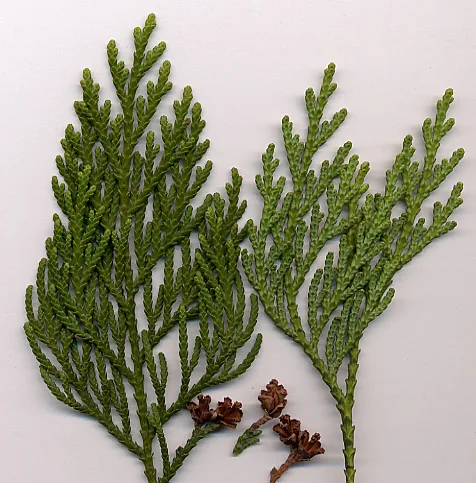
The name understates the scale. This is a forest-dimension tree, reaching 40 to 60 feet tall and 12 to 18 feet wide, held in a narrow pyramidal outline and clothed in soft, scale-like foliage that stays green through winter. The 'Green Giant' designation is literal. Allocate that mature footprint and the plant repays it with minimal upkeep.
Its popularity rests on genuine toughness. It resists most pests and disease, deer largely bypass it, and it establishes across a broad soil range. The single unforgiving condition is impeded drainage, where saturated soil sets up root rot that can claim the entire plant.
Care
The short version: site it in full sun on well-drained soil, allow room for its full 40 to 60 feet, and irrigate through the first couple of years while the root system establishes.
Light
Green Giant performs best in full sun, which sustains dense growth from base to apex. It accepts partial sun and light shade, but reduced light thins the canopy and loosens the foliage as available light falls.
Water
Maintain the soil moist through the first one to two years during establishment, irrigating on roughly a 7 to 14 day interval. Once established it withstands brief drought, though sustained moisture in well-drained soil supports its fastest rate of growth.
Soil
It is soil-tolerant, accepting clay, sand, and most intermediate textures provided the profile drains. A moist, fertile, well-drained loam is optimal, and it performs across a broad pH range of 5.5 to 8.0.
Temperature
This is a cold-hardy conifer, functional from roughly -20°F to 100°F (-29°C to 38°C), which corresponds to USDA zones 5 through 8. It retains color through severe winters, though desiccating wind can scorch exposed foliage.
Humidity
Ambient outdoor humidity is sufficient, so no target is warranted. Adequate airflow between plants carries more weight, because crowding retains moisture and predisposes the canopy to problems.
Feeding
In fertile soil it rarely requires fertilizer. Where growth is weak, incorporate a balanced slow-release tree fertilizer in spring, but withhold it from plants already growing vigorously.
Pruning
Green Giant needs little to no pruning and maintains its form unaided. Shear in late spring to early summer only where a hedge is intended, and remove or tie multiple leaders so accumulating snow cannot pull them apart.
Repotting
As a landscape tree rather than a container subject, repotting seldom applies. In a nursery pot, note roots circling or emerging from the drainage holes as the signal to plant it out.
Size & spacing
Plan on a mature specimen of 40 to 60 feet (12 to 18 m) tall and 12 to 18 feet (3.7 to 5.5 m) wide, and space any screen against that full spread. Underspacing yields crowded, oversized plants pressed against structures and utility lines.
When to plant
Grown for foliage rather than flowers, this evergreen has no bloom or harvest window to schedule. Establish new plants in spring or fall, while soil is workable and temperatures moderate, so the roots can consolidate before the stress of summer heat or winter cold.
Northern hemisphere
Southern hemisphere
Typical months for a temperate climate: start earlier in warm zones, later where spring frosts linger.
- Plant: spring or fall
- Harvest: non-flowering (grown for evergreen foliage)
Hardiness
USDA hardiness zones: 5–8
Temperature: down to -29°C
Troubleshooting
A well-sited Green Giant is largely trouble-free, and the disorders it does present read either in the foliage or in the aftermath of a severe winter. Distinguishing winter burn from a pest, and a drainage-driven decline from drought stress, lets you intervene before the problem widens. Match the symptom below, then act while intervention still changes the outcome.
Generalized yellowing and decline on a wet site
A whole-plant decline on heavy, saturated ground typically traces to root rot, with Phytophthora the common pathogen in soils that stay wet. The evidence sits below grade, where the roots read as dark, soft, and discolored rather than firm and pale. Because saturated soil starves roots of oxygen and no reliable cure exists once the rot advances, the response is cultural: correct the drainage, withhold excess water, and remove severely affected plants to check further spread.
Fix:
- Improve drainage and stop overwatering
- Avoid planting in low, waterlogged spots
- Remove severely affected plants to limit spread
Bleached, scorched foliage emerging after a hard winter
This pattern points to winter burn, a desiccation injury concentrated on the wind- and sun-facing side. The mechanism is simple: the evergreen foliage keeps transpiring through winter while the frozen root zone cannot resupply that water, so the tissue dries and bleaches rather than developing discrete spots. Correct it by watering deeply in fall ahead of freeze-up, mulching the root zone to prolong uptake, and delaying pruning until new spring growth defines the living tissue.
Fix:
- Water deeply in fall before the ground freezes
- Prune out clearly dead tissue once new spring growth shows what survived
- Apply mulch over the root zone to extend water uptake
Defoliating branches strung with small spindle-shaped bags
The pendant cases identify evergreen bagworm, whose larvae feed on the foliage and carry a protective bag constructed from the plant's own material. Confirm the diagnosis by the bags themselves, 0.25 to 2 inches long and hanging from the twigs. Because control turns on the life cycle, hand-pick the overwintering bags through fall and winter before egg hatch, and target young larvae with Bt in late spring should the population rebuild.
Fix:
- Hand-pick and destroy bags in fall, winter or early spring before eggs hatch
- Spray Bacillus thuringiensis (Bt) on young larvae in late spring/early summer, repeating every 7 to 14 days
Leaders splayed or fractured after snow and ice load
The narrow pyramidal habit intercepts snow and ice, and that accumulated load levers multiple leaders apart or fractures them outright. Reduce the load before it consolidates by brushing snow off ahead of freezing, and bind the upright stems together with soft material so the canopy retains its form. The durable fix is genetic and structural: select single-leader stock, which resists this splaying by lacking the competing verticals that snow pries open.
Fix:
- Gently brush snow off before it accumulates and freezes
- Tie multiple leaders together with soft material for support
- Prune cleanly broken branches
Stippled, bronzed foliage carrying fine webbing
Foliage that reads dull and bronzed under hot, dry conditions signals spider mites, whose feeding removes chlorophyll cell by cell and leaves the characteristic stippling. Diagnose them by tapping a branch over white paper and watching for minute mites moving across it, sometimes with fine webbing present. A forceful jet of water dislodges the colonies, horticultural oil clears a heavy infestation, and sustained irrigation through heat is the surest prevention, since drought-stressed plants favor mite outbreaks.
Fix:
- Spray foliage with a strong jet of water to dislodge mites
- Treat heavy infestations with horticultural oil or miticide
Toxicity
Green Giant arborvitae is best kept out of reach, though an incidental nibble is a matter of gastric upset rather than emergency. The foliage carries thujone, an oil capable of irritating the digestive tract and skin of pets, livestock, and people. The principal hazard is concentrated arborvitae essential oil, which should never be left accessible to animals.
Toxic to
Cats · Dogs · Horses · Rabbits · Livestock · Birds · People
Cats Mild
A cat that chews the foliage generally shows only drooling, gastrointestinal upset, or diarrhea, driven by the thujone oil the leaves carry. That casual ingestion sits well below the risk posed by the concentrated essential oil.
Dogs Mild
In dogs the foliage tends to produce drooling, vomiting, loose stools, and transient lethargy, which typically resolve without intervention. The concentrated arborvitae oil is the material to secure, since it delivers a far higher dose.
Horses Mild
Browsing horses may develop mild gastrointestinal upset from the foliage, and the record lists the plant among those to keep them off. Serious effects from an incidental taste remain uncommon.
Rabbits Mild
The thujone that affects cats and dogs will likewise upset a rabbit's digestion, so browsing on the foliage warrants prevention. Its ordinary forage is the appropriate diet.
Livestock Mild
Cattle, goats, and sheep usually reject the bitter foliage, but an underfed animal that strips a branch can take in enough oil to cause digestive upset. Excluding stock from young plantings is the sound precaution.
Birds Caution
Birds use the dense canopy for shelter without any recorded harm, and they do not seek the foliage as forage. The relevant precaution is excluding concentrated thuja oil, not the plant itself.
People Caution
No part of the plant is intended for consumption, and contact or ingestion can irritate the skin and digestive tract. Glove up if the sap irritates during shearing, and keep the concentrated essential oil out of children's reach.
Keep pets from chewing foliage and never apply or leave out concentrated thuja/arborvitae essential oil around animals; oral exposure is the highest-risk route.
Helpline numbers

United States
ASPCA Animal Poison Control: (888) 426-4435 (fee applies)
Poison Control: (800) 222-1222



Canada
Poison Centres: 1-844-764-7669
Varieties
Green Giant is the largest of the commonly grown arborvitae, and several relatives cover the situations in which it would be oversized. These are the selections worth distinguishing.
'Emerald Green' ('Smaragd')
A considerably smaller Thuja occidentalis that matures near 10 to 15 feet tall and 3 to 4 feet wide, suiting confined sites that Green Giant would overrun.
'Spring Grove'
A fast, large pyramidal arborvitae cultured on the same terms as Green Giant for rapid privacy screening.
'American Pillar' (Thuja occidentalis 'Pillar')
A markedly columnar selection built for tight vertical screens, appreciably narrower in profile than the broad-shouldered Green Giant.
How to propagate
One practical method applies, dictated by the plant's own biology, since it sets no seed of its own.
Stem cuttingsModerate
Late summer to fall (semi-hardwood cuttings) · Several weeks to a few months to root
Sterility rules out seed propagation, so vegetative cuttings are the sole route and every Green Giant is a clone. Collect semi-hardwood cuttings in late summer or fall and allow several weeks to a few months for rooting before they are grown on.
Myths
Green Giant arborvitae is a tidy little hedge plant.
The record describes a fast-growing forest tree, not a foundation shrub. It attains 40 to 60 feet in height and 12 to 18 feet in spread, so it demands genuine allocation of space. Sited as a small hedge, it will overtake the space entirely.
Arborvitae will spread and become invasive.
As a sterile hybrid, 'Green Giant' produces no viable seed and therefore has no pathway to naturalize beyond the planting. It remains precisely where it is set.