Tree · Cupressaceae
Emerald Green Arborvitae
Thuja occidentalis
Sited in full sun with steady moisture and protected from deer and snow load, it delivers a dense green screen for decades.
Full sun
Every 5–10 days
USDA 3–7
12–14 ft · 3.7–4.3 m
Overview
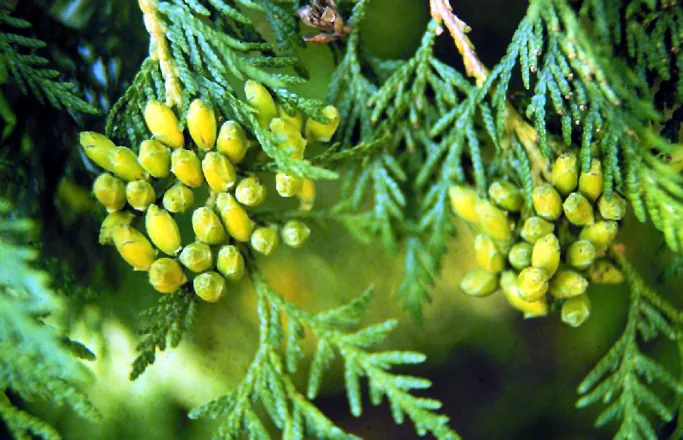
Emerald Green Arborvitae is the narrow columnar evergreen widely planted as a living privacy screen through the cold north. The cultivar is a 'Smaragd' selection of the eastern white cedar, Thuja occidentalis, prized because it holds a tight pyramidal habit of bright green foliage year-round. Mature dimensions settle near 12 to 14 feet (3.7 to 4.3 m) tall against a slim 3 to 4 feet (91 to 122 cm) spread, a ratio that suits property-line plantings.
Because its growth rate is slow, the plant builds structure gradually and demands little once established. Its cold hardiness reaches -40°F (-40°C), and it adapts to a broad range of soils, clay included, provided drainage is adequate. Two conditions undermine it: drought, which it cannot buffer, and a saturated root zone, which excludes the oxygen roots require.
The real management challenges are seasonal and biological. Deer browse it preferentially, accumulated snow load can splay a multi-stem specimen, and a dry, windy exposure desiccates the foliage to brown. Address siting and winter preparation correctly, and what remains is easy hedging for years.
Care
The short version: full sun to light shade, soil held evenly moist but never saturated, and a deep autumn irrigation before the ground freezes. Buffer it from deer and desiccating winter wind, and tie up multi-stem plants ahead of snow load.
Light
Provide full sun for the densest, healthiest growth, since maximum light drives the photosynthesis that fills out the canopy, though it tolerates partial shade. Under insufficient light the foliage thins and gaps open, defeating the purpose of a screen.
Water
Hold the soil consistently moist and well drained, irrigating deeply every 5 to 10 days in dry spells, because the species cannot tolerate drought or dry, windy exposure. A thorough autumn soak before the ground freezes is critical, since frozen roots cannot resupply water lost from foliage, the very mechanism behind winter desiccation.
Soil
It performs in moist, fertile, well-drained loam and tolerates clay where water does not stagnate, since standing water starves roots of oxygen. The acceptable pH spans 6.0 to 8.0, covering ground from slightly acidic to alkaline, which removes most soil-chemistry barriers to establishment.
Temperature
Its thermal tolerance runs from -40°F to 100°F (-40°C to 38°C), an exceptional cold-hardiness that explains its use as a hedge across the far north. That range, not heat tolerance, is the defining trait for siting decisions.
Humidity
Average outdoor humidity is sufficient, so there is no target figure to manage. Airflow and steady soil moisture influence plant health far more than ambient humidity, since adequate root-zone water offsets atmospheric drying.
Feeding
A single spring application of a balanced, slow-release evergreen fertilizer meets its needs. Because the growth rate is slow, demand for nutrients is correspondingly low, and one seasonal feeding suffices.
Pruning
Confine pruning to a light shearing in late spring or early summer to shape a hedge. Avoid cutting into bare old wood, which lacks the latent buds to regenerate, and tie up or wrap multi-stem plants before winter, since several leaders are mechanically vulnerable to snow and ice.
Repotting
As a permanent landscape plant, it is rarely repotted. In containers, roots circling the root-ball edge, stunted new growth, or water draining straight through all indicate the root system has outrun the available volume.
Size & spacing
Plan for a mature 12 to 14 feet (3.7 to 4.3 m) height and a narrow 3 to 4 feet (91 to 122 cm) spread. For an unbroken screen, space plants so the slim crowns merge as they mature, since the narrow habit will not fill wide gaps on its own.
When to plant
This evergreen has no sowing window and no harvest, so timing turns entirely on transplant survival. Set new plants out in spring or early fall, when warm soil lets roots establish before stress arrives, and avoid midsummer heat or hard winter, both of which work against root recovery.
Northern hemisphere
Southern hemisphere
Typical months for a temperate climate: start earlier in warm zones, later where spring frosts linger.
- Plant: spring or early fall
- Harvest: Non-flowering; grown for evergreen foliage
Hardiness
USDA hardiness zones: 3–7
Temperature: down to -40°C
Troubleshooting
Most arborvitae disorders trace to winter conditions or to a few recurring pests, and each leaves a distinct signature. Browning foliage, stripped branches, and splayed stems arise from different mechanisms, so diagnose before treating. Match the symptom below and intervene early, while the cause is still reversible.
Winter browse line where lower foliage once grew
Stripping concentrated on the lower canopy in winter indicates deer browsing, to which Thuja occidentalis is highly susceptible. The diagnostic is a ragged browse line up to about deer height, with tracks and droppings nearby, while rabbits account for damage at the lowest foliage. Exclude deer with fencing or netting on young plants before snowfall, because browsing intensifies once alternative forage is buried.
Fix:
- Install fencing or netting around plants
- Apply deer repellents and reapply after rain
- Wrap plants with burlap over winter
Spindle-shaped brown cases on eaten, bare branches
Spindle-shaped sacks on defoliated branches are bagworms, the most significant defoliator of arborvitae. Each case measures 1 to 2 inches, incorporates foliage as camouflage, and moves as the larva feeds in early summer. Handpick the bags through fall and winter to eliminate overwintering eggs, and apply Bt to young larvae in late spring, since an unchecked population can defoliate and kill the plant.
Fix:
- Handpick and destroy bags in fall and winter to remove overwintering eggs
- Apply Bacillus thuringiensis (Bt) to young larvae in late spring or early summer
- Use labeled insecticide for larger infestations
Progressive browning and decline in poorly drained soil
Browning and decline in persistently wet soil signal root rot, the consequence of waterlogging that deprives roots of oxygen. Excavate at the root ball to find dark, soft, mushy roots in place of firm white ones. Correct the drainage, reduce irrigation, and relocate severely affected plants to free-draining ground, since the reliable prevention is avoiding low spots where water collects.
Fix:
- Improve drainage around the root zone
- Avoid overwatering
- Replace severely affected plants in well-drained sites
Late-winter bronzing and scorch on the plant's windy side
Bronzing and desiccation on the exposed face reflect winter burn, where foliage transpires water faster than frozen roots can replace it on dry, windy sites. The damage appears late winter to early spring, and although 'Smaragd' retains winter color better than the species, severe exposure still scorches it. Irrigate deeply in fall before freeze-up, screen exposed sites with burlap, and prune dead tissue once growth resumes, recognizing that ordinary winter bronzing is reversible and recovers unaided.
Fix:
- Water deeply in fall before ground freezes
- Wrap or screen with burlap on exposed sites
- Prune out dead brown areas in spring once new growth resumes
Multiple leaders spread or cracked after ice and snow
Leaders bent outward or cracked after a storm point to mechanical failure under snow and ice load, a risk concentrated in multi-stem specimens whose several trunks lack mutual support. Clear snow gently after storms, bind the stems with soft material, and wrap multi-stem plants before winter. Where snowfall is heavy, a single-leader plant is structurally superior and holds its form far better.
Fix:
- Gently brush snow off branches after storms
- Tie stems together with soft material
- Stake or cable weakened leaders
Yellow stippling with faint webs through hot, dry spells
Stippling, yellowing, and fine webbing during hot, dry weather indicate spider mites, which thrive under heat and plant stress. Confirm by tapping a branch over white paper and watching for moving specks. Dislodge them with a strong water jet, follow with horticultural oil or a miticide if populations persist, and maintain soil moisture, since drought stress predisposes the plant to infestation.
Fix:
- Spray foliage with strong water jet to dislodge mites
- Apply horticultural oil or miticide
- Maintain adequate soil moisture to reduce stress
Toxicity
Emerald Green carries low risk in a home with animals. The foliage contains thujone, a compound regulated for concern, which can cause mild gastrointestinal irritation when a pet ingests an appreciable amount, though the bitter foliage deters most animals. The greater hazard is concentrated thuja essential oil, where the compound is far more dangerous than in the plant tissue.
Toxic to
Cats · Dogs · Horses · Rabbits · Livestock · People
Safe for
Birds
Cats Mild
A single nibble typically passes uneventfully, but a cat that consumes more may drool, vomit, or refuse food. Cats are the most sensitive of the household animals here, and concentrated thuja essential oil is far more dangerous than the foliage, so oil products belong well out of reach.
Dogs Mild
A dog that chews the foliage may drool or develop a transient upset stomach, though small tastes seldom progress beyond that. The essential oil, not the occasional mouthful of clippings, is the genuine hazard.
Horses Mild
Thujone in grazed foliage can irritate the equine gut, producing mild colic or reduced appetite. Most horses reject the bitter foliage, so cases arise mainly when other forage is unavailable.
Rabbits Mild
Arborvitae should not be offered to rabbits, since the aromatic oils can disturb a small digestive system. An incidental nibble rarely harms, but it has no legitimate place in their diet.
Livestock Mild
Cattle, goats, and sheep generally bypass the bitter foliage without consequence. Consumed in quantity, however, the thujone can mildly disrupt the gut, so prunings should be kept out of pasture.
People Caution
No part of this tree is intended for consumption, and foliar thujone can irritate the gastrointestinal tract and skin. Keep children from chewing the leaves, and wear gloves if shearing exposes the skin to irritating sap.
Birds Safe
Backyard and wild birds shelter and nest in the dense foliage without harm, and the plant presents no meaningful risk to them.
Keep clippings and any thuja essential oil products away from pets; the concentrated oil is the main concern.
Helpline numbers

United States
ASPCA Animal Poison Control: (888) 426-4435 (fee applies)
Poison Control: (800) 222-1222



Canada
Poison Centres: 1-844-764-7669
Varieties
Thuja occidentalis offers a wide range of habits, from tall screening cultivars to compact globes. The selections below are the ones most worth weighing when matching a plant to a site.
'Green Giant'
A substantially larger, faster hybrid reaching 40 to 60 feet at 3 to 4 feet per year that resists the deer and disease pressures affecting the deer-favored 'Emerald Green'.
'Techny' (Mission)
A broad, dense pyramidal selection in deep green that retains winter color and withstands severe cold.
'North Pole'
A markedly narrow, columnar selection developed for tight vertical screening where lateral space is limited.
'Holmstrup'
A slow, compact, narrowly pyramidal cultivar that maintains rich green coloration through winter.
'Hetz's Midget'
A dwarf globe of roughly 3 to 4 feet in height and width, rounded rather than conical in form.
'Danica'
A compact dwarf globe used as a small, rounded foundation accent.
How to propagate
Named cultivars are clonal, so they are propagated vegetatively from cuttings rather than seed to preserve the parent's traits. Layering serves as a slower alternative when only one or two plants are needed.
Stem cuttingsModerate
Late summer to fall (semi-hardwood) or late winter (hardwood) · 6 to 12 weeks to root
Cuttings reproduce a named cultivar true to type, which seed cannot. Collect semi-hardwood cuttings in late summer or fall, or hardwood cuttings in late winter, treat the bases with rooting hormone to improve strike rates, and expect rooting within 6 to 12 weeks.
LayeringModerate
Spring · One growing season
Layering pins a low branch to the soil in spring, allowing it to root in situ over a single growing season. The method is reliable but slow, so cuttings remain the standard for propagating cultivars at scale.
Myths
Arborvitae of every kind, this cultivar among them, are safe from deer browsing.
The record contradicts this directly. Emerald Green is among the species deer browse most frequently and most severely, with pressure peaking in winter once other forage is gone. Only the hybrid 'Green Giant' qualifies as genuinely deer-resistant, so it is the appropriate choice wherever deer pressure is high.