Tree · Cupressaceae
Italian Cypress
Cupressus sempervirens
Sited once in full sun and dry, well-drained soil, this slim green column keeps its architectural form for decades.
Full sun
Every 7–14 days
USDA 7–10
39–69 ft · 12–21 m
Overview
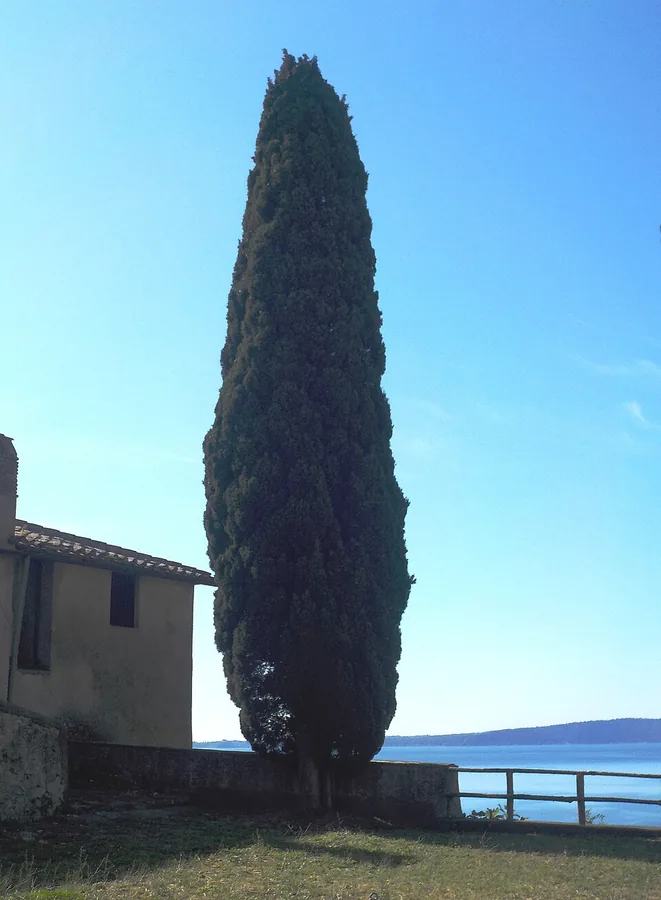
Italian cypress is the tall, columnar conifer that reads as a green exclamation point in the Mediterranean landscape, the dark spire that lines the driveways and frames the villas of Tuscany. Rather than spreading laterally, it extends a strongly upright leader, and that vertical geometry is precisely why designers specify it. A mature specimen reaches 40 feet and beyond while holding to a width of only a few feet.
Its low demands follow directly from its origins. Once the root system is established, the tree withstands drought, poor rocky substrates, and alkaline soils, and it endures cold to 0°F (-18°C). The one condition it cannot tolerate is a saturated root zone, since standing water excludes oxygen and invites the root rot that undermines everything else.
Growth is measured and the tree is long-lived, so establishment rewards patience. Provide full sun, sharp drainage, and vertical room, and it retains its sword-like outline for generations with no shearing required.
Care
The short version: full sun, lean and sharply drained soil, and deep watering through establishment, after which the tree needs almost nothing. Forgo pruning, and keep the root zone clear of standing water.
Light
Site Italian cypress in full sun for the whole day where possible. It has no meaningful shade tolerance, and a light-deprived tree grows thin and leaning, sacrificing the dense column that justifies planting it.
Water
Water young trees on a regular schedule to establish them, allowing the top half of the soil to dry between applications. Once established, the tree is very drought tolerant and requires little. Its one intolerance is wet, poorly drained soil, which precipitates root rot.
Soil
It performs best in well-drained sandy loam yet accommodates poor, rocky, sandy, and alkaline ground. A pH across the 6.0 to 7.8 range suits it, and in practice drainage governs success far more than soil fertility does.
Temperature
The species is hardy across a broad thermal range, enduring roughly 0°F to 104°F (-18°C to 40°C). It withstands Mediterranean heat and genuine winter cold alike, which places it soundly within hardiness zones 7 to 10.
Humidity
Italian cypress favors low humidity consistent with its native Mediterranean air. Damp, muggy climates work against it, because moisture retained on the foliage elevates the risk of foliar disease.
Feeding
Fertilization is seldom warranted. Only where growth is visibly poor should a balanced slow-release fertilizer be applied in spring, and then sparingly. A well-sited tree draws adequate nutrition from lean soil.
Pruning
The correct management is non-intervention. The tree sustains its natural columnar habit unaided, so do not shear it for shape. Remove only dead or diseased branches, cutting well below any canker with disinfected tools.
Repotting
As a landscape tree, Italian cypress is rarely repotted. Establish it in its permanent position and leave it undisturbed, since this slow grower responds poorly to root disturbance once anchored.
Size & spacing
A mature tree attains roughly 40 to 70 feet (12 to 21 m) in height on a narrow frame, with a spread of 3 to 20 feet (91 cm to 6 m) depending on the selection. Plan for the ultimate height and allow the crown adequate room and air movement.
When to plant
Transplant Italian cypress when the roots are physiologically active. Spring and fall both work, with April and September the optimal windows, and deep watering through that establishment period lets the tree anchor before summer drought or winter cold sets in.
Northern hemisphere
Southern hemisphere
Typical months for a temperate climate: start earlier in warm zones, later where spring frosts linger.
- Plant: Spring or fall (April and September are best for transplanting when roots are actively growing)
- Harvest: Non-flowering; produces round woody cones to 1.5 in across
Hardiness
USDA hardiness zones: 7–10
Temperature: down to -18°C
Troubleshooting
A vigorous Italian cypress seldom develops problems, because stress is the common precondition for the disorders it does encounter. Inspect for browning branches, thinning foliage, or structures hanging from the twigs, and intervene early. Most of what follows resolves to excess water at the roots or a deficit reaching the canopy.
Flagging brown branches with resin-oozing stem cankers
Scattered dead branches flagging against green foliage point to cypress canker, most often Seiridium, a pathogen that gains ground on trees already weakened by drought stress. The sunken, resin-oozing cankers girdle the stem and cut off the branch beyond them, which is why the dieback appears branch by branch. No fungicide controls it, so the only route is sanitation: cut well below each canker into clean wood, disinfect tools between cuts to avoid spreading spores, and restore vigor with deep irrigation.
Fix:
- Prune out diseased branches 3-4 in below the canker into healthy wood
- Disinfect pruning tools between cuts with a 10 percent bleach solution
- Destroy or discard all pruned material
- Reduce drought stress with regular deep irrigation to help trees recover
Decline and yellowing where the soil stays wet
Stunted growth with sparse, yellowing or purpling foliage on a tree in wet ground signals Phytophthora root rot, a water mold that thrives in saturated, compacted soil where oxygen runs short. As it decays the roots and cankers the crown, the canopy is starved of water and nutrients and thins from the top. Correct the drainage and halt the overwatering that feeds the pathogen, remove trees past saving, and avoid replanting cypress into soil that still harbors the organism.
Fix:
- Improve drainage and stop overwatering
- Remove and destroy severely affected plants
- Do not replant cypress in contaminated soil
Stippled, bronzing foliage from mite feeding
Fine stippling that dulls and bronzes the foliage is classic spider mite injury, the result of countless mites draining cells one at a time, and their populations build in cool, dusty, drought-stressed conditions. Confirm by tapping a branch over white paper and looking for tiny moving mites and fine webbing. A forceful jet of water dislodges them, and restraint with broad-spectrum insecticides preserves the lady beetles and predatory mites that hold their numbers down.
Fix:
- Spray foliage with a strong jet of water to dislodge mites
- Preserve natural predators such as lady beetles and predatory mites by minimizing insecticide use
Foliage-covered bags on twigs from feeding larvae
The 1 to 2 inch spindle-shaped bags hanging from the twigs are the casings of bagworms, each sheathed in fragments of the tree's own foliage, and the larva within thins the branches as it feeds. Because the bags overwinter with the next generation's eggs inside, handpicking and destroying them through winter and early spring breaks the cycle before hatch. Where handpicking falls short, an application of Bt in May targets the young larvae while they remain susceptible.
Fix:
- Handpick and destroy bags in winter and early spring
- Apply Bacillus thuringiensis (Bt) in May when larvae are small
Toxicity
For households with animals, the verdict is reassuring: Italian cypress is not toxic. The species is absent from ASPCA's lists of plants that poison cats or dogs, and it poses no hazard to horses, livestock, or people. Ingestion of the aromatic foliage may cause a brief, mild gastrointestinal upset, but the tree contains nothing genuinely dangerous.
Safe for
People · Cats · Dogs · Horses · Rabbits · Livestock · Birds
Cats None
The species is safe for cats and does not appear on ASPCA toxic plant lists. Should a cat ingest the aromatic foliage, the likely response is limited to drooling or mild gastrointestinal upset driven by the bulk of plant matter rather than any toxin.
Dogs None
Dogs share space with the tree without worry, as the record carries no evidence of toxicity. The most a persistent chewer risks is a short episode of mild digestive upset, which resolves on its own.
Horses Safe
The tree is not toxic to horses, and the resinous, strongly aromatic foliage generally deters grazing before intake becomes an issue. An incidental taste produces no harm.
Rabbits Safe
Rabbits face no danger from Italian cypress. The volatile oils that make the foliage aromatic act as a natural deterrent, so browsing rarely reaches a meaningful quantity.
Livestock Safe
Cattle, goats, and sheep may graze nearby safely. The pungent foliar oils render it unpalatable, and the plant contains no compound documented to poison farm animals.
Birds Safe
Birds nest and perch in the canopy at no risk. Neither the small woody cones nor the scale-like foliage presents any toxic hazard to them.
People Safe
Italian cypress is not poisonous to people. It is not cultivated as a food plant, so nothing on it is intended for consumption, but handling the foliage and brushing against it carry no risk.
Foliage is aromatic when crushed; minor gastrointestinal upset is possible if large amounts are chewed.
Varieties
The Italian cypress in cultivation is largely a set of named selections chosen for form, stature, or foliage color. The following are the ones worth distinguishing.
Glauca (Blue Italian)
A narrow columnar selection whose blue-green, scale-like foliage tops out at 40 to 60 feet tall on a form held to 5 to 10 feet wide.
Stricta
The classic pencil-form Italian cypress, notable for a very narrow, tightly upright habit that maintains its own vertical line.
Swane's Golden
A slim columnar cultivar distinguished by golden-yellow foliage in place of the typical deep green.
Tiny Tower (Monshel)
A compact, slow-growing dwarf that carries the columnar habit at a scale suited to small gardens and confined spaces.
How to propagate
Italian cypress can be raised from seed or from cuttings, and the two methods yield different outcomes. Seed introduces variation in form, whereas cuttings reproduce the parent faithfully.
SeedModerate
Sow in spring; seed of columnar forms may not come true to shape · 1-2 years
Sow seed in spring and allow a year or two for a seedling to establish. Because columnar forms do not come true from seed, the resulting trees vary in habit rather than reproducing the narrow pencil outline. For that reason the named cultivars are propagated vegetatively from cuttings.
Stem cuttingsModerate
Take semi-hardwood cuttings in summer to early fall · 1-2 years
Vegetative propagation preserves a named cultivar's tight columnar habit, since the clone reproduces the parent exactly. Take semi-hardwood cuttings from summer into early fall, then allow a year or two for the young plant to establish before vertical growth accelerates.
Myths
Italian cypress is poisonous to cats and dogs.
ASPCA does not list the species as toxic, and it is regarded as safe around companion animals. A cat or dog that consumes a large quantity of foliage may show mild gastrointestinal upset, but the tree itself is not poisonous.
Italian cypress requires regular shearing to keep its shape.
The species maintains its tight, narrow column genetically, so routine shearing serves no purpose. Confine cuts to dead or diseased wood, because each fresh pruning wound is an entry point for canker pathogens.