Tree · Cupressaceae
Juniper
Juniperus chinensis
Site it in full sun with sharp drainage and juniper demands little else across a long, hardy life.
Full sun
Every 7–14 days
USDA 3–9
1–59 ft · 0.3–18 m
Overview
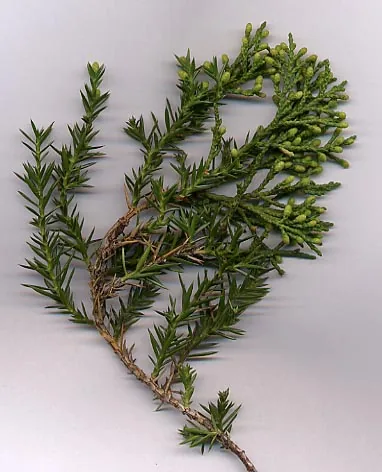
Juniper ranks among the most stress-tolerant evergreens available to the grower. A member of the cypress family distributed across the northern hemisphere, it withstands cold, heat, drought, salt, and impoverished ground that would kill less-adapted shrubs, largely because its scale-like or needle-like foliage limits water loss and its roots tolerate lean conditions. Habit ranges from prostrate groundcovers a foot high to upright trees reaching up to 59 feet (18 m).
The plant's low maintenance follows directly from that adaptation: once established in sun and free-draining soil, it holds foliage color through winter, stabilizes slopes, screens boundaries, or stands as a specimen with minimal intervention. On female plants the berry-like blue cones require about two years to mature, a slow ripening that sustains bird foraging well into the cold months.
One physiological constraint governs long-term management. Juniper grows slowly and will not resprout from bare old wood, because it lacks the latent buds on defoliated stems that would drive regrowth, so the framework established early is effectively permanent. Prune lightly and repeatedly rather than deferring to a single severe reduction.
Care
The short version: full sun and fast-draining soil are the governing requirements. Irrigate through the first year to establish the root system, then withhold water except in drought, feed only rarely, and confine pruning to green growth.
Light
Juniper is a full sun plant, performing best with 6 or more hours of direct light and tolerating a little partial sun. In genuine shade the canopy thins, foliage color degrades, and the reduced vigor invites disease.
Water
Irrigate a new juniper regularly through its first year to establish the root system. Once established it is markedly drought tolerant and needs supplemental water only in a prolonged dry spell, because its one intolerance is soggy soil, which starves and rots the roots.
Soil
Drainage governs success here far more than fertility. Juniper performs in sandy, rocky, and even clay soils provided water moves through freely, and it accepts a broad pH of 5.0 to 8.0.
Temperature
Cold hardiness is exceptional for a woody ornamental. Juniper endures roughly -29°F to 100°F (-34°C to 38°C), retaining foliage through severe winters and tolerating summer heat without dieback.
Humidity
Ambient outdoor humidity is a non-issue for juniper. Air movement is the operative factor, since stagnant, humid air within a dense canopy prolongs leaf wetness and favors the tip blights.
Feeding
Juniper seldom requires supplemental nutrition. Where growth is genuinely poor, a single light application of balanced or slow-release fertilizer in spring suffices, and excess feeding is counterproductive.
Pruning
Shape lightly in late spring and cut only into green growth, because defoliated old wood carries no latent buds and a cut into it leaves a permanent void. Remove dead, diseased, or blight-killed tips during dry weather to limit inoculum.
Repotting
Container and bonsai specimens warrant fresh substrate every 2 to 3 years. Repot when roots circle the container, water channels straight through, or growth slows and foliage yellows.
Size & spacing
Mature dimensions span an unusually wide range, spanning 1 to 59 feet (0.3 to 18 m) in height, with spreads of 2 to 20 feet (60 cm to 6 m). Select the cultivar to the site and space plants so air circulates through the canopy.
When to plant
Juniper is established from nursery stock rather than sown, and spring and fall offer the workable soil and mild temperatures that favor root establishment. Plant in either window so the roots extend before summer heat or winter cold imposes stress, and irrigate through that first season while the plant anchors.
Northern hemisphere
Southern hemisphere
Typical months for a temperate climate: start earlier in warm zones, later where spring frosts linger.
- Plant: spring or fall
- Harvest: inconspicuous; blue berry-like female cones mature over about two years
Hardiness
USDA hardiness zones: 3–9
Temperature: down to -40°C
Troubleshooting
A correctly sited juniper remains largely trouble-free for years, so most disorders trace to excess soil moisture or the stagnant, humid conditions of crowded growth. Examine the new tips, the interior foliage, and the branch structure, and match the signs below before applying any control.
Whole plant thinning in a slow, general decline
Generalized thinning from the top down signals Phytophthora root rot, a water mold that thrives in poorly drained or overwatered soil and destroys the roots that supply the canopy. Once the root system is dark and rotted the decline is essentially irreversible, which is why the response is cultural rather than curative. Correct the drainage, stop overwatering to deny the pathogen the saturated conditions it needs, and remove specimens too far gone to recover.
Fix:
- Improve drainage and stop overwatering
- Plant in raised beds and amend heavy clay with porous material such as ground pine bark
- Remove severely affected plants, as root rot is difficult to reverse
New shoot tips discoloring and dying back
Two fungal tip blights produce this progression. Phomopsis tip blight colonizes succulent new growth during warm, wet periods, whereas Kabatina tip blight enters year-old twigs in spring through existing wounds, which is why sanitation and dry-weather cutting matter. Prune well below the dead tissue in dry conditions, disinfect between cuts to avoid spreading spores, and thin the canopy so foliage dries faster and denies the fungi the standing moisture they need.
Fix:
- Prune out and destroy blighted tips well below the dead tissue during dry weather, disinfecting tools between cuts
- Improve air circulation by spacing and selective thinning
- Avoid overhead watering and wetting foliage
- Apply a labeled fungicide (mancozeb, thiophanate-methyl, or copper) protectively on new growth where blight is recurring
Stippled, yellowing needles with fine webbing
Two sap-feeding arthropods create this stippling. Spruce spider mites feed most heavily in the cool weather of spring and fall, puncturing needle cells and leaving fine webbing, while juniper scale settles as fixed bumps that drain sap and yellow the foliage. Dislodge and detect mites by tapping a branch over white paper, then reduce them with a forceful water jet or insecticidal soap, and target scale with a dormant horticultural oil in late winter when the sessile stages are exposed.
Fix:
- Dislodge mites with a strong spray of water
- Apply insecticidal soap or a labeled miticide for heavy mite infestations and preserve natural predators
- Apply 2-3 percent horticultural oil as a dormant spray in late winter for scale, or treat crawlers with a labeled insecticide
Spindle-shaped larval bags and progressive defoliation
The hanging cases are bagworms, whose larvae feed while enclosed in a portable case constructed from bits of the host foliage, which conceals them from many predators. Heavy populations can defoliate branches or kill a whole plant, so timing the response to the life cycle is what matters. Handpick the bags through fall and winter to remove the overwintering eggs at their source, then apply Bt in spring while the larvae are small and still feeding actively enough to ingest it.
Fix:
- Handpick and destroy bags in fall and winter to remove overwintering eggs
- Apply Bacillus thuringiensis (Bt) in spring while larvae are young and small
- Use a labeled insecticide for heavy infestations of older larvae
Woody twig galls extruding orange horns in spring
These galls are the juniper phase of cedar-apple rust and related Gymnosporangium fungi, which require two hosts and alternate between junipers and Rosaceae such as crabapple and hawthorn. Because the gall does little structural harm to the juniper, control targets the alternate hosts rather than the juniper itself. Excise the woody galls before they hydrate and release spores from their orange horns, and separate junipers from apples and crabapples to break the disease cycle.
Fix:
- Prune out and remove woody galls before they produce orange horns in spring
- Plant rust-resistant juniper cultivars
- Do not plant junipers within a few hundred yards of apples, crabapples, or hawthorns
- Apply a labeled fungicide (mancozeb or propiconazole) where control is needed, though galls do little harm to the juniper itself
Toxicity
Juniper presents a low toxicity profile for animals and people alike. It carries none of the compounds on the standard poison lists, and its sharp, bitter, terpene-rich foliage generally deters browsing before ingestion becomes an issue. The relevant caveats are that the berry-like cones can cause mild gastric upset in quantity, and that only a few species constitute the true culinary juniper used to flavor gin.
Safe for
People · Cats · Dogs · Horses · Rabbits · Livestock · Birds
Cats Caution
No toxin in juniper affects cats, and the sharp, aromatic foliage generally deters browsing before it starts. A cat that ingests a quantity of the berry-like cones may show a brief, self-limiting gastric upset driven by the volatile oils, which resolves without treatment.
Dogs Caution
Dogs face no listed toxins in juniper, so investigation of the plant carries no real hazard. Ingestion of a mouthful of cones or resinous foliage tends to produce nothing beyond transient drooling or a loose stool for roughly a day.
Horses Caution
The concentrated terpenes render juniper unpalatable, so horses typically decline it. Grazing a large volume of the berries can provoke mild gastrointestinal irritation, yet the species is not classed as a poisoning risk.
Rabbits Caution
Rabbits seldom browse the resinous needles, and juniper contains no toxin that threatens them. Limit any feeding to small amounts, since the volatile oils can loosen the gut when consumed in quantity.
Livestock Safe
Cattle, goats, and sheep generally avoid juniper because of its bitter, aromatic foliage, and it does not appear on the standard lists of plants that poison them.
Birds Safe
Birds consume the ripe blue cones readily and disperse the seed, so the fruit presents no hazard to them whatsoever.
People Edible with care
The cones of select species, principally Juniperus communis, supply the culinary spice that flavors gin, but ornamental landscape junipers are not uniformly edible and some cones can irritate the digestive tract. Confine culinary use to verified species, and handle the prickly, oil-laden foliage with gloves.
The aromatic foliage and berry-like cones may cause mild, self-limiting stomach upset if eaten in quantity, and the prickly juvenile needles plus juniper oils can mildly irritate skin, so wear gloves when pruning. This is irritation, not poisoning.
Varieties
Few evergreens match juniper's range of form, from prostrate mats to pencil-thin columns, which is what makes the genus so versatile in the landscape. The selections below are the ones most often encountered in the nursery trade.
'Hetzii'
A vigorous, wide-spreading blue-green shrub suited to the scale of large foundation plantings and screens.
'Sea Green'
A compact, fountain-shaped selection whose arching branches and mint-green foliage lend themselves to a low, informal hedge.
'Spartan'
A narrow, dense, dark green column reaching roughly 15 to 20 feet tall at only about 5 feet wide, the standard upright screening form.
'Hollywood' / 'Kaizuka'
An irregular, twisted upright clothed in rich green foliage, grown for its sculptural, contorted habit.
Juniperus scopulorum 'Skyrocket'
A pencil-thin blue-gray column narrow enough to serve as a vertical accent where lateral space is minimal.
Juniperus squamata 'Blue Star'
A dwarf mounding selection of 1 to 3 feet carrying dense, silvery blue-gray needles.
How to propagate
The propagation method follows from the goal, since named cultivars will not reproduce true from seed and must be increased vegetatively.
Stem cuttingsModerate
Late fall through winter from semi-hardwood to hardwood growth · Several weeks to a few months to root
Cuttings are the standard route for cultivars because vegetative propagation preserves the clone true to the parent. Collect semi-hardwood to hardwood material from late fall through winter, treat the base with rooting hormone, and insert it into a well-drained medium, where roots form over several weeks to a few months.
GraftingDemanding
Winter under glass · Weeks to months
Grafting serves the upright tree forms and choice cultivars that resist rooting from cuttings, joining scion to a compatible rootstock. Worked in winter under glass, the union takes weeks to months to knit, which is why the technique remains the province of experienced growers.
LayeringEasy
Spring · Several months to a year
Layering exploits the natural rooting of low, spreading habits along contact with soil. Pin a trailing branch to the ground in spring and it will root in place over several months to a year, a low-risk method well matched to groundcover and shrub forms.
SeedDemanding
After cleaning and cold stratification · Slow and erratic, often more than a year to germinate
Seed propagates species rather than cultivars, since seedlings do not reproduce a named clone true to type. Clean the cones and cold-stratify the seed to satisfy its dormancy requirement, then expect slow, erratic germination that often exceeds a year.
Myths
Berries from any landscape juniper can be harvested and eaten like the ones that flavor gin.
Only a small number of species, principally Juniperus communis, are cultivated as a culinary spice. Many ornamental junipers bear berry-like cones that are unpalatable and can cause mild gastric upset, so the berries on a landscape juniper should not be assumed edible.
An overgrown juniper can be rejuvenated by cutting it back hard into the old bare wood.
Juniper foliage does not regenerate from old leafless wood, so a hard cut into bare branches produces a permanent dead gap that will not refill. Confine all cuts to green, foliage-bearing growth and reduce the plant incrementally over time.