Tree · Cupressaceae
Bald Cypress
Taxodium distichum
A bottomland conifer that withstands flood, drought, and alkaline-free urban soil and colors rust-orange before leaf drop.
Full sun
Every 7–14 days
USDA 4–11
50–70 ft · 15.2–21.3 m
Overview
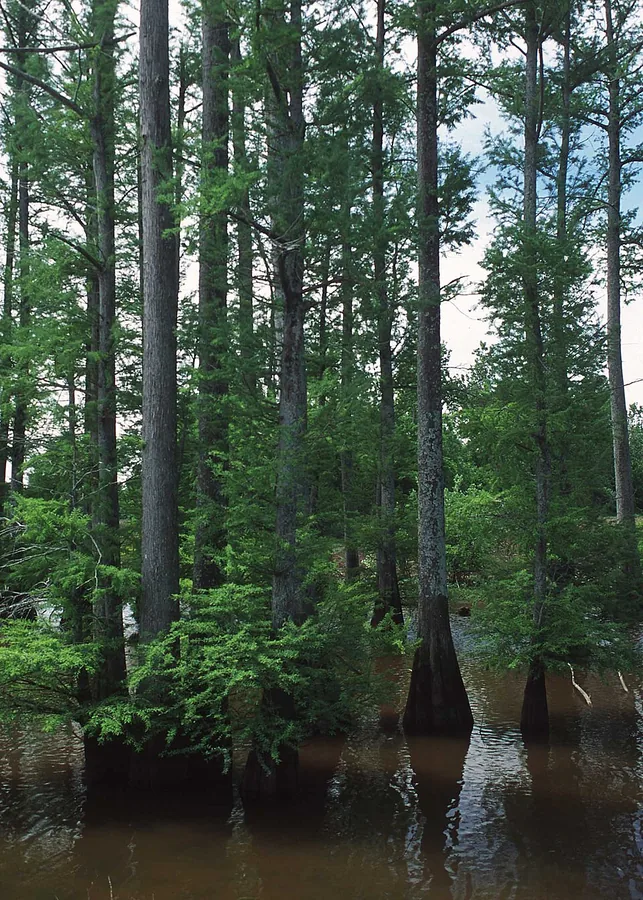
Bald cypress is a tall deciduous conifer native to the swamps and river bottoms of the southeastern United States, and its bottomland origin explains much of its famous resilience. Because it evolved where water levels swing widely, it tolerates conditions that defeat most large trees. It is deciduous, shedding all of its needles each winter, which is precisely the trait that gives the bald in its name.
Its swamp reputation understates its true range. A flooded rooting zone deprives most species of oxygen, yet bald cypress endures weeks of standing water, and once established it just as readily handles drought, heavy clay, compacted soil, and the restricted root zones of city streets. That breadth of tolerance is why the same species thrives in a wild bayou and in a downtown planting pit, where soil oxygen and moisture differ sharply.
Its seasonal interest is structural as well as ornamental. Soft, feathery needles carry the canopy through spring and summer, then senesce to a warm russet to copper-orange before they abscise, leaving a clean pyramidal frame defined by a strong central leader through winter. Where the tree grows in or near water, the roots produce woody knees, the pneumatophores that create its distinctive swamp-edge silhouette.
Care
The short version: site it in full sun and acidic, ideally moist soil, then irrigate steadily until the root system establishes. Thereafter bald cypress proves hardy from zone 4 to 11, drought tolerant once rooted, and close to maintenance free.
Light
Site bald cypress in full sun, which yields the densest, most uniform canopy and the strongest growth, though it tolerates partial shade. The relationship is direct: more incident light builds a fuller, more even crown.
Water
Few trees match its adaptability to moisture. It thrives in wet, swampy, even flooded ground because it tolerates the low soil oxygen of saturated sites, yet once rooted it also grows well in ordinary or dry urban soil. Irrigate young trees regularly until they establish a supporting root system; mature trees are drought tolerant. In a hot, dry summer without irrigation, water stress favors mites, which can brown the needles prematurely.
Soil
It prefers moist, acidic, sandy to loamy soil at pH 4.5 to 6.5 yet tolerates clay, compaction, and poor drainage. Above roughly pH 7.5 the soil locks up iron, so the foliage develops iron chlorosis; for that reason, avoid strongly alkaline sites.
Temperature
Its cold and heat tolerance is wide, withstanding winter lows near -29°F (-34°C) and summer highs to 104°F (40°C) without injury. That envelope corresponds to USDA zones 4 through 11.
Humidity
Atmospheric humidity is immaterial to an established tree. Air movement and adequate soil moisture matter far more, since dry, stagnant heat is the condition that encourages mite outbreaks.
Feeding
An established bald cypress seldom requires fertilizer. Where growth is genuinely poor, a balanced slow-release tree fertilizer in spring addresses it, and on alkaline soil chelated iron or soil acidification corrects the chlorosis at its cause by restoring iron availability.
Pruning
Expect minimal pruning. The tree forms a strong central leader without training, so the only routine work is removing dead, damaged, or crossing branches in late winter during dormancy, when cuts heal cleanly.
Repotting
Bald cypress is rarely a container subject and seldom needs repotting. The reliable indicators that it has outgrown a pot are roots circling or emerging from the drainage holes, stunted new growth, and water running straight through the medium.
Size & spacing
This is a large tree, attaining 50 to 70 feet (15 to 21 m) in height and 20 to 30 feet (6 to 9 m) in spread. Place it well clear of buildings and pavement, because both the mature canopy and the spreading, knee-forming root system demand room.
When to plant
Bald cypress imposes no narrow planting window. Establish it in spring or fall while temperatures stay mild, which limits transplant stress, irrigate it through its first couple of seasons until the roots extend, and allow the autumn color to develop on its own as the needles turn copper and drop.
Northern hemisphere
Southern hemisphere
Typical months for a temperate climate: start earlier in warm zones, later where spring frosts linger.
- Plant: Spring or fall
- Harvest: Non-showy; sheds russet to copper-orange foliage in autumn, then bare ('bald') in winter
Hardiness
USDA hardiness zones: 4–11
Temperature: down to -34°C
Troubleshooting
A vigorous bald cypress is rarely troubled, and most disorders that do appear are cosmetic rather than structural. The needles are the diagnostic surface: uniform yellowing implicates the soil and its chemistry, while browning implicates pests. Identify the precise pattern below before applying any treatment.
Pale yellow needles with green veins on new growth
Pale new needles with green veins are diagnostic of iron chlorosis, the result of soil too alkaline for the tree to take up iron. The cause is almost always a pH above 7.5, sometimes compounded by tight, compacted soil. Lower the pH with elemental sulfur over the long term to address the cause, apply chelated iron for a faster correction, and mulch to raise organic matter and improve uptake.
Fix:
- Acidify soil with elemental sulfur over time
- Apply chelated iron as a foliar spray or soil drench
- Mulch and improve soil organic matter
Knobby green-to-brown galls on the twigs
Spindle-shaped to knobby galls are tissue the tree forms around feeding larvae of the cypress twig gall midge. Cut one open and the small orange larvae confirm the identification. Because the galls drop in autumn and the larvae overwinter on the ground, raking and destroying them reduces the next generation; a light infestation does no real harm, and predatory insects supply natural control.
Fix:
- Rake and destroy fallen galls in autumn to reduce overwintering larvae
- Tolerate light infestations; predatory insects provide natural control
Needles browning and dropping early in summer
Browning, stippled needles that drop before fall typically indicate twospotted spider mites, whose feeding intensifies in hot, dry weather. Tapping foliage over white paper and watching for moving specks confirms them. Bagworms produce the same patchy early drop, identifiable by spindle-shaped silk bags hanging from the twigs; hand removal addresses those, while maintaining steady soil moisture through drought is the most effective deterrent to both.
Fix:
- Irrigate during droughts to reduce mite stress
- Hand-pick and destroy bagworm bags in late winter
- Use insecticidal soap or horticultural oil for heavy mite pressure
Toxicity
For households with pets or young children, the toxicological record is reassuring: bald cypress is not toxic. It is absent from the ASPCA and NC State Extension toxic-plant lists, and neither the soft needles nor the woody cones are known to poison animals or people. An incidental nibble carries no recognized risk.
Safe for
People · Cats · Dogs · Horses · Rabbits · Livestock · Birds
Cats None
Bald cypress appears on no toxic-plant list for cats, so ingestion of the soft foliage will not poison one. The only plausible effect is mild gastrointestinal upset from a large quantity of fibrous plant material, a mechanical response rather than a toxic one.
Dogs Safe
No part of the tree is known to harm dogs. Its absence from the ASPCA list supports that, so a dog that chews a fallen twig or some needles is at no toxicological risk.
Horses Safe
Horses may browse in proximity to bald cypress without concern. Neither the needles nor the woody cones contain toxins that affect equines.
Rabbits Safe
A rabbit grazing beneath the tree faces no poisoning risk, since the fine foliage is non-toxic, though rabbits are best maintained on their customary grasses and greens.
Livestock Safe
Cattle, goats, and sheep can occupy a pasture containing bald cypress safely, as none of its parts are toxic to grazing livestock.
Birds Safe
Birds nest and perch in bald cypress without hazard, and the seeds borne in the small cones serve as forage for some species rather than a danger.
People Safe
The tree presents no poisoning risk to people, and children who handle the needles or cones are in no danger. No part is intended for consumption, but contact and an incidental taste produce no harm.
No special handling precautions for toxicity; foliage and woody cones are not known to be poisonous to pets or people.
Varieties
The straight species reaches forest dimensions, so most plantings call for a selection scaled to the available space. The cultivars below are the ones most often offered in the trade.
'Shawnee Brave' ('Mickelson')
A narrow, near-columnar selection that reaches 50 to 75 feet tall while holding to just 15 to 20 feet wide, the form best suited to a confined planting space.
'Peve Minaret'
A genuine dwarf with fine, fern-like foliage that needs about ten years to attain roughly 6 feet in height and only 2 to 3 feet in width.
'Cascade Falls'
A weeping form grafted onto a standard, its branches descending vertically to form a mound about 8 to 12 feet tall and 5 to 8 feet wide.
Pond Cypress (Taxodium ascendens / T. distichum var. imbricarium)
A closely allied swamp taxon whose awl-like needles press against upward-angled branchlets, giving it a narrower habit and the constitution to occupy poorer, sandier wet ground.
How to propagate
Bald cypress propagates readily from seed but poorly from cuttings, a difference that dictates how the named forms reach the nursery. The mechanics of each method, and why the results diverge, follow below.
SeedModerate
Sow stratified seed in spring · 1-2 growing seasons to a transplantable seedling
The cones ripen in fall, and the enclosed seed requires cold, moist stratification to break dormancy before it will germinate; collect it and chill it over winter, then sow in spring. A consistently moist seedbed is what the seed most needs, and one to two growing seasons are required to produce a transplantable seedling.
Stem cuttingsDemanding
Softwood cuttings in early summer · Several months to root, often low success
Softwood cuttings taken in early summer are worth attempting only with realistic expectations, because the species roots poorly. Rooting can take several months and most cuttings fail, which is exactly why the named weeping and dwarf forms are propagated by grafting rather than from cuttings.
GraftingDemanding
Late winter onto seedling rootstock · 1 season to a viable grafted plant
Grafting in late winter onto a seedling rootstock is the standard method for reproducing cultivars such as 'Cascade Falls' and the other weeping forms, and it produces a viable grafted plant within a single season.
Myths
Bald cypress is just a dawn redwood and must be planted in water to survive.
The two are distinct species, separable by needle arrangement. Bald cypress bears its needles alternately in two ranks and can produce woody knees, whereas dawn redwood bears its needles in opposite pairs and never does. Bald cypress requires no standing water at all; it performs equally in ordinary moist or even dry upland and urban soils, and the knees develop chiefly when the tree stands in or beside water.