Ornamental · Montiaceae
Lewisia
Lewisia cotyledon
Give it sharp drainage and a dry crown, and lewisia crowns its rosette with bright flowers each spring.
Partial sun
Every 7–14 days
USDA 4–8
6–12 in · 15–30 cm
Overview
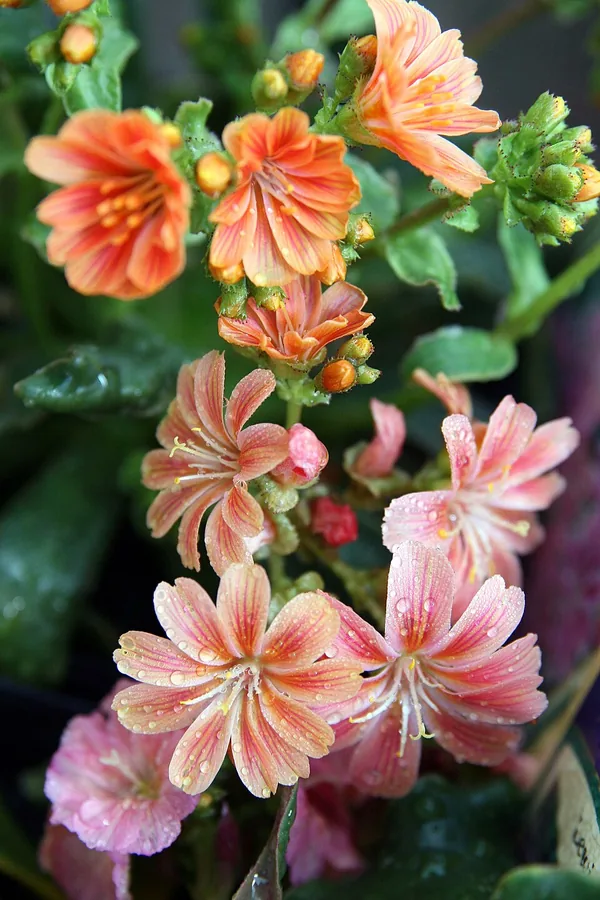
Lewisia is an evergreen montane species from western North America, where it establishes in gravelly crevices on cool, sharply drained slopes. It builds a compact rosette of thick, water-storing leaves and lifts airy flower sprays in late spring. The blooms fall in a warm range of pink, apricot, orange, and yellow, and many carry the fine candy striping that runs the length of the petals.
Its whole architecture answers the demands of a rock ledge. The fleshy leaves buffer the plant through dry intervals, and the deep taproot anchors it in the thin, gritty substrate that a more demanding plant could not exploit. That adaptation is precisely why saturated soil is fatal to it, so the aim is the sharp drainage of its native scree rather than the rich, retentive bed that suits most border flowers.
Sited in a trough, a raised rock garden, or laid sideways into a wall crevice, it performs for many years. It is hardy and long-lived, tolerating hard winters down to its rated zones, yet its one exacting requirement is water management. Once the drainage is correct, the remaining care is straightforward.
Care
The short version: grow lewisia in gritty, sharply drained soil with the crown seated high and dry, supply bright light with afternoon shade under hot summers, and water at the base only after the surface of the soil has dried.
Light
Lewisia performs best under bright light with afternoon shade, and this matters most where summers are hot. It accepts full sun in cooler climates and tolerates partial shade, but direct afternoon sun on an exposed site raises leaf temperature enough to scorch the rosette.
Water
Confine water to the base and never to the center of the rosette, since moisture held in the crown drives rapid rot. Let the surface dry between applications, which resolves in practice to roughly every 7 to 14 days, and reduce watering sharply during summer dormancy when demand falls.
Soil
Use gritty, sharply drained soil composed of gravel and sand that reproduces a mountain scree. A pH of 5.5 to 7.0 suits it, and the single condition it cannot tolerate is heavy, retentive ground that keeps water standing at the roots.
Temperature
The species is cold-hardy to -4°F (-20°C) and holds up to about 75°F (24°C). Heat above that threshold is the limiting factor, so provide cool root run and afternoon shade through a hot summer to keep it within range.
Humidity
This is a low-humidity plant adapted to dry mountain air. Damp, stagnant conditions favor rot organisms, so free airflow around the crown counts for far more than ambient moisture.
Feeding
Apply a dilute, low-nitrogen balanced fertilizer through spring and early summer only. Excess nitrogen forces soft, sappy tissue that is prone to rot, so restraint outperforms generosity here.
Pruning
Cut spent flower stems after bloom and remove withered outer leaves, since dead tissue against the crown gives rot a foothold. No hard pruning is warranted; the work is sanitation rather than structural cutback.
Repotting
Repot every 2 to 3 years, or sooner if the rosette outgrows the pot, working in early spring into fresh gritty mix. Seat the crown at or just above the soil line, and read roots at the drainage holes or declining flowering as the trigger.
Size & spacing
Mature dimensions run 6 to 12 inches (15 to 30 cm) in height and about 8 to 12 inches (20 to 30 cm) in spread. The compact, slow habit suits troughs, crevices, and the forward edge of a rock garden.
When to plant
Lewisia is a hardy perennial across zones 4 through 8, an evergreen that persists over years rather than completing a seasonal cycle. Plant young stock in spring once the soil is workable, and expect the rosette to raise flowers from late spring into early summer.
Northern hemisphere
Southern hemisphere
Typical months for a temperate climate: start earlier in warm zones, later where spring frosts linger.
- Harvest: Late spring to early summer
Hardiness
USDA hardiness zones: 4–8
Temperature: down to -34°C
Troubleshooting
Nearly every disorder in lewisia traces to a single mechanism: water retained where it should drain. Inspect the crown and the youngest growth first, since that tissue registers stress earliest. Detected early, most cases are reversible.
Rosette collapse with a browned, softened crown
A collapsing rosette over a browned, softening neck points to crown rot, driven by moisture held in the rosette center or by soil that drains too slowly. Once the neck tissue turns soft and sour, the vascular column has failed and recovery is rare. Confine watering to the base, work grit and a gravel collar around the neck so it dries fast, and set the plant on a slope where the ground otherwise stays wet.
Fix:
- Stop overhead watering and water only at the base
- Improve drainage by adding grit and a gravel collar
- Lift and replant on a slope or crevice if soil stays wet
- Remove badly rotted plants to prevent spread
Distorted new growth with a sticky film and clustered insects
Clustered soft-bodied insects on the youngest leaves and flower stems are aphids, which feed on phloem sap and excrete the sticky honeydew you see coating the growth. A firm stream of water at the base dislodges the colony, and insecticidal soap breaks down their cuticle where infestations persist. Resident ladybirds prey on the colony and hold numbers down without intervention.
Fix:
- Rinse off with a gentle stream of water at the base
- Apply insecticidal soap if persistent
- Encourage natural predators such as ladybirds
Toxicity
For households with pets and children, the record is reassuring: lewisia is not toxic. The genus has an established food history, and the related bitterroot was dug and eaten across generations, so an incidental nibble poses no hazard. The realistic worst case is mild gastric upset from overconsuming any plant material.
Safe for
People · Cats · Dogs · Horses · Rabbits · Livestock · Birds
Cats None
No toxic principle affects cats. A curious taste will not poison one, though any plant eaten in bulk can irritate a sensitive gut.
Dogs None
Dogs face no toxin here. Chewing foliage or excavating the crown may cause transient gastric upset, but nothing of clinical concern.
Horses Safe
Grazing horses meet no compound in lewisia known to harm them.
Rabbits Safe
Rabbits digest the fleshy leaves without harm, though heavy browsing can strip a young rosette past its capacity to regrow.
Livestock Safe
Cattle, goats, and sheep encounter it in the rock garden without any poisoning risk.
Birds Safe
Garden birds and poultry take no harm from foraging the foliage or seed.
People Safe
The genus carries a long food history, the related bitterroot root having been dug and eaten across generations, so no toxicity applies.
Varieties
Most garden lewisias are selections of Lewisia cotyledon, offered as seed strains or as named hybrids. A few of them merit sourcing by name.
Sunset Group / Sunset Strain
A seed strain selected for a warm color range that runs from orange and apricot into pink and yellow.
'Elise'
A compact F1 hybrid noted for rapid flowering from seed and repeat bloom across the season.
var. heckneri
A natural variety defined by the toothed, wavy margins on its rosette leaves.
How to propagate
Lewisia propagates from seed or from the offset rosettes it produces at the crown. Neither method is fast, but both are reliable provided the medium stays gritty and moisture stays restrained.
SeedModerate
Sow fresh seed in autumn or late winter; benefits from cold stratification · 1-2 years to flowering size
Surface sow fresh seed onto a gritty mix in autumn or late winter and hold it cool, because the required cold stratification breaks dormancy and raises the germination rate. Once seedlings emerge, allow 1 to 2 years for them to reach flowering size.
Offsets & pupsModerate
Spring or early summer once side rosettes form · Several weeks to root, full establishment in one season
As side rosettes develop in spring or early summer, detach an offset with a sliver of crown tissue and let the wound callus over a few hours before planting, which limits rot at the cut. Set it into barely moist gritty mix, where it roots within a few weeks and reaches full establishment across a single season.
Myths
Lewisia is a desert succulent suited to hot, dry, baking conditions.
The fleshy leaves and the demand for sharp drainage are what seed this confusion, and both are genuine traits. In its native ecology, though, it is an alpine rock-crevice species that requires cool roots and afternoon shade under hot summers, where crevice shade and rock mass buffer root temperature. Subject it to sustained dry heat and it stalls or dies rather than thriving.