Ornamental · Verbenaceae
Lantana
Lantana camara
Grown in full sun and lean soil, lantana flowers through the heat of summer, yet every part of it is poisonous.
Full sun
Every 5–10 days
39–48°F · 4–9°C
USDA 7–11
Overview
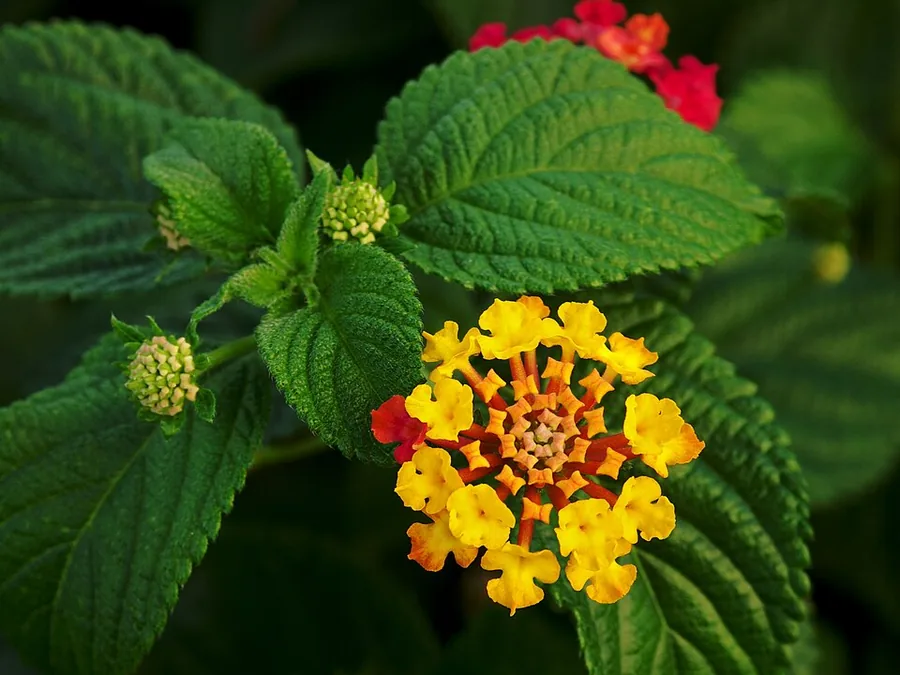
Lantana is a fast-growing shrub in the verbena family, valued for the dense corymbs of small florets that frequently change color as they mature. It sustains butterflies and hummingbirds across the season and withstands heat, drought, and impoverished soil once its root system is established. Through zones 7 to 11 it behaves as a woody perennial, whereas in colder climates it is cultivated as a summer annual.
Its ease of culture is inseparable from its liabilities. Every part is toxic, the unripe green berries most acutely, and in warm frost-free regions its aggressive spread has earned it invasive status. Site it where pets, livestock, and children cannot access the berries.
Flowering runs from midsummer until the first frost, in oranges, yellows, pinks, reds, and bicolors according to selection. The habit ranges from low, spreading forms to upright shrubs, which supplies a suitable candidate for a border, a container, or a hot, dry slope that defeats most other plantings.
Care
The short version: establish lantana in full sun and well-drained soil, water moderately and let it dry between applications, feed sparingly, and shear it to maintain a bushy, free-flowering habit.
Light
Lantana requires full sun, 6 or more hours daily, to flower well, because insufficient light diverts the plant into foliage rather than bud production. Positioned in the brightest, hottest situation available, it sets the heaviest bloom.
Water
Water moderately and allow the top half of the soil to dry between applications, on the order of every 5 to 10 days. An established plant is markedly drought tolerant, and because its roots resent standing water, waterlogging inflicts far more harm than a dry interval.
Soil
Undemanding as to medium, it grows in clay, loam, or sand and even in poor ground, provided the site drains freely. A soil pH across the range 6.0 to 8.0 is entirely satisfactory.
Temperature
As a warm-climate species with scant cold tolerance, lantana is hardy only in zones 7 to 11. It endures brief lows near 39°F to 48°F (4°C to 9°C), but frost destroys the top growth, which is precisely why it is grown as an annual where winters are severe.
Humidity
Ambient outdoor humidity meets its needs, so no specific level need be maintained. Air movement is the more consequential factor, particularly among plants crowded together over winter, where stagnant air favors pest buildup.
Feeding
Apply a balanced fertilizer monthly through the growing season. Restrict the nitrogen, since an excess promotes leaf expansion at the expense of the floral display sought.
Pruning
Pinch or shear through the season to sustain a bushy, floriferous habit, as removing shoot tips stimulates branching. On specimens carried over as perennials, a hard cutback in late winter or early spring drives vigorous regrowth.
Size & spacing
Depending on the selection, lantana attains 1 to 6 feet (30 to 183 cm) in height and spreads 3 to 5 feet (91 to 152 cm). Allow each plant adequate room to develop and to admit air movement through the canopy.
When to plant
Lantana demands warmth and is cut down by the first frost, so its schedule tracks the frost-free window. Sow seed indoors 6 to 8 weeks before the last spring frost, transplant once frost has passed and the soil has warmed, and expect flowering from midsummer until frost terminates the display.
Northern hemisphere
Southern hemisphere
Typical months for a temperate climate: start earlier in warm zones, later where spring frosts linger.
- Sow: 6 to 8 weeks before last spring frost
- Plant: After all danger of frost has passed and soil has warmed in spring
- Harvest: Midsummer until first frost
Hardiness
USDA hardiness zones: 7–11
Temperature: down to -18°C
Troubleshooting
Outdoors, lantana is largely free of problems, and the difficulties that do arise concentrate on specimens held indoors over winter. Identify the symptom below and intervene early, before a minor pest or a lapse in flowering becomes entrenched.
Sticky foliage dotted with tiny white flies
The stickiness is honeydew excreted by feeding whitefly, a pest that concentrates on plants overwintered in the shelter of the house. A forceful jet of water dislodges the adults, after which insecticidal soap or horticultural oil applied to the leaf undersides smothers the nymphs where they feed. Because still, crowded air lets colonies build, opening up the spacing around overwintering plants keeps a repeat in check.
Fix:
- Rinse foliage with a strong stream of water
- Apply insecticidal soap or horticultural oil to leaf undersides
- Improve air circulation around overwintering plants
Fine stippling and bronze cast with light webbing
The stippling and bronzing come from spider mites puncturing leaf cells to feed, and their populations explode in the hot, dry air of a winter interior. Tapping a leaf over white paper reveals the moving specks that confirm them. A water spray dislodges the colony, insecticidal soap or horticultural oil kills what remains, and raising the humidity denies the mites the dry conditions they need to rebound.
Fix:
- Spray foliage with water to dislodge mites
- Apply insecticidal soap or horticultural oil
- Raise humidity around overwintered plants
Plenty of leaves but hardly any flowers
Vigorous foliage paired with scant flowers points to inadequate light or surplus nitrogen, both of which steer the plant toward vegetative growth rather than bud set. Restore 6 or more hours of direct sun and change to a balanced feed to correct the nutrient balance. Removing the spent flower heads then relieves the plant of seed set and prompts a further flush of bloom.
Fix:
- Move or site plant in full sun
- Reduce nitrogen and use a balanced fertilizer
- Deadhead spent blooms to encourage reflowering
Toxicity
This is a genuinely hazardous plant. Its tissues contain hepatotoxic pentacyclic triterpenoids known as lantadenes, and the unripe green berries hold the highest concentration. Because the toxin injures the liver of cats, dogs, horses, livestock, and people alike, every part must be kept well away from animals and children.
Toxic to
Cats · Dogs · Horses · Rabbits · Livestock · Birds · People
Cats Severe
A cat that ingests any part presents with vomiting and diarrhea, then weakness and lethargy and eventually respiratory difficulty. Since the lantadenes are hepatotoxic and target the liver, even a minor exposure justifies prompt veterinary assessment.
Dogs Severe
Dogs tend to ingest the green berries, the fraction of the plant richest in toxin. The clinical picture runs from vomiting, diarrhea, and weakness to labored breathing, and it can progress to outright liver failure.
Horses Severe
In horses the lantadenes produce depression, weakness, and gastrointestinal upset before liver damage and jaundice appear. As hepatic function fails, photosensitization sets in and blisters the sun-exposed skin, and advanced cases prove fatal.
Rabbits Severe
Rabbits share the mammalian susceptibility to the same hepatotoxic lantadenes. A rabbit that grazes the plant can develop gastrointestinal upset and liver injury, so the plant should be positioned well beyond its reach.
Livestock Severe
Grazing stock face one of the plant's gravest risks. Cattle, sheep, and goats develop constipation first, then jaundice, with liver damage and a swollen, photosensitized muzzle and eyelids. Mortality is common, which makes exclusion essential.
Birds Caution
The conspicuous berries attract birds, and the unripe green fruit holds the greatest concentration of toxin. Certain birds disperse ripe seed without ill effect, yet the prudent course is to regard the plant as unsafe near pet and backyard birds.
People Caution
The unripe green berries pose the principal human hazard, and children have been poisoned after eating them, with vomiting, diarrhea, and liver involvement. Contact with the foliage can also provoke skin irritation, so gloves are warranted and the berries should be kept from children.
All parts are toxic; the immature green berries are the most toxic part. Keep plants away from pets, children, and grazing animals, and wear gloves as foliage can irritate skin.
Helpline numbers

United States
ASPCA Animal Poison Control: (888) 426-4435 (fee applies)
Poison Control: (800) 222-1222



Canada
Poison Centres: 1-844-764-7669
Varieties
Lantana is offered in dozens of named selections, distinguished chiefly by flower color, cold hardiness, or reduced fertility. The following are among the most widely grown.
Miss Huff
A notably cold-hardy orange-and-yellow selection that persists to USDA zone 7b and shows better resistance to phytophthora than the run of cultivars.
Ham and Eggs
A pink-and-yellow selection that withstands Piedmont frost and returns reliably at around zone 7b.
New Gold
A low, spreading form dense with golden-yellow flowers whose lateral reach can approach 6 feet.
Bloomify Red
A near-sterile UF/IFAS release selected for minimal seed set to restrain the species' invasive spread.
How to propagate
Lantana increases readily, and vegetative cuttings are the dependable method for preserving a named selection true to type.
Stem cuttingsEasy
Take softwood cuttings in late spring or summer during active growth · Roots typically form in about 2 to 4 weeks
Lantana propagates readily from vegetative cuttings. Softwood cuttings taken in late spring or summer, while cambial activity and rooting hormones are at their peak, establish roots in roughly 2 to 4 weeks. Seed and division also work for the species, but because named cultivars do not come true from seed, cuttings are the only route to a genetically identical plant.
Myths
Toxicity resides in the flowers alone, so every lantana color is harmless to cultivate.
The entire plant is poisonous, and the unripe green berries carry the highest toxin concentration. Flower color bears no relation to toxicity, so no color offers any margin of safety over another.
Lantana amounts to no more than an innocuous tropical annual for bedding.
It is in fact a tender perennial that has naturalized out of cultivation across the globe. In warm regions it is designated a Category 1 invasive in Florida and a noxious weed elsewhere, forming dense thickets that displace native vegetation.