Tree · Cornaceae
Kousa Dogwood
Cornus kousa
A small tree that delivers star-shaped bracts, edible fruit, and exfoliating bark across all four seasons.
Full sun
Every 5–10 days
USDA 5–8
15–30 ft · 4.6–9.1 m
Overview
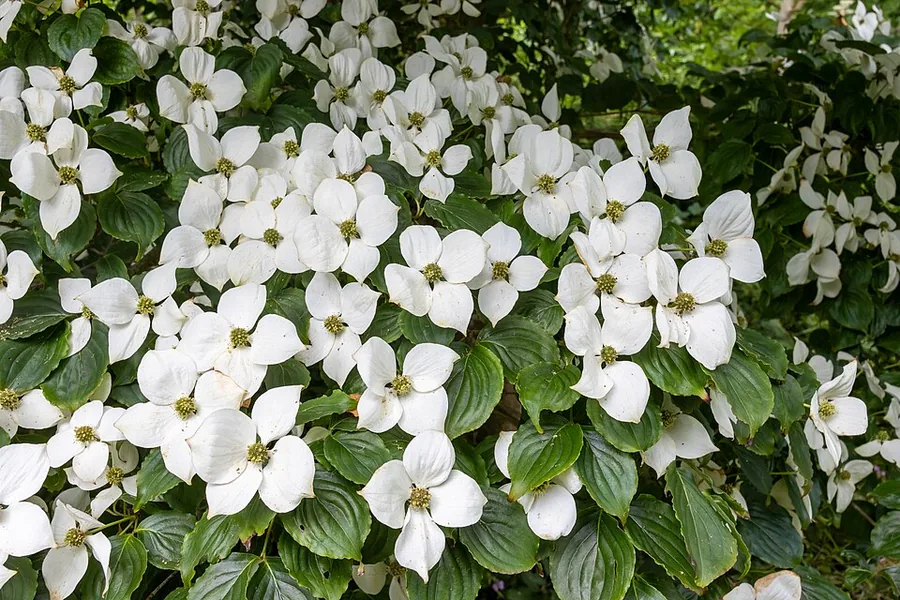
Cornus kousa holds interest across the whole growing year. Its late-spring display comes from pointed, star-shaped bracts, and because these open after the leaves have expanded, unlike Cornus florida, the inflorescences are presented against fully developed foliage. By late summer the tree carries pinkish-red aggregate fruit that feeds birds and is edible to people.
Mature dimensions are moderate, roughly 15 to 30 feet (4.6 to 9.1 m) in height with a comparable spread, the crown vase-shaped when young and rounding with age. Growth is slow, which keeps the tree in scale on a small site. As the trunk matures the outer bark exfoliates in plates to expose a mottled underlayer, an ornamental feature that sustains winter interest.
The species is often specified as a more durable substitute for Cornus florida. It resists both dogwood anthracnose and borers that afflict the native species, demands little maintenance once established, and is cold hardy to -20°F (-29°C). Provided with suitable soil and consistent moisture, it is largely self-reliant.
Care
The short version: full sun to part shade in rich, mildly acidic, well-drained soil, held at even moisture through summer heat because transpiration then runs highest. Mulch the root zone, prune almost never, and let this slow grower establish at its own rate.
Light
Site kousa dogwood in full sun to part shade. Full sun maximizes flowering, but in hot regions light afternoon shade reduces the transpirational load and limits midsummer scorch of the foliage.
Water
Hold the soil at even, medium moisture, irrigating every 5 to 10 days and more frequently in hot, dry weather when water demand peaks and scorch risk rises. Once established it withstands drought better than Cornus florida, but the root system will not tolerate waterlogging.
Soil
Grow it in rich, humusy, well-drained loam in the acidic to neutral range, a pH of 5.5 to 7.0. Incorporating compost and top-dressing with an acidic organic mulch keeps the root zone cool and supplies nutrients as the mulch breaks down.
Temperature
The species is hardy across a broad thermal range, -20°F to 95°F (-29°C to 35°C), corresponding to USDA zones 5 through 8. It tolerates severe winters and is stressed mainly where summers are persistently hot and dry.
Humidity
Ambient outdoor humidity is adequate, so no target figure applies. The more consequential factor is air movement, since still, stagnant conditions in a dense canopy favor powdery mildew on the leaves.
Feeding
A single application in early spring of a balanced slow-release fertilizer suffices, or the tree can simply be top-dressed with acidic compost or mulch. This slow grower has modest nutrient demands and does not respond well to forcing.
Pruning
Keep pruning minimal. Remove only dead, damaged, or crossing branches, and time the work to just after flowering in late spring to early summer so the following season's flower buds are not removed.
Repotting
Kousa dogwood is seldom held in a container long-term, so repotting rarely arises. If a specimen is potted and its roots begin circling or emerging from the drainage holes, pot it on into a larger container or, preferably, plant it out.
Size & spacing
Allow for a mature tree of 15 to 30 feet (4.6 to 9.1 m) in height with an equivalent spread. Provide that much clear space so the broad, rounded crown can develop fully and air can circulate through the branches.
When to plant
Cornus kousa is a woody tree established once and retained for decades. Plant it in spring or fall so the root system can develop before the stress of summer heat or hard frost, and expect flowering in late spring with edible fruit ripening from late summer into early fall.
Northern hemisphere
Southern hemisphere
Typical months for a temperate climate: start earlier in warm zones, later where spring frosts linger.
- Plant: spring or fall
- Harvest: Blooms late spring to early summer (May to June), after leaves emerge; pinkish-red edible fruit ripens late summer to early fall.
Hardiness
USDA hardiness zones: 5–8
Temperature: down to -29°C
Troubleshooting
Most problems on kousa dogwood register on the foliage, and the underlying cause is usually the site or the season rather than a defect in the tree. Distinguish summer scorch from the two leaf-spotting fungi and the correct response, irrigation versus sanitation, follows directly. Match the symptom below, then intervene before it advances.
Marginal leaf browning and curl during summer heat
The marginal browning is leaf scorch, which develops when transpiration in a hot, full-sun site outpaces the water the roots can supply, so the leaf tissue at the margins dries and dies. Young trees, with their limited root spread, reach that deficit soonest. Correct it by watering deeply through drought, laying a 2 to 3 inch (5 to 8 cm) mulch ring to conserve soil moisture, and siting the tree in afternoon shade where summers are severe.
Fix:
- Provide deep, regular watering during heat and drought
- Apply a 2-3 inch organic mulch layer to conserve soil moisture and keep roots cool
- Site in partial afternoon shade in hot climates
White powdery growth across the leaf surface
The coating is powdery mildew, a foliar fungus favored by humid air and the still, shaded conditions of a crowded canopy, which let its spores germinate on the leaf surface. It can distort the foliage but seldom causes lasting harm to an established tree. Manage it by thinning and spacing to raise air movement, removing the most heavily colonized leaves, and applying a labeled fungicide only when colonization becomes severe.
Fix:
- Improve air circulation by thinning and proper spacing
- Remove and dispose of affected foliage
- Apply a labeled fungicide if infection is severe
Angular brown to purple lesions on the foliage
The angular, dark-margined lesions are septoria leaf spot, a fungus that becomes active later in the season once foliage stays wet long enough for spores to infect. Its discrete spotting distinguishes it from the marginal drying of scorch. Because the fungus overwinters in fallen debris, rake and dispose of infected leaves, keep the foliage dry, and apply a labeled fungicide only when defoliation becomes significant.
Fix:
- Rake and dispose of fallen infected leaves
- Avoid overhead watering and wetting foliage
- Apply a labeled fungicide only if defoliation is significant
Toxicity
The toxicological picture is uniformly clear. Cornus kousa is non-toxic to pets, livestock, and people, and its ripe pinkish-red fruit is edible. No part of the tree requires exclusion, and incidental sampling by a curious animal carries no toxic risk.
Safe for
People · Cats · Dogs · Horses · Rabbits · Livestock · Birds
Cats Safe
The tissue holds no toxin that affects cats. Ingestion of a leaf may at most produce brief, self-limiting gastrointestinal upset, the mechanical response to any non-food plant matter, and nothing systemic.
Dogs Safe
Dogs face no meaningful risk from the foliage, bark, or dropped fruit. A large mouthful may provoke transient digestive upset, which resolves without intervention because no active compound is involved.
Horses Safe
The species is non-toxic to horses across both foliage and fruit. No exclusion from a paddock is warranted on toxicological grounds.
Rabbits Safe
Rabbits can browse the foliage without toxic effect. Introduce any new green gradually, since an abrupt dietary shift, not the plant itself, is what disturbs their gut.
Livestock Safe
Cattle, goats, and sheep can graze in proximity without adverse effect, as the tree contains no compound toxic to ruminants.
Birds Safe
Birds consume the ripe aggregate fruit and disperse the seed, an intended ecological function rather than a hazard.
People Safe
The ripe pinkish-red fruit is edible, with sweet, soft interior flesh, and the remainder of the tree is non-toxic. The thin skin and gritty seeds are generally not consumed.
No special handling required; ingestion of plant material may rarely cause mild, transient gastrointestinal upset as with any non-food plant.
Varieties
Most kousa dogwoods in commerce are named selections chosen for floral display, foliage, or disease tolerance. The cultivars below are the ones most worth identifying.
Milky Way
A free-flowering selection frequently placed under var. chinensis, valued for a dense set of creamy-white bracts and a correspondingly heavy fruit set.
Wolf Eyes
A compact, slow-growing cultivar whose green leaves carry clean white margins, which suits it to smaller sites and to positions where brighter foliage is wanted.
Satomi
Distinguished by deep pink to rose bracts, a pigmentation that departs from the species' typical white.
Cornus × rutgersensis (Stellar series)
The Rutgers interspecific hybrids of Cornus florida and Cornus kousa, including Aurora, Constellation, and Stellar Pink, were selected for resistance to anthracnose and borers.
How to propagate
Cornus kousa can be propagated by several methods, ranging from slow, genetically variable seed to layering, which asks very little of the grower. Method selection turns on whether a genetically identical copy of a named tree is required.
SeedModerate
Sow cleaned seed in fall or after cold-moist stratification in late winter. · Several years to reach flowering size
Clean the pulp from the seed, then either sow in fall or provide a cold-moist stratification before a late-winter sowing, which satisfies the embryo's chilling requirement and releases dormancy. A resulting seedling needs several years to reach flowering size. Because the offspring are genetically variable, seedlings do not reliably reproduce the parent tree.
Stem cuttingsModerate
Take softwood to semi-hardwood cuttings in late spring to summer. · One growing season to root and establish
Take softwood to semi-hardwood cuttings from late spring into summer, treat them with rooting hormone, and hold them under mist to limit moisture loss while roots form. They root within one growing season, and kousa strikes more readily than many other tree species.
GraftingDemanding
Graft named cultivars onto seedling rootstock in late winter or summer. · One to two seasons to establish union
This is the demanding option, achieved by grafting or budding a named cultivar onto seedling rootstock in late winter or summer. The graft union consolidates over one to two seasons. It is the standard means by which nurseries maintain cultivars true to type, since seed-derived offspring will not be.
LayeringEasy
Layer low flexible branches in spring. · One to two growing seasons to root
The simplest technique for the home grower is layering: pin a low, flexible branch to the soil in spring so it forms roots while still attached to the parent. Rooting takes one to two growing seasons, after which the layer can be severed and transplanted.
Myths
Kousa dogwood catches anthracnose and borers just as badly as the native flowering dogwood.
The record contradicts this: Cornus kousa shows markedly greater resistance to both dogwood anthracnose and the dogwood borer than Cornus florida. This resistance is precisely why it is planted on sites with a history of anthracnose, and why it is so consistently recommended as a substitute.
The red raspberry-like fruit is poisonous and shouldn't be eaten.
The pinkish-red aggregate fruit is edible, developing soft, sweet flesh at full ripeness. It is also consumed by birds and other wildlife, so it functions both as human food and as a wildlife resource.