Tree · Cornaceae
Flowering Dogwood
Cornus florida
Give it part shade and moist, acidic soil, and the flowering dogwood returns spring bracts and red autumn fruit.
Partial shade
Every 5–10 days
USDA 5–9
15–30 ft · 4.6–9.1 m
Overview
Flowering dogwood ranks among the defining small trees of eastern North America, the species that brightens the spring woods with wide white blooms. In its native setting it performs as an understory tree, establishing beneath taller oaks and pines where light arrives filtered and the soil stays cool and damp. That ecological niche dictates nearly everything about growing it successfully.
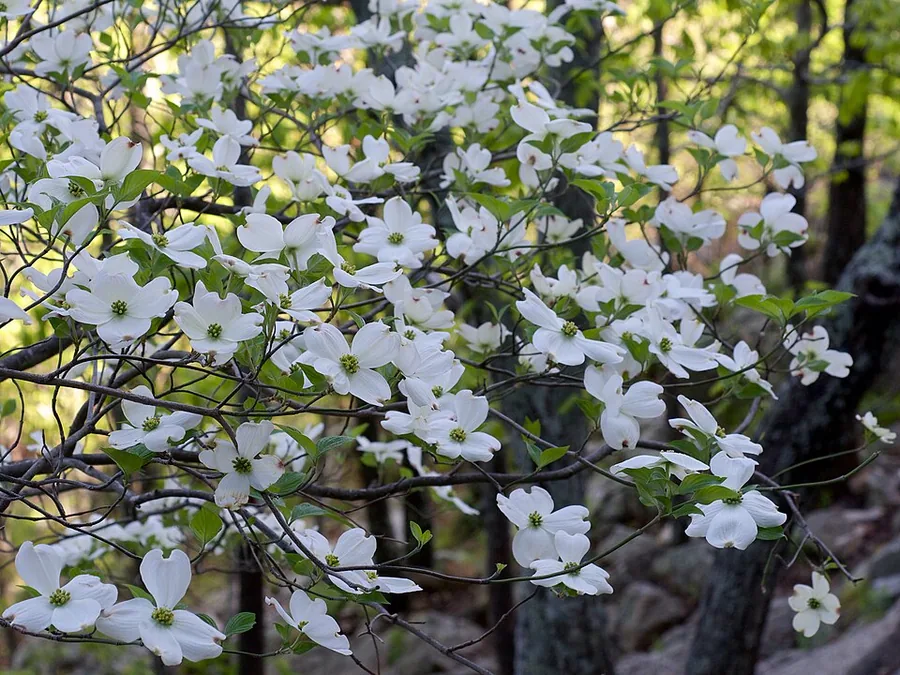
The celebrated spring display is something of an illusion. The four large white structures that read as petals are in fact bracts, modified leaves arranged around a tight cluster of tiny true flowers at the center. They open in April and May, at times ahead of the foliage, and are followed by clusters of bright red fruit from August into October that birds strip quickly.
It earns a moderate rating because it is exacting about its site and inclined toward several diseases once stressed. Place it well, with shelter from the harshest afternoon sun and ground that drains freely yet never bakes, and it settles into a long, unhurried life. Force it into hot, dry, compacted soil and you create the very stress that opens the door to the troubles which cut its years short.
Care
The short version: part shade with cover from harsh afternoon sun, moist acidic well-drained soil, a 2 to 4 inch mulch layer to keep the roots cool, and a watchful eye for anthracnose through cool, damp seasons.
Light
As an understory species it inclines toward part shade and benefits from relief from hot afternoon sun. It will accept full sun in cooler regions or where moisture stays steady, but an exposed, baking position stresses the tree and leaves it open to disease.
Water
Maintain the soil consistently moist, because the tree tolerates neither drought, heat, nor compacted ground. Irrigate deeply through dry spells and lay 2 to 4 inches of mulch over the root zone to conserve moisture and keep the shallow roots cool.
Soil
Set it in rich, acidic, well-drained loam amended with ample organic matter. A pH between 6.0 and 7.0 suits it, and ground that drains freely while never drying out hits the target.
Temperature
It is hardy across a broad range, roughly -20°F to 100°F (-29°C to 38°C), spanning cold winters and hot summers alike. Heat poses the greater threat than cold, since a tree dried and stressed by heat is the first one disease exploits.
Humidity
Ambient outdoor humidity is entirely adequate and asks for no attention. Airflow counts for far more than any humidity figure, because the still, crowded air around a dense canopy is what allows anthracnose and mildew to establish.
Feeding
Feed once in early spring with a balanced slow-release fertilizer formulated for acid-loving plants. Keep nitrogen modest, since a surge of soft new growth is exactly the tissue anthracnose colonizes.
Pruning
Prune in late fall or winter while the tree is dormant, removing dead, diseased, or cankered wood together with any water sprouts. Work with care and avoid wounding the bark, because open cuts are the entry points borers use.
Repotting
This is a landscape tree that rarely needs repotting. If you are growing a young one in a container, pot it up only once roots begin circling the surface or the medium dries rapidly after each watering.
Size & spacing
A mature flowering dogwood attains 15 to 30 feet (4.5 to 9 m) in height and spreads to a comparable width. Allow it that full 15 to 30 feet (4.5 to 9 m) of clear space so the canopy can ventilate and disease gains less of a foothold.
When to plant
Flowering dogwood follows the rhythm of the temperate forest. The bracts open in April and May, the red fruit colors up from August into October, and the optimal window for planting a new tree is spring or fall while it remains dormant.
Northern hemisphere
Southern hemisphere
Typical months for a temperate climate: start earlier in warm zones, later where spring frosts linger.
- Sow: Not typically started indoors; seed is sown outdoors in fall or stratified at about 41 degrees F for up to 120 days before spring sowing
- Plant: Spring or fall while dormant
- Harvest: April to May (showy white bracts before or with leaf emergence); red fruit August to October
Hardiness
USDA hardiness zones: 5–9
Temperature: down to -29°C
Troubleshooting
Nearly every dogwood problem can be traced to a stressful site, and the first symptoms surface on the foliage before the trouble reaches the wood. Spot it early, particularly through a cool, wet spring, and a minor issue can often be stopped before it advances into the trunk. Match your observations to the entries below, then intervene while it still does some good.
Leaf blotches and drooping foliage giving way to sunken trunk cankers
What you are looking at is dogwood anthracnose, the gravest disease this tree contends with, and the pathogen builds fastest in cool, damp, shaded conditions where leaf surfaces stay wet. Infection begins on the lowest foliage as tan spots edged in purple, then advances into twigs and trunk as cankers. Those cankers are the danger, because a band of dead tissue that encircles the stem cuts off the flow of water and sap and can girdle and kill the tree. Cut out cankered wood in dry weather, clear fallen leaves that harbor spores, open the canopy so foliage dries quickly, and apply a labeled fungicide from bud break onward where pressure is high.
Fix:
- Prune out and destroy dead and cankered wood during dry summer weather
- Remove water sprouts and rake and dispose of fallen leaves
- Improve air circulation and avoid excess nitrogen
- Apply a labeled fungicide (chlorothalonil, mancozeb, propiconazole, or copper) from bud break through new growth in high-risk sites
Premature red leaves, peeling bark, and sawdust at trunk holes
These signs point to the dogwood borer, a larva that mines the living tissue just beneath the bark and typically gains entry through an existing wound. Look for bark that sloughs away and sawdust-like frass on the trunk and larger limbs, because the feeding interrupts the vascular layer and a young tree can be lost within a season or two. Keep the tree well watered and vigorous so it resists attack, protect the bark from mower and trimmer strikes that create entry points, and treat the trunk with a labeled permethrin beginning in early May.
Fix:
- Keep trees healthy with proper watering and fertilization
- Avoid bark wounds from lawn equipment
- Apply labeled permethrin to trunk and major branches beginning in early May, repeating per label
Powdery white film coating the foliage with scorched leaf edges
A fine, dusty white layer over the new growth is the signature of powdery mildew, a fungus that establishes where shade is heavy and air movement is poor. Leaf margins scorch and some foliage drops ahead of schedule, yet the tree generally pulls through without lasting harm. Open up the canopy and the plantings around it so air keeps moving across the leaves, and apply a labeled fungicide the moment the first colonies appear.
Fix:
- Thin canopy and surrounding plantings to improve air circulation
- Apply a labeled fungicide (myclobutanil, propiconazole, sulfur, or copper) early when symptoms first appear
Small purple-rimmed spots scattered across bracts and young leaves
Numerous small tan spots ringed in reddish purple across the spring bracts indicate spot anthracnose, a fungus that becomes active in wet weather when bracts stay moist. The spotting can wrinkle and distort the bracts and looks unsightly, but it seldom causes the tree any real injury. Open the canopy to keep air moving, plant resistant varieties, and in severe years apply a labeled fungicide every 10 to 14 days from bud break through leaf expansion.
Fix:
- Thin the canopy to improve air circulation
- Plant resistant varieties
- Apply a labeled fungicide every 10 to 14 days from bud break through leaf expansion in severe cases
Toxicity
Reassuring news for a household with animals: flowering dogwood is not toxic. The ASPCA does not place it among the plants that poison cats or dogs, and it carries no genuine risk for other pets, livestock, or people. The red fruit is bitter, so eating a large quantity might cause a mild stomach ache, but the tree contains nothing harmful.
Safe for
People · Cats · Dogs · Horses · Rabbits · Livestock · Birds
Cats Safe
The ASPCA does not classify flowering dogwood as toxic to cats, so an inquisitive bite carries no real concern. Any plant eaten in bulk can irritate the stomach enough to be brought back up, but the tree holds no toxin of its own.
Dogs Safe
Dogs are equally safe, as the species is absent from the ASPCA toxic list. A large mouthful of bark or fruit might produce a brief digestive upset, yet there is no lasting risk.
Horses Safe
Horses can graze near a dogwood with no ill effect. The foliage and twigs contain nothing toxic, and the tree has no record of causing problems for grazing animals.
Rabbits Safe
Rabbits may browse the leaves without harm, since no part of the plant is poisonous to them. A rabbit is still better served by its usual ration of hay and greens than by tree foliage.
Livestock Safe
Cattle, goats, and sheep are at no risk from a dogwood in or beside the pasture. The tree counts as non-toxic, so an animal that strips a few low branches comes to no harm.
Birds Safe
Birds feed readily on the bright red fruit, and that appetite is precisely how the seed disperses. The berries serve as a valued food source rather than any kind of hazard.
People Safe
The tree presents no poisoning risk to people. Its red fruit is bitter, so consuming a good deal of it can bring on a mild stomach ache, but nothing about the plant is dangerous.
No special toxicity handling required; as with any plant, discourage pets from chewing large amounts of foliage or fruit.
Varieties
Most dogwoods offered for sale are named cultivars, selected for bract color, heavier flowering, or disease resistance. A few worth recognizing follow.
Cherokee Chief
Departs from the typical white with deep rosy-red bracts that read strongly against fresh spring foliage.
Cherokee Princess
A reliable, free-flowering selection that opens early under a heavy load of large white bracts.
Cloud 9
Densely covered in white flowers and inclined to bloom generously even while still young.
Appalachian Spring
A white-bracted form valued chiefly for its resistance to dogwood anthracnose.
How to propagate
Three methods exist for raising more flowering dogwoods, and the right choice turns on whether matching a named cultivar matters to you.
SeedModerate
Sow in fall, or stratify cleaned seed at about 41 degrees F for up to 120 days then sow in spring · Germinates the following spring; some seed delays to the second year
The seed holds an internal dormancy that a sustained cold period releases, which is why a chilling step is required. Sow cleaned seed outdoors in fall, or stratify it at around 41°F (5°C) for up to 120 days and sow in spring, and germination follows the next spring, though a portion of seed waits until the second year. Because seedlings segregate genetically, they will not come true to a named cultivar.
Stem cuttingsModerate
Softwood cuttings in summer · Several weeks to root; cuttings from young trees root and grow better than those from mature trees
Collect softwood cuttings in summer, or hardwood cuttings through winter. Rooting takes a few weeks, and cuttings drawn from young trees root and establish far more reliably than wood off mature trees, where rooting capacity declines with age.
GraftingDemanding
Dormant season grafting or budding · One or more growing seasons to establish
This is the method the nursery trade relies on to reproduce a named cultivar true to type. Grafting or budding in the dormant season preserves the bract color and disease resistance of the parent, and the resulting tree needs a season or more to knit and establish.
Myths
Flowering dogwood does best in full, hot sun like most flowering trees.
This species evolved as a native understory tree, so it favors part shade over moist, acidic, organically rich soil. It has scant tolerance for drought, heat, or compacted ground, and a specimen sited in a hot, dry exposure runs chronically stressed. A stressed dogwood is far more susceptible to disease, which is why the site you choose carries as much weight as anything done afterward.
The big white petals of a dogwood bloom are its real flowers.
The four conspicuous white structures everyone admires are not petals. They are bracts, which are modified leaves, and the actual flowers are the small yellowish-green clusters set at the center.