Tree · Taxaceae
Japanese Yew
Taxus cuspidata
A rugged, shade-tolerant evergreen suited to hedging and topiary, and at the same time among the most lethal plants that can be grown in a landscape.
Partial shade
Every 7–14 days
USDA 4–7
4–25 ft · 1.2–7.6 m
Overview
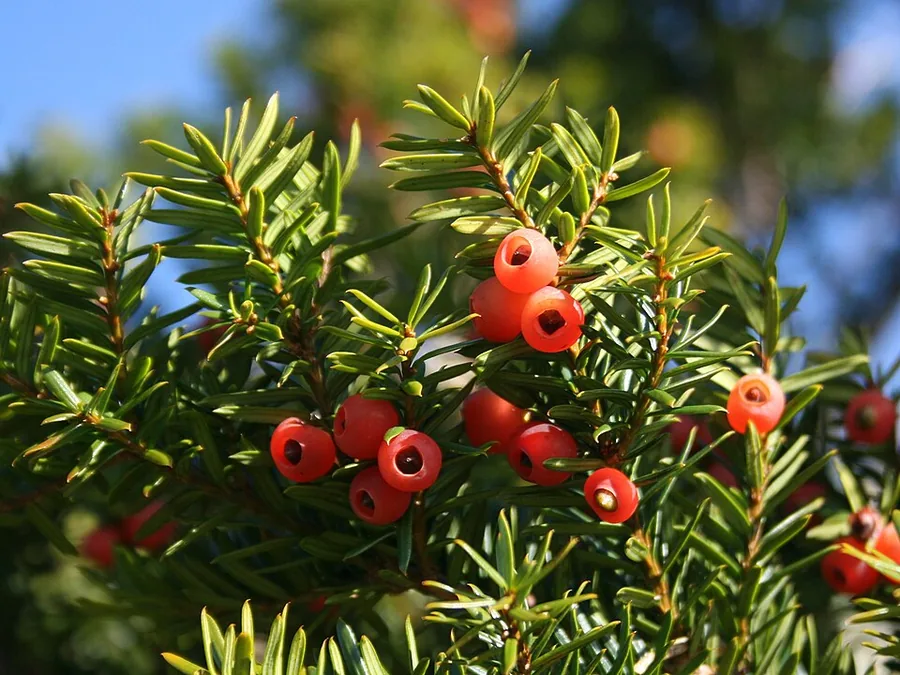
Japanese yew is a slow-growing evergreen conifer whose dark green needles persist and hold color through all four seasons. Its dense, fine branching regenerates readily from cuts, so it responds to shearing better than nearly any other woody plant, and that trait accounts for its long use as hedges, screens, and topiary in cold-winter regions. Rated for zones 4 to 7, it withstands severe cold and deep shade with equal ease.
The same chemistry that defines the genus makes it hazardous. Apart from the soft red aril, every tissue accumulates taxine alkaloids, cardiotoxins that disrupt normal heart function. Those compounds are stable, so the needles, bark, and seeds stay poisonous whether the material is fresh, wilted, or long dried, and the dose lethal to a horse or a child is remarkably small.
Site it where drainage is genuinely sharp and where its toxicity is respected. Undemanding once established and long-lived over decades, it nonetheless belongs nowhere near pasture, paddock, or play area, and its clippings must never be left within reach of an animal.
Care
The short version: establish it in well-drained soil under conditions from full sun to deep shade, irrigate until rooted in and thereafter only through drought, shear in early spring, and keep every part of it away from animals and children.
Light
Few woody plants are as accommodating for light. Japanese yew performs across the full range from full sun through to deep shade, though partial shade is optimal. That breadth of tolerance is precisely what allows it to succeed on a shaded north exposure where most other plants fail.
Water
Hold the soil evenly moist but never saturated while a young plant establishes, then water chiefly during drought once the root system is set. The governing risk is excess rather than deficit, because standing water and heavy soil induce fatal root rot. Allow the top half of the profile to dry between irrigations.
Soil
Provide moist, fertile, well-drained sandy or loamy soil and its requirements are largely met. A pH of 5.5 to 7.0 is suitable, but drainage is the non-negotiable factor. Yew has no tolerance for wet ground and will rot where water lingers.
Temperature
This is a markedly cold-hardy evergreen, functional from roughly -20°F to 95°F (-29°C to 35°C). Severe winter cold poses no difficulty, though dry winter wind can desiccate and scorch the needles of exposed specimens.
Humidity
Ambient outdoor humidity fully suffices, so no target figure applies. Good air circulation contributes more than any moisture level, keeping the dense interior dry and discouraging pests.
Feeding
A restrained approach is sufficient. Incorporate a balanced slow-release fertilizer or composted organic matter in early spring and do no more, since this slow grower has little demand for heavy feeding.
Pruning
Yew is among the few conifers that tolerate hard shearing and renewal pruning, regenerating even from cuts into old wood. Shape hedges and topiary in early spring ahead of the flush of new growth. Never leave the clippings within reach of an animal, since they stay lethal long after they wilt.
Repotting
Yew is seldom container-grown and rarely requires repotting. When roots begin circling the pot, emerging from the drainage holes, or water passes straight through, shift it up a size or into open ground.
Size & spacing
Mature dimensions vary widely by cultivar, from low spreaders to columnar forms reaching 4 to 25 feet (1.2 to 7.5 m) in height and spreading 5 to 25 feet (1.5 to 7.5 m) across. Consult the label for your selection and allow adequate room for it to develop without crowding.
When to plant
As a woody evergreen, yew has no sowing season to schedule, only a planting window for establishing young stock. Set plants out in spring or early fall while the soil remains workable, giving the roots time to establish ahead of summer heat or hard frost. Flowering is inconspicuous in spring, and female plants ripen their red arils into fall.
Northern hemisphere
Southern hemisphere
Typical months for a temperate climate: start earlier in warm zones, later where spring frosts linger.
- Plant: Spring or early fall
- Harvest: Inconspicuous spring; red arils on female plants in fall
Hardiness
USDA hardiness zones: 4–7
Temperature: down to -34°C
Troubleshooting
A well-sited yew is remarkably free of problems, and nearly every disorder traces to excess soil moisture, harsh winter exposure, or a small number of persistent pests. Recognize the early symptoms below and intervention becomes straightforward. Identify what you observe, then act while a correction still holds value.
Yellowing then browning needles atop dark, decayed roots
Foliage that yellows, then browns, above dark and softened roots points to root rot, driven here by Phytophthora in saturated soil. Yew has no tolerance for standing water, so a low or compacted site keeps the root zone anaerobic and the roots suffocate and decay. Relocate the plant to well-drained ground, reduce irrigation to break the saturation, and remove specimens too far gone to recover.
Fix:
- Improve drainage or relocate the plant to a well-drained site
- Reduce watering and avoid standing water
- Remove and discard severely affected plants
Bronzing needles on the wind-exposed face following winter
Needles that bronze or brown on the windward face in late winter indicate winter burn, a desiccation injury rather than disease. Cold, dry wind and sun draw transpirational moisture from the evergreen foliage while the frozen root zone cannot resupply it, so tissue on the exposed side dries and dies as sheltered growth holds green. Irrigate deeply in fall before the soil freezes to charge the plant with water, shield exposed specimens with burlap, and prune the killed foliage after new growth resumes.
Fix:
- Water thoroughly in fall before the ground freezes
- Provide a windbreak or burlap screen in exposed sites
- Prune out dead foliage in spring once new growth resumes
C-shaped notches on leaf margins with a wilting, fading plant
Most of the harm from the black vine weevil occurs below ground, where the larvae feed on roots and undermine water uptake, while the adults leave the diagnostic C-shaped notches along the leaf margins. Scale insects and mealybugs compound the stress by drawing sap from an already weakened plant. Target the weevil at both adult and larval stages, suppress scale with horticultural oil, and sustain vigor through sharp drainage and consistent care.
Fix:
- Treat for weevils targeting adults and larvae
- Control scale and mealybugs with horticultural oil
- Maintain plant vigor with proper drainage and care
Toxicity
Regard this species as a genuine hazard rather than an ornamental with a caveat. Nearly all of its tissue carries taxine alkaloids capable of arresting the heart with little or no warning, and dried clippings retain the full lethality of fresh growth. It has killed cats, dogs, horses, livestock, and people, so keep it well removed from animals and children and never establish it near pasture.
Toxic to
Cats · Dogs · Horses · Rabbits · Livestock · Birds · People
Cats Severe
The taxine alkaloids are cardiotoxic enough that a nibble can be fatal to a cat. Tremors, an unsteady gait, and respiratory distress precede collapse as cardiac function fails, at times with no prior warning.
Dogs Severe
Ingestion of any part places a dog in serious danger. Salivation, vomiting, and muscle tremors can progress to seizures and abrupt cardiac arrest, frequently within hours of exposure.
Horses Severe
Horses show extreme sensitivity, and a single mouthful of foliage or clippings can prove fatal within minutes. Trembling, ataxia, and a slowing, irregular heartbeat may precede collapse, though sudden death without signs is common.
Rabbits Severe
The taxine alkaloids arrest a rabbit's heart at an equally small dose. Every part of the plant, fresh or dried, must be kept beyond reach.
Livestock Severe
Cattle, sheep, and goats are frequently found dead within hours of grazing yew or consuming discarded trimmings. Animals that survive briefly display trembling, labored breathing, and sudden collapse from heart failure.
Birds Severe
The needles and seed poison birds through the same cardiotoxic mechanism seen in other animals. Only the soft red aril flesh is harmless; the hard seed enclosed within it is not.
People Caution
This ranks among the most dangerous plants in cultivation, with documented human fatalities from ingesting needles or seeds. The red aril flesh alone is non-toxic, but the enclosed seed is deadly, so keep children well away and treat no green part as safe.
Never leave yew prunings or clippings where animals can reach them; wilted and dried clippings remain lethal. Keep all plant parts away from children, pets, horses, and livestock, and never plant near pasture or dump trimmings within animal reach.
Helpline numbers

United States
ASPCA Animal Poison Control: (888) 426-4435 (fee applies)
Poison Control: (800) 222-1222



Canada
Poison Centres: 1-844-764-7669
Varieties
Most yews in cultivation are Anglojap hybrids or closely allied species, selected for habit and cold-hardiness. The following are the forms encountered most often in the landscape.
Taxus × media 'Hicksii'
An Anglojap yew of upright, columnar habit reaching roughly 20 feet, long valued for tall hedging and screening.
Taxus × media 'Densiformis'
A dense, low semi-dwarf whose spread exceeds its height, plateauing near 3 to 4 feet.
Taxus × media 'Hatfieldii'
A male, fruitless clone of broad pyramidal to columnar form attaining about 12 feet.
Taxus baccata (English yew)
The European progenitor of the Anglojap hybrids, ornamental but appreciably less cold-hardy than Japanese yew.
Taxus canadensis (Canada yew)
A low, spreading North American native adapted to deep shade and to cold beyond the tolerance of most yews.
How to propagate
Yew propagates by two routes, neither of them rapid. Cuttings preserve a cultivar's identity, while seed offers a slow, exacting alternative suited to the patient. Handle all plant material with care at every stage, since the tissue is toxic throughout.
Stem cuttingsModerate
Late summer to fall (semi-hardwood cuttings) · Several weeks to a few months to root
Cuttings remain the reliable method for reproducing a named cultivar true to type, since seed will not fix hybrid characters. Collect semi-hardwood material in late summer or fall and expect a protracted rooting period, as the slow growth of yew stretches root formation across several weeks to a few months.
SeedDemanding
Fall after cleaning seed from arils · Often a year or more due to deep dormancy
Seed propagation demands patience because of physiological dormancy. Clean the seed from the red arils in fall and apply prolonged cold stratification to overcome a deep dormancy, after which germination proceeds slowly and unevenly, frequently a year or more later. Handle the seed carefully, as it is highly toxic.
Myths
Because birds consume the red yew fruits, those fruits must be safe for people to eat.
Only the soft red aril, the fleshy cup surrounding the seed, is non-toxic, and it is that pulp a bird typically passes while voiding the seed intact. The enclosed seed carries taxine alkaloids in common with the needles and bark. A swallowed seed can be lethal to a person, which is why the entire plant warrants treatment as off-limits.
Once yew clippings have dried or wilted, they pose no danger if fed to or dumped near animals.
Desiccation does not degrade the taxine alkaloids. Wilted and dead clippings remain as lethal as fresh foliage, and they account for many poisonings precisely because limp growth entices animals that would refuse the intact plant. A large share of equine and livestock fatalities trace to trimmings discarded over a fence.