Ornamental · Athyriaceae
Japanese Painted Fern
Athyrium niponicum var. pictum
Under dappled shade with reliable moisture, this fern turns a dark border into its most colorful planting.
Partial shade
Every 4–7 days
USDA 3–8
12–18 in · 30–46 cm
Overview
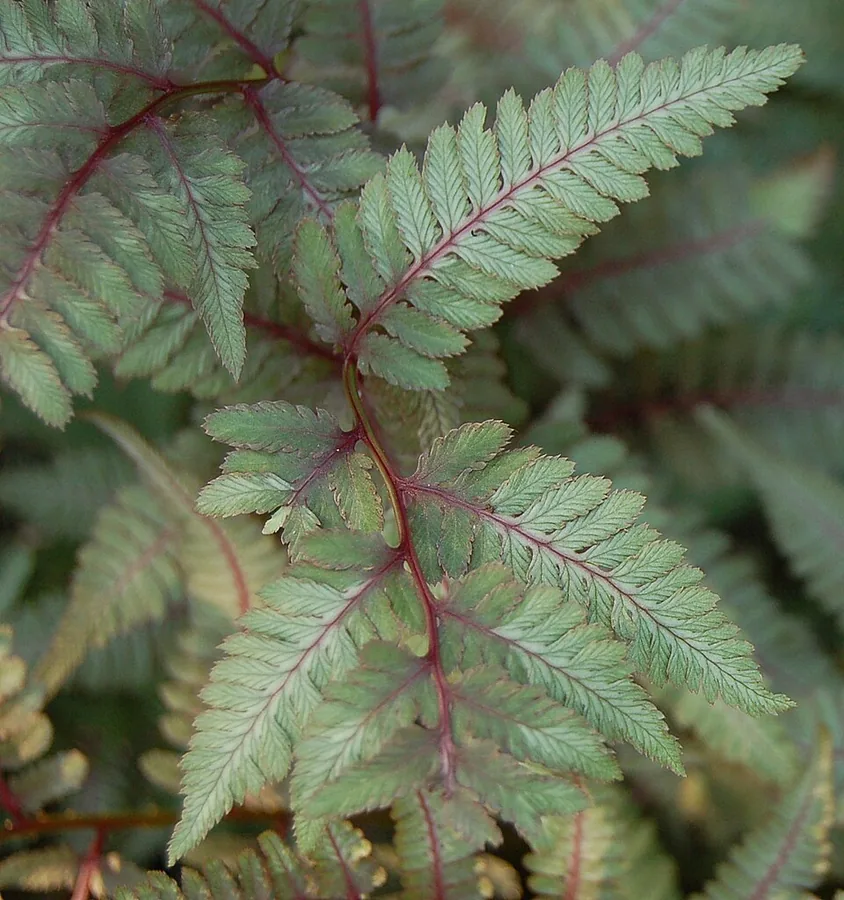
Athyrium niponicum var. pictum ranks among the most colored of the hardy ferns. Its fronds carry a silvery-gray ground washed with wine-burgundy over dark reddish stems, and that pigmentation is what distinguishes it from the uniformly green ferns grown alongside it. It is a hardy perennial suited to shade, cold-tolerant enough to persist through winters across USDA zone 3 to 8.
The plant grows slowly in a clumping habit and stays compact, reaching 12 to 18 inches (30 to 46 cm) in height with a slightly greater spread. Being deciduous, it dies back to the ground each autumn and regenerates in spring, and the emerging fronds show the most saturated color of the year. Site it within close viewing range, where the painted detail reads clearly.
Its cultural demands are minimal. Provide light to dappled shade and a soil that remains moist while draining freely, and the fern is largely self-sufficient. Two conditions account for most decline: excess sun, which suppresses the variegation, and saturated ground, which induces crown rot.
Care
The short version: part to full shade, soil held evenly moist but never saturated, and a humus-rich bed improved with compost. Mulch to conserve moisture, divide the clump every few years, and allow adequate spacing for the spread.
Light
Site it in part to full shade, the exposure this fern is adapted to. Light, dappled shade elicits the strongest silver and burgundy, whereas excess direct sun both suppresses the pigment and scorches the frond tips through moisture loss.
Water
Hold the soil consistently moist and never let it dry, since drought is the direct cause of marginal crisping. Increase watering through heat or drought, and use mulch to slow evaporation and steady the moisture between waterings.
Soil
It requires humus-rich soil high in organic matter, moist yet freely draining. Boggy, waterlogged ground is the condition to exclude, because oxygen deprivation there rots the crown and roots.
Temperature
This is a cold-hardy taxon that endures winters to -31°F (-35°C) and summer maxima near 86°F (30°C). That broad thermal tolerance is the basis for its performance across USDA zones 3 to 8.
Humidity
It favors high humidity and performs in the moist, sheltered atmosphere of a shaded bed. Dry, moving air raises transpiration and browns the frond margins, so sustained soil moisture and some shelter offset that stress.
Feeding
Apply a balanced fertilizer sparingly in spring, or top-dress with compost or leaf mold in its place. It is a light feeder, so heavy applications serve no purpose and are best withheld.
Pruning
Remove the old, dead fronds in late winter or early spring before the fiddleheads emerge. Cut away tattered fronds through the season as needed, though the plant otherwise dies back on its own each fall.
Repotting
This fern is grown in the ground rather than a container, so repotting does not apply. Instead, divide the clump every 3 to 4 years in early spring to sustain vigor, dividing once the center thins or the fronds diminish.
Size & spacing
Mature plants reach 12 to 18 inches (30 to 46 cm) tall and spread 18 to 24 inches (46 to 61 cm) wide. Allot each that spacing so the clump can develop fully without competing with adjacent plantings.
When to plant
This fern is governed by the seasons rather than a sowing calendar. Establish new plants in spring once hard frost has passed, allow the painted fronds to expand through the growing season, and let them senesce as cold returns before they regenerate the following spring.
Northern hemisphere
Southern hemisphere
Typical months for a temperate climate: start earlier in warm zones, later where spring frosts linger.
- Plant: Spring, after danger of hard frost has passed
Hardiness
USDA hardiness zones: 3–8
Temperature: down to -40°C
Troubleshooting
Nearly every problem this fern presents registers on the fronds, and the cause is typically a matter of water or light rather than pathogen pressure. Reading the early symptoms lets you intervene before a stand declines. Match the symptom below and correct the underlying condition while the response still holds.
Crown decay accompanied by wholesale frond collapse
A wholesale collapse with a softened base signals that the roots have suffocated in saturated soil, the setting in which crown rot develops. Waterlogged ground and standing water around the base drive out soil oxygen, and the fern's fine roots fail quickly once starved of it. Amend the soil with organic matter to open drainage, reset the plant on a raised or drier site, and reduce the watering that caused the saturation.
Fix:
- Improve drainage by amending with organic matter
- Replant in a raised or better-drained location
- Reduce overwatering
Scorched brown margins and tips on the fronds
Marginal browning traces back to a moisture deficit at the leaf edge, which is why drought stress ranks first, followed by excess direct sun and dry, moving air that raises transpiration. Because the fern lacks a waxy cuticle to slow water loss, the thin tissue at the tips dies first. Restore even soil moisture with deep watering, add a few inches of mulch to buffer the root zone, and relocate a scorched plant into deeper shade.
Fix:
- Water deeply to keep soil evenly moist
- Apply 5-8 cm of organic mulch to retain moisture
- Relocate or shade plants exposed to hot afternoon sun
Variegation bleaching out as fronds revert to green
The painted variegation responds to light intensity and to the progression of the season, so its strength is never fixed. Too much sun overrides the pigmentation and greens the fronds, and accumulated summer heat dulls the tones as the months advance. Midsummer greening is a normal seasonal response, and the flush of spring fronds returns in full color, but persistent washout in a bright site calls for a move into lighter, dappled shade.
Fix:
- Provide light to dappled shade
- Accept natural midsummer greening, as fresh spring fronds return with color
Ragged holes chewed through the fronds
Irregular holes with torn margins and a nearby silvery trail identify slugs and snails, which favor the same cool, damp shade this fern occupies. Their rasping mouthparts leave the characteristic ragged edge. Hand-pick them after dark when they feed, apply iron-phosphate bait, and clear the leaf litter and debris that give them daytime cover.
Fix:
- Hand-pick slugs and snails at night
- Use iron-phosphate slug bait
- Remove debris and litter that shelter slugs
Toxicity
For households with animals, the assessment is favorable: this is a true fern with no documented toxins, and it does not appear on the ASPCA's list of harmful plants. It is safe around cats, dogs, horses, and other animals. It is not a food plant, so there is no reason to permit grazing, but an incidental nibble poses no hazard.
Safe for
People · Cats · Dogs · Horses · Rabbits · Livestock · Birds
Cats None
As a true fern with no documented toxins, this plant poses no poisoning risk to a cat that samples a frond. Bulk ingestion of any foliage can still provoke drooling or regurgitation through simple gastric irritation, so it does not merit encouragement as a browse.
Dogs None
The fern contains no compounds known to harm dogs, so contact and casual tasting carry no toxic consequence. A dog that consumes a large volume of fronds may show a transient digestive upset, the ordinary result of overeating plant matter rather than a poisoning.
Horses None
No recognized equine toxin occurs in this fern, which places it outside the roster of pasture hazards. It has no role in the equine diet, yet an incidental mouthful taken during grazing warrants no concern.
Rabbits None
Rabbits can browse the fronds without toxic effect, and in practice they tend to bypass this species. Restrict it to an occasional taste rather than a dietary staple, since it supplies them with little of value.
Livestock None
Ruminants such as cattle, goats, and sheep encounter no documented risk from this fern. It carries no toxins that would affect an animal that grazes into a stand of it.
Birds None
The foliage is compatible with both aviary and wild birds, as the plant holds nothing injurious. A bird that pecks at a frond meets no harmful constituent.
People None
The fern is non-hazardous to handle and safe to have near children. It is not cultivated as an edible, so no part of it should be regarded as food.
No known toxicity, but the plant is not a food and large quantities of any plant material can cause mild stomach upset if eaten.
Varieties
The painted fern has yielded several named selections, each expressing the same silver-and-burgundy pigmentation in a distinct proportion. The following are the ones worth recognizing by name.
Pictum
The type selection presents silvery-gray fronds infused with wine-burgundy over dark reddish midribs and stems.
Silver Falls
This vigorous, mounding selection bears brightly silvered fronds marked with deep burgundy veining.
Burgundy Lace
A silvery overlay covers pronounced wine-burgundy across finely divided, lacy fronds.
Ursula's Red
Deep red-burgundy extends outward from the midrib into silvered frond margins.
Pewter Lace
Finely divided fronds carry a subdued pewter-silver finish.
How to propagate
The painted fern increases readily, and dividing a clump yields true-to-type copies of a plant already in the garden.
DivisionEasy
Early spring · One growing season
Division of an established clump in early spring is the standard means of increase and ranks among the least demanding propagation techniques. Lift the crown, separate it into sections with viable roots and growing points, and reset the divisions, each of which establishes over a single growing season. Spore propagation is also possible but slow, and it is best reserved for specialists.
Myths
Athyrium niponicum poses a poisoning risk to household animals.
The taxon is absent from the ASPCA toxic plant database, and true ferns are classed as non-toxic. It is safe around cats, dogs, and other animals, though as a foliage ornamental it is not intended as feed.
Fern culture requires dense shade and zero direct light.
This selection develops its strongest silver and burgundy under light to dappled shade. Too much direct sun washes the color out, while dense, sunless shade produces weak, sparse growth, so an intermediate light level serves it best.
Fern roots thrive only in saturated, marsh-like conditions.
The painted fern requires soil that holds even moisture while draining freely, amended with ample humus. Waterlogged ground rots the crown and roots, so drainage governs its health as much as consistent moisture does.