Ornamental · Poaceae
Japanese Forest Grass
Hakonechloa macra
Give it shade and steady moisture, and this grass cascades over a bed's edge like falling water.
Partial shade
Every 3–7 days
USDA 5–9
12–18 in · 30–46 cm
Overview
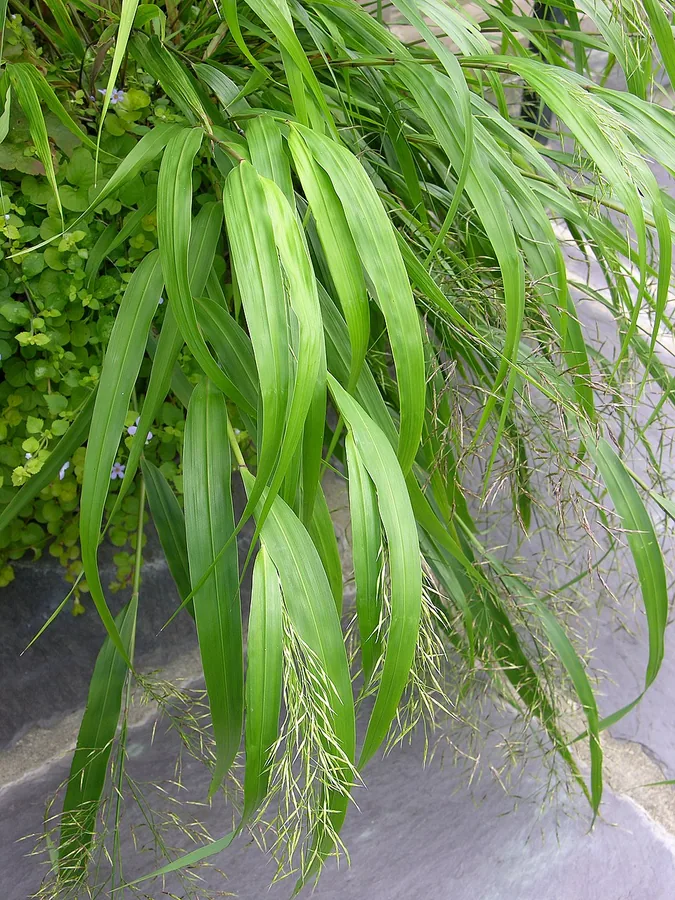
Japanese forest grass is the uncommon ornamental grass adapted to shade rather than open sun. It originates in the wooded mountains of Japan, on damp, rocky slopes, and that woodland origin explains its cascading mound and its intolerance of dry, exposed sites. The blades orient in a single direction, so a planting reads like green water flowing downhill.
Growth is slow and the habit stays low, holding to 12 to 18 inches (30 to 46 cm) in height, which suits it to a path edge or the front of a shade border. The gold and variegated selections, notably Aureola, carry enough foliage color to illuminate the dim positions that defeat many perennials. Green forms develop autumn tones of red and orange before dying back for winter.
The species earns its easy reputation once sited correctly. Maintain a rich, evenly moist root zone, screen it from hot afternoon sun, and its demands are few. The chief constraint is its pace, since a young clump requires several seasons to establish and spread to full width.
Care
The short version: partial to dappled shade, a root zone held rich and evenly moist, and a single cut back in late winter. Provide slightly acidic soil, shelter from hot afternoon sun, and time for a slow clump to establish.
Light
Site it in partial to dappled shade, the exposure that distinguishes it from the sun-loving majority of ornamental grasses. It withstands full shade and a measure of morning sun, but hot afternoon light scorches the blades. Gold and variegated forms develop their fullest color in bright shade rather than deep gloom, since the pigment depends on adequate light.
Water
Hold the soil consistently moist, because this is a moisture-adapted species that scorches once the root zone dries. Heat and sun raise transpiration and increase demand accordingly. Water deeply through dry spells and mulch to reduce evaporation around the roots.
Soil
Grow it in humus-rich, well-drained soil on the slightly acidic side, within a pH of 5.5 to 6.5. Incorporated compost supplies the slow roots and helps the medium retain even moisture without becoming waterlogged.
Temperature
Cold hardiness is strong, extending to roughly -20°F (-29°C), with summer tolerance to about 84°F (29°C). Heat by itself is not the problem; heat combined with a dry root zone or direct sun is what burns the tissue.
Humidity
Ambient garden humidity is sufficient, so no target figure applies. Even soil moisture is the governing factor, far more than atmospheric humidity, and it is what prevents the leaf tips from crisping.
Feeding
Apply one feed in spring, either a balanced fertilizer or a top-dressing of compost or organic matter over the crown. That single seasonal application meets the nutrient needs of an established clump.
Pruning
Cut the spent foliage to the ground in late winter or early spring, ahead of the emerging shoots. The plant dies back completely and offers no winter structure, so this one annual cut is the whole of its pruning.
Repotting
Lift and divide the clump every 2 to 3 years, or sooner when the center congests and begins to die out. Reduced vigor and roots heaving the crown are the further indicators that division is due.
Size & spacing
Mature plants reach 12 to 18 inches (30 to 46 cm) in height with a spread of 18 to 24 inches (46 to 61 cm). Allow that footprint per clump and let the slow grower occupy the interval over several seasons.
When to plant
This grass follows a seasonal cycle rather than a harvest. Plant it out in spring, cut the spent foliage to the ground in late winter before the new shoots emerge, and expect its inconspicuous yellow-green flower spikes in late summer.
Northern hemisphere
Southern hemisphere
Typical months for a temperate climate: start earlier in warm zones, later where spring frosts linger.
- Plant: spring
- Harvest: late summer (July to August), inconspicuous yellow-green flower spikes
Hardiness
USDA hardiness zones: 5–9
Temperature: down to -29°C
Troubleshooting
Nearly every complaint with Japanese forest grass resolves to a light problem or a moisture problem, and the foliage records which. Diagnose from what the leaves show, match it against the entries below, and correct the siting or the watering before the appearance of the clump declines.
Clumps slow to expand across seasons
A clump that widens little each year is exhibiting its slow growth rate, an inherent trait of the species, which establishes over several seasons rather than colonizing a bed quickly. Dry or impoverished soil compounds the lag by limiting the vigor the roots can build. Allow it time, maintain a rich and evenly moist root zone, top-dress with compost in spring to feed the crown, and mulch through winter to guard against frost heave.
Fix:
- Be patient; it is a slow grower that establishes over several years
- Maintain rich, evenly moist soil and a spring top-dress of compost
- Mulch crowns over winter to prevent frost heaving
Scorched leaf tips and bleached margins
Crisped, bleaching margins point to sun scorch, the result of too much hot, direct sun or soil that has dried in the heat and left the blades unable to keep up with water loss. Gold and variegated forms carry less pigment to shield the tissue, so they burn first under harsh afternoon exposure. Relocate the clump to part or dappled shade, hold the soil evenly moist, and mulch to slow evaporation from the root zone.
Fix:
- Move or site in partial to dappled shade, giving only morning sun in hot climates
- Keep soil consistently moist and mulch to conserve moisture
- Water deeply during heat and drought
Gold fading to lime green in deep shade
When gold and variegated forms drift to a dull lime green and open into a loose, flopping habit, the cause is too much shade, since low light cannot sustain the pigment that gives these selections their color. The correction is more light, not less. Site colored cultivars in bright dappled shade or morning sun, where stronger illumination deepens the gold and firms the mounding form. Deep shade belongs to the green forms, which do not depend on bright foliage.
Fix:
- Move gold and variegated forms to brighter dappled shade or morning sun for best color
- Accept that color is most vivid in part shade, not deep shade
Ragged feeding holes in the blades
Irregular holes chewed through the blades point to slugs, which favor the damp, shaded conditions this grass is grown in. Confirm by the slime trails that accompany the damage and by its worsening after wet weather. Hand-pick the slugs or apply a control, remove the surface debris that shelters them, and thin congested clumps to raise air movement. The species is otherwise free of serious pests.
Fix:
- Hand-pick slugs or use slug controls
- Reduce excess debris and improve air circulation around clumps
Toxicity
Households with pets or children can be at ease with this species. Japanese forest grass is not toxic and is absent from the ASPCA's poison lists, so ingestion of the blades carries no poisoning risk. The outer limit is mild vomiting, the ordinary reaction to eaten grass, or pollen-triggered allergy symptoms in already sensitized people.
Safe for
People · Cats · Dogs · Horses · Rabbits · Livestock · Birds
Cats None
Poses no toxic risk to cats. A cat that grazes the blades may regurgitate a little, as grass often prompts, but the tissue contains nothing poisonous.
Dogs None
Holds no toxins that would affect a dog. A mouthful of foliage tends to produce at most a brief episode of mild vomiting, the ordinary response to eaten grass.
Horses None
Presents no hazard to grazing horses, being a non-toxic ornamental grass.
Rabbits None
Carries nothing injurious to rabbits, whose nibbling of the foliage does no harm.
Livestock None
Contains no toxic compounds, so cattle, goats, and sheep face no risk from it.
Birds None
Remains harmless to birds that perch among the blades or take the seed heads.
People None
Safe around children and adults. The one qualification is grass pollen, which may provoke allergy symptoms in individuals already sensitized to it.
Not poisonous, but pets that nibble grass foliage may occasionally vomit, and grass pollen can trigger allergies in sensitive individuals.
Varieties
The named selections separate chiefly by foliage color and by how strongly they brighten a shaded position. The following are the ones worth knowing.
Aureola
Named 2009 Perennial Plant of the Year, Aureola bears gold leaves striped with narrow green and develops its strongest color in part shade.
All Gold
All Gold carries solid bright golden-yellow blades in a more upright, spiky habit than the arching Aureola.
Beni Kaze
Beni Kaze, a name meaning red wind, holds green blades through the season that shift to red and gold in autumn.
Nicolas
Nicolas is a compact green selection that colors to fiery orange and red as autumn advances.
How to propagate
Japanese forest grass is increased by dividing an established clump, a slow but dependable operation carried out in spring.
DivisionEasy
Spring, just as new foliage emerges · Slow; clumps need 2 to 3 years between divisions and are slow to fill in
Division is the simplest method of increase and the only reliable way to keep a cultivar's coloring true, since vegetative propagation preserves the parent genotype. Lift and split the clumps in spring as the new foliage emerges. Space divisions generously, because the clumps require 2 to 3 years to knit back together between operations. Seed propagation is possible, but the resulting seedlings will not reproduce the parent's coloring.
Myths
All ornamental grasses need full sun.
Japanese forest grass is among the few ornamental grasses that genuinely prefer shade, and it excels in the shady beds where sun-demanding grasses fail. Hot, full sun scorches the foliage, whereas partial to dappled shade develops both its strongest color and the graceful, cascading form the species is grown for.