Ornamental · Poaceae
Japanese Blood Grass
Imperata cylindrica 'Rubra'
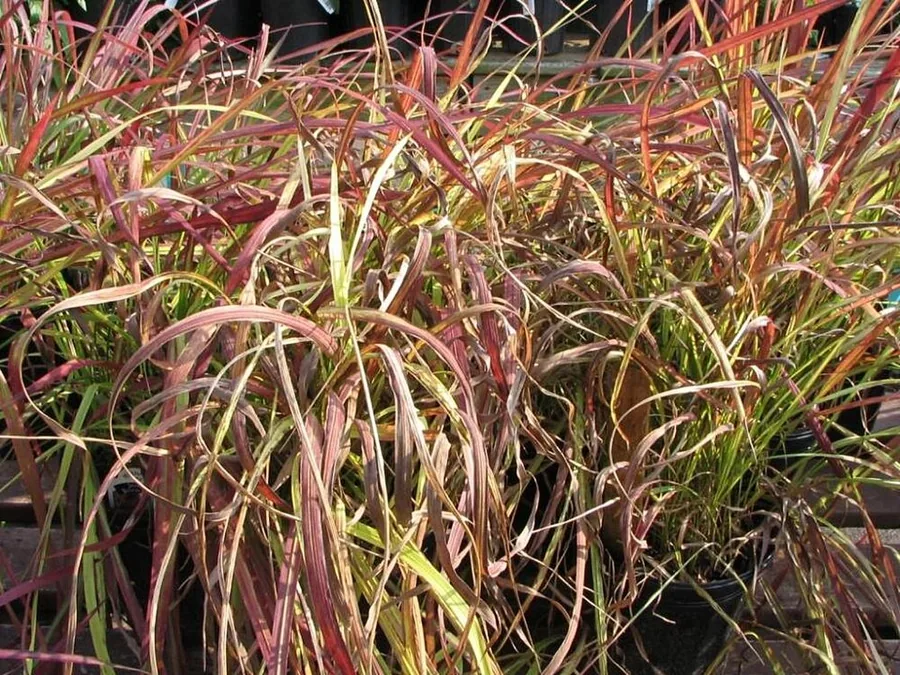
Give it full sun and even moisture, and the blades develop blood-red pigment from the tips downward.
Full sun
Every 5–10 days
USDA 5–9
12–18 in · 30–46 cm
Overview
Japanese blood grass is cultivated principally for foliage color. Its slender upright blades emerge green at the base and accumulate blood-red pigment from the tips downward, so the clump appears luminous when low sun transmits through the leaves from behind. A member of the grass family, it builds a compact, roughly knee-high mound and expands at a modest rate that keeps it in position.
The plant is a cold-hardy perennial, tolerating winter minima of -20°F (-29°C) and regenerating from its root system each spring. Once established it is undemanding, though it holds its pigment best under full sun with consistent moisture, since both drive the color response. As an ornamental it performs at the front of a planting or against a dark backdrop that heightens the contrast with the red.
One characteristic distinguishes it from a routine ornamental and warrants attention. The red cultivar can revert to its wild green form, cogongrass, which holds federal noxious weed status and ranks among the most destructive invasive grasses recorded. The plant poses no toxic hazard to people or pets, but the regulatory and invasive dimension is substantive and is addressed below.
Care
The short version: full sun for maximal red pigment, evenly moist soil, and an annual cutback in late winter. Monitor the clump for any green shoots and excavate them the moment they appear.
Light
Site it in full sun, which drives the most intense pigment. The blades tolerate light shade, but under anything deeper the red recedes toward green, negating the ornamental purpose of the selection.
Water
Maintain evenly moist soil, irrigating roughly every 5 to 10 days according to conditions. An established clump withstands a brief dry interval, yet consistent moisture yields the best color and the strongest vigor.
Soil
It performs best in fertile, well drained loam with some moisture retention. A pH between 5.5 to 7.0 is suitable, a range that encompasses most ordinary garden soils.
Temperature
This is a markedly cold-hardy grass spanning a wide thermal range, from a winter minimum of -20°F (-29°C) to summer highs near 100°F (38°C). It dies back over winter and regenerates from the roots each spring.
Humidity
Ambient outdoor humidity meets its requirement, so no atmospheric moisture management is warranted. It accommodates average garden conditions without difficulty.
Feeding
A single application of balanced general-purpose fertilizer in spring suffices. Additional feeding through the season is unnecessary, since the grass advances at a steady, moderate rate on its own.
Pruning
Cut the entire clump to ground level in late winter, ahead of new growth. The essential task is prompt removal of any all-green shoots as they emerge, because they denote reversion to the invasive form.
Repotting
In containers, divide and renew the clump every 2 to 3 years, or earlier if roots fill the pot or the center declines. Division restores vigor and sustains pigment intensity.
Size & spacing
Anticipate a clump roughly 12 to 18 inches (30 to 46 cm) tall with a spread of 12 to 24 inches (30 to 60 cm). Allocate that spacing per plant so the mound develops fully without crowding.
When to plant
Plant Japanese blood grass outdoors in spring once the last frost has passed, and it establishes over the first growing season. It seldom flowers in cultivation, so no bloom period governs the schedule. Cut the clump to the ground in late winter, and new red growth emerges as temperatures rise.
Northern hemisphere
Southern hemisphere
Typical months for a temperate climate: start earlier in warm zones, later where spring frosts linger.
- Plant: spring after last frost
- Harvest: rarely flowers in cultivation
Hardiness
USDA hardiness zones: 5–9
Temperature: down to -29°C
Troubleshooting
Two issues account for most problems: diminished color and, more consequentially, the plant reverting toward its invasive green progenitor. Distinguishing the two matters, because one is a simple cultural correction and the other requires prompt intervention. Match the observed symptom below and act while the response still carries weight.
Fully green blades arising among the red foliage
Vigorous green shoots signal the plant reverting to cogongrass, the wild green form of the species and among the most damaging invasive grasses known. Because that green growth spreads aggressively by rhizome, excavate each reverting shoot the moment it appears, tracing and lifting the connected rhizomes as well. Bag and bin the material rather than composting, since fragments can resprout, and keep inspecting the site, as unseen rhizomes travel underground.
Fix:
- Dig out the green-reverting shoots immediately, including rhizomes
- Bag and destroy all removed material; do not compost
- Monitor the area repeatedly for regrowth
Prohibited or classed a noxious weed in your region
The species carries federal noxious weed status, which makes sale and interstate transport unlawful, and numerous states extend that prohibition to the ornamental cultivar. In its cogongrass form it establishes dense, fire-promoting monocultures that displace native vegetation, which is precisely why regulators restrict it. Confirm your state's regulations before planting or relocating it, avoid the southeastern US entirely, and remove and destroy any specimen growing where it is prohibited.
Fix:
- Verify local and state legality before planting or moving the plant
- Do not plant in or near the southeastern US
- Remove and destroy plants where prohibited
Washed-out color instead of deep red
Poor coloration nearly always traces to insufficient light. The red pigment develops most intensely under full sun, whereas a clump held in heavy shade retains far more green. Relocate it to a sunnier position and maintain even soil moisture, and the deep coloration returns as the new growth develops.
Fix:
- Relocate to a site with full sun for best red color
- Ensure soil stays evenly moist
Toxicity
On toxicity the record is favorable: Japanese blood grass is not poisonous to people or pets, and the ASPCA does not list it among toxic plants. A cat or dog that chews the blades may regurgitate a little grass, and nothing further. The genuine hazard is not toxicological but the plant's capacity to turn invasive, so consult the section above on reversion and state regulation.
Safe for
People · Cats · Dogs · Horses · Rabbits · Livestock · Birds
Cats None
No toxic principle affects cats. Any vomiting after a cat chews the blades reflects the common mechanical response to grass fiber rather than poisoning.
Dogs None
The foliage holds no compounds harmful to dogs. At most, an ingested mouthful produces mild, self-limiting gastrointestinal upset.
Horses None
Horses are unaffected, as the grass lacks the toxic constituents responsible for poisoning in many ornamental species.
Rabbits None
Rabbits may graze the blades without hazard, since no part of the plant contains a toxic principle.
Livestock None
The foliage presents no poisoning risk to cattle, goats, or sheep.
Birds None
Birds are unaffected, with neither the leaves nor the seed carrying a toxic compound.
People None
The plant is safe to handle and to keep around children. It is not cultivated for consumption, and the only relevant sensitivity is grass pollen in individuals predisposed to hay fever.
Not chemically poisonous; pets that nibble grass may vomit or have mild stomach upset, and grass pollen can affect allergy-prone individuals. The real risk with this plant is invasiveness and legality, not toxicity.
Varieties
Only two forms merit discussion, and the distinction between them defines the plant's entire horticultural profile.
Red Baron
This is the standard ornamental selection, its upright slender blades developing blood-red pigment from the tips downward and appearing to ignite when low sun transmits through them from behind.
Imperata cylindrica (species, cogongrass)
The all-green wild form ranks among the world's most destructive grasses and holds federal noxious weed status, establishing dense fire-prone stands, and the red cultivar is capable of reverting to it.
How to propagate
This grass is increased by a single method, clump division, and the operation is straightforward provided you remain vigilant for green-reverting growth.
DivisionEasy
Spring · One growing season
Division in spring is the sole practical means of increase, because the cultivar seldom produces viable seed. Lift an established clump, separate it into sections, and replant them, and each division establishes over a single growing season. Discard rather than distribute any section exhibiting green reverting growth, since it carries the invasive form.
Myths
The red-leaved cultivar carries no toxicity and demands no special caution.
The toxicological claim is sound, as the red form is genuinely non-toxic to pets. The concern lies elsewhere: the cultivar can revert to the aggressive green cogongrass, the species itself holds federal noxious weed status, and its sale is banned or restricted in many states. The operative hazard is invasiveness and legality, not toxicity.