Ornamental · Polemoniaceae
Jacob's Ladder
Polemonium caeruleum
Give it cool shade and steady moisture, and Jacob's ladder raises tidy rungs of foliage beneath spring-blue flowers.
Partial shade
Every 3–7 days
USDA 4–8
18–24 in · 46–61 cm
Overview
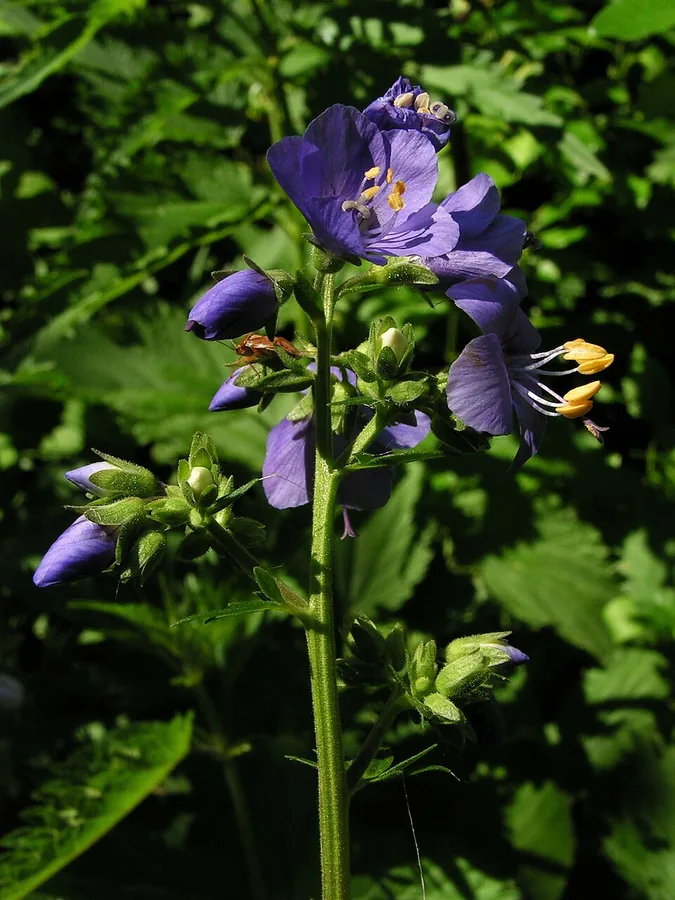
The common name describes the leaf architecture, in which pinnate pairs of leaflets ascend each stem in the manner of ladder rungs. Jacob's ladder is a clump-forming herbaceous perennial in the phlox family, native to cool, moist meadows and woodland margins across the northern hemisphere. Its spring inflorescences carry loose cymes of nodding blue flowers held above a fine, ferny basal mound.
In cultivation it is an undemanding shade perennial. It requires rich, moisture-retentive soil and protection from intense insolation, and under those conditions it maintains form from spring through much of the season. Because leaflet tips brown as soil moisture falls, the foliage serves as a visible indicator of its water status.
Its garden value extends to plantings frequented by pets and children. Contrary to a persistent confusion with a toxic namesake, Polemonium caeruleum is not poisonous, and a related species carries a documented record of human use.
Care
The short version: site it in part to full shade in rich, humusy soil held evenly moist, with adequate air movement. Divide the clump periodically and cut it back post-bloom, and it is largely self-sustaining.
Light
Site Jacob's ladder in part to full shade. It tolerates limited morning sun, but strong afternoon exposure scorches the leaflets because the light load exceeds what the foliage can dissipate, so favor deeper shade in warm gardens.
Water
Hold the soil evenly moist at all times, irrigating every 3 to 7 days as conditions dictate. The species has no drought tolerance, and browning at the leaflet tips is the earliest sign that root moisture has fallen too low.
Soil
Grow it in rich, humusy loam that retains moisture while draining freely. Incorporate ample compost or leaf mold, since the spongy organic profile of a woodland-edge soil matches its native rooting environment.
Temperature
It is adapted to cool conditions, performing from roughly 19°F to 75°F (-7°C to 24°C) and hardy across zones 4 to 8. Heat rather than cold is the limiting factor, so summer shade reduces thermal stress and preserves appearance.
Humidity
Ambient outdoor humidity is adequate; the species does not require elevated moisture in the air. The more consequential factor is air movement, because still, saturated air favors leaf spot and mildew colonization of the foliage.
Feeding
Nutrient demand is modest. A single spring application of balanced fertilizer, or a compost top-dressing, supplies enough to sustain the plant through the growing season.
Pruning
After flowering, cutting the plant back to its basal foliage both tidies the clump and removes developing seed, which limits self-sowing. The regenerated basal mound then maintains structure for the remainder of the year.
Repotting
Lift and divide the clump every 2 to 4 years to sustain vigor. A center that is dying out, diminished flowering, or crowded and declining foliage all indicate that the clump has aged and needs dividing.
Size & spacing
Mature dimensions are a compact mound of about 18 to 24 inches (46 to 61 cm) in height and comparable spread. Allow each plant that same 18 to 24 inches (46 to 61 cm) so airflow through the stand limits foliar disease.
When to plant
Jacob's ladder is keyed to the cooler portion of the temperate year. Sow seed indoors in late winter or under glass in autumn, transplant in spring after frost or in fall, and the blue flowers open from April into May.
Northern hemisphere
Southern hemisphere
Typical months for a temperate climate: start earlier in warm zones, later where spring frosts linger.
- Sow: Late winter to early spring, or autumn under glass
- Plant: Spring after frost, or autumn
- Harvest: April to May
Hardiness
USDA hardiness zones: 4–8
Temperature: down to -34°C
Troubleshooting
Nearly all disorders in this species reduce to two environmental drivers: excess sun with drought stress, or high humidity in stagnant air. The foliage generally reveals which is at work. Match the symptom below and correct the siting before the problem progresses.
Dark spots or a white powdery film on the leaves
Distinct dark lesions signal leaf spot, while a chalky white coating is powdery mildew, and both advance where warm, humid, unmoving air lets fungal spores settle and germinate on the leaf surface. Remove and destroy the affected foliage to cut the inoculum, then thin or space the clump so the canopy dries faster after rain or dew. Keeping water off the leaves denies the spores the surface film they need to establish.
Fix:
- Remove and discard affected foliage
- Improve air circulation by thinning or spacing plants
- Avoid overhead watering
Browning leaflet tips or scorched, sun-baked foliage
Browned tips indicate leaf scorch, which develops when transpiration outruns the roots' water supply, either from excess sun load or from soil that dried out. Relocating the plant to part or full shade lowers that demand, and holding the soil evenly moist keeps the roots supplied. A mulch layer buffers soil temperature and slows evaporation, so moisture stays available through hot spells.
Fix:
- Move or transplant to part to full shade
- Keep soil consistently moist
- Mulch to conserve soil moisture
Ragged holes chewed through the leaves overnight
Irregular holes paired with silvery slime trails are diagnostic of slugs, which rasp the leaf tissue at night and shelter by day in the cool, moist debris around the crown. Handpicking after dark removes the active feeders, while traps or iron-phosphate bait reduce the population over time. Clearing damp litter and pulling mulch back from the crown removes the humid refuge they depend on.
Fix:
- Handpick slugs in the evening
- Use slug traps or iron-phosphate baits
- Reduce moist hiding spots near plants
Toxicity
For households with pets or young children, the assessment is straightforward: Jacob's ladder is not toxic. It belongs to the benign phlox family, and the warnings circulating online in fact reference a different plant that shares the vernacular name. It can be grown wherever animals or children have access.
Safe for
People · Cats · Dogs · Horses · Rabbits · Livestock · Birds
Cats None
No toxicity is reported in cats. Ingesting a leaf or flower carries no risk of poisoning.
Dogs None
Dogs face no poisoning risk. Chewing a stem may cause a passing digestive upset from the plant fiber and nothing more serious.
Horses Safe
The record notes no toxic compounds, so the species is regarded as safe in the presence of horses.
Rabbits Safe
Foliage is harmless to rabbits, though sustained browsing can set back an immature clump through defoliation rather than toxicity.
Livestock Safe
Cattle, goats, and sheep incur no poisoning risk from grazing this species.
Birds Safe
The plant poses no hazard to birds; its flowers function as a nectar source for bees and other pollinators.
People Safe
The species is not poisonous to people, and a relative has documented historical human use. Even so, its role is ornamental rather than culinary.
No special handling precautions reported; routine garden plant.
Varieties
The species type bears blue flowers, but several selections merit attention for foliage character or flower color. The following are the cultivars most often encountered in trade.
Brise d'Anjou
This clump-forming cultivar is grown chiefly for its ladder-like foliage margined in cream over green.
Snow and Sapphires
Its white-margined variegated leaves are set against the species' blue flowers, producing a two-tone effect.
White Pearl
This selection substitutes clean white flowers for the blue bloom typical of the species.
How to propagate
Jacob's ladder is readily increased. An established clump can be divided for genetically identical plants, or the species can be allowed to self-sow around the planting.
DivisionEasy
Early spring or fall · One growing season
Division is the most reliable method for renewing a clump, since it removes the exhausted center and resets vigor in the younger outer growth. Lift and divide in early spring or fall on a 2 to 4 year cycle, ensuring each division retains both roots and viable shoots, after which the pieces reestablish over a single growing season.
SeedEasy
Spring or autumn · Self-seeds freely; blooms typically the following year
Left undisturbed, the plant self-sows readily in spring or autumn, and the resulting seedlings generally reach flowering size the following year. Where volunteers are unwanted, deadheading the spent inflorescences or cutting the plant back before seed dispersal prevents the spread.
Myths
Jacob's ladder is poisonous to cats and dogs.
As a member of the phlox family, this species has no reported toxicity. The error originates in an ASPCA entry filed under 'Jacob's ladder' that in fact refers to a distinct plant, Smilax herbacea. Polemonium caeruleum is safe to grow around pets and children.