Ornamental · Polemoniaceae
Creeping Phlox
Phlox subulata
Sited in full sun with sharp drainage, creeping phlox forms a dense spring carpet of bloom.
Full sun
Every 7–14 days
USDA 3–9
4–6 in · 10–15 cm
Overview
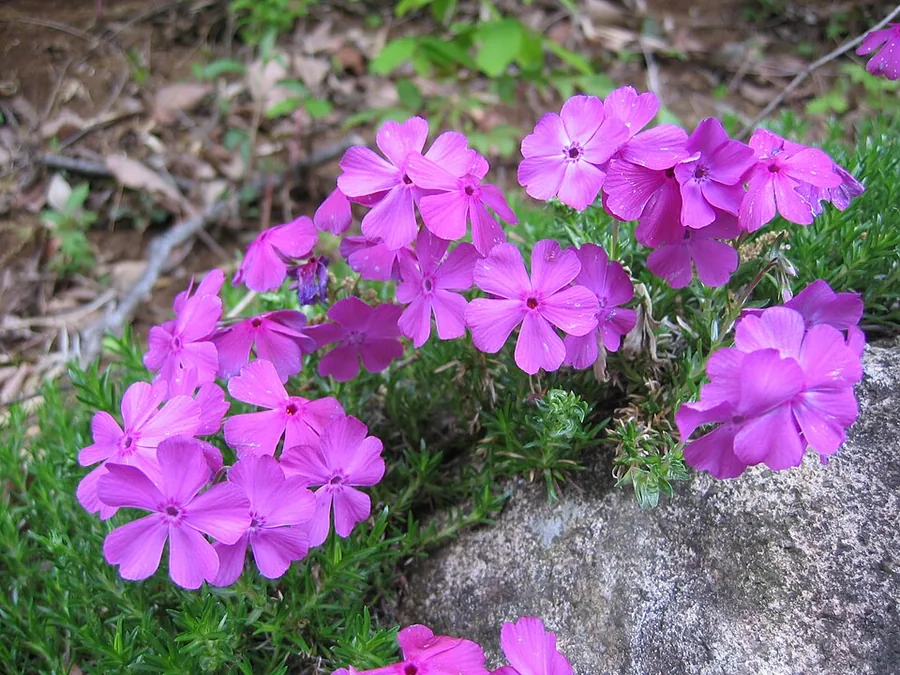
Among spring groundcovers, creeping phlox stands out for sheer floral density. This low, mat-forming perennial builds a thick stand of needle-like foliage, then carries so heavy a flush of bloom in early to mid spring that the leaves all but disappear beneath it. Its tolerance of dry, rocky substrate explains its success on slopes, walls, and rock gardens, sites that defeat many other plants.
The planting holds value through the rest of the year as well. The evergreen mat persists across hot summers and severe winters, and its cold hardiness reaches -40°F (-40°C). Once established, its requirements narrow to two: adequate sun and soil that drains.
It should not be confused with garden phlox, the tall summer perennial that shares the common name. Creeping phlox remains ankle high and extends by creeping outward rather than growing upward, a prostrate habit that suits it precisely for knitting between stones and edging the front of a border.
Care
The short version: full sun, sharp-draining sandy or gravelly soil, and water only during prolonged dry spells once the plant is established. Shear the stems back by half after bloom to keep the mat dense.
Light
Creeping phlox flowers most heavily in full sun; it tolerates partial shade, but flowering diminishes as shade increases. An open, sunny exposure produces the full sheet of color the plant is grown for.
Water
Once established it is drought tolerant and needs supplemental water only during prolonged dry spells. It performs on fast-draining ground and even on dry, rocky sites, so the top half of the soil should dry between waterings.
Soil
Grow it in sandy or gravelly, humus-rich soil that drains freely, since waterlogging is its principal weakness. A pH of 5.5 to 7.0 suits it, and a slope or raised bed improves drainage by shedding excess water.
Temperature
It is exceptionally cold hardy, withstanding -40°F to 95°F (-40°C to 35°C). No winter protection is required anywhere within its range, and it reliably resumes growth each spring.
Humidity
Ambient outdoor humidity is sufficient, so no target level applies. Drainage and air movement matter far more, because damp, stagnant conditions are what predispose the foliage to disease.
Feeding
It performs on lean soil and has modest nutrient demands. A light application of balanced general-purpose fertilizer in spring meets its needs, while excess nitrogen produces soft, lax stems.
Pruning
Immediately after flowering, cut the stems back by about half. This single shearing maintains a dense, compact mat, prevents the center from lignifying and going bare, and keeps the planting tidy.
Size & spacing
The mat stays low at 4 to 6 inches (10 to 15 cm) in height, while each plant spreads 24 to 35 inches (60 to 90 cm) across. Spaced to that width, individual plants merge into a continuous carpet.
When to plant
Because creeping phlox is grown for its spring flush, the calendar turns on two operations: establishment and a single post-bloom cut. Set new plants in spring or early fall, expect flowering from April into May, and shear the mat once the display finishes.
Northern hemisphere
Southern hemisphere
Typical months for a temperate climate: start earlier in warm zones, later where spring frosts linger.
- Sow: Usually propagated vegetatively rather than from seed; not typically sown indoors.
- Plant: Plant in spring or early fall in a sunny, well-drained site.
- Harvest: Blooms in early to mid spring, roughly April to May.
Hardiness
USDA hardiness zones: 3–9
Temperature: down to -40°C
Troubleshooting
Creeping phlox remains largely problem-free, and what trouble does arise registers either on the foliage or as a thinning mat. Learn the few diagnostic signs below to intervene early. Match the symptom, then act while the response still helps.
Fine leaf stippling and yellowing with silky webbing underneath
Stippled, yellowing foliage strung with fine webs underneath points to spider mites, which feed heavily in hot, dry conditions and drain pigment from the leaf as they go. A forceful spray of water knocks the colony loose, and keeping the planting from drought stress denies the mites the dry, stressed tissue they favor. Where they persist, insecticidal soap or horticultural oil will finish them.
Fix:
- Spray foliage with a strong jet of water to dislodge mites
- Improve airflow and avoid drought stress
- Treat with insecticidal soap or horticultural oil if needed
Leaf distortion and discoloration through extended humid weather
Distorted, discolored leaves that appear during prolonged warm, wet weather indicate foliar nematodes, which migrate through films of surface moisture into the leaf tissue and damage it from within. Removing and destroying the affected foliage at first sight cuts the population that can spread. Watering at the base rather than overhead, along with better drainage and air movement, removes the wet conditions the nematodes depend on.
Fix:
- Remove and destroy affected foliage
- Avoid overhead watering and improve drainage
Cleanly severed stems just above the soil line
Clean-cut stems and foliage near soil level are the signature of rabbit browsing, since rabbits clip growth cleanly rather than tearing it. A barrier fence or a repellent denies them access to the mat. Young plantings draw the heaviest pressure, so protecting them first matters most where rabbit numbers are high.
Fix:
- Use fencing or repellents to deter rabbits
Central dieback leaving woody, open growth
A woody, hollow center ringed by spreading edges develops when the planting is left unpruned, because older interior stems lignify and stop producing dense foliage while only the growing margins stay vegetative. Shearing the stems back by roughly half right after bloom stimulates branching from the base and refills the gap with fresh growth. Lifting and replanting the vigorous outer sections offers a second route to the same dense habit.
Fix:
- Shear stems back by about half after bloom to promote dense regrowth
- Divide and replant vigorous outer sections
Toxicity
For households with pets or grazing stock, the verdict is favorable: creeping phlox is safe throughout. The ASPCA classifies moss phlox as non-toxic to cats, dogs, and horses, and the species poses no risk to other animals or to people. It can be sited anywhere without concern.
Safe for
People · Cats · Dogs · Horses · Rabbits · Livestock · Birds
Cats Safe
The ASPCA classifies moss phlox as non-toxic to cats, so incidental grazing carries no toxicological risk.
Dogs Safe
Dogs may investigate and chew the mat without consequence, as the species contains no compound harmful to them.
Horses Safe
Horses grazing near a stand are unaffected, since creeping phlox holds no toxin documented to harm them.
Rabbits Safe
Rabbits routinely browse the foliage, and while that reduces the planting, the plant is harmless to them.
Livestock Safe
Cattle, goats, and sheep can graze around it without risk, as it carries nothing toxic to farm animals.
Birds Safe
Birds feeding on the flowers or seeds suffer no ill effect from this species.
People Safe
It presents no hazard to people, though it is cultivated as an ornamental and not as an edible.
Varieties
Numerous named cultivars exist, separated chiefly by flower color and degree of disease resistance. The few below are the ones worth knowing.
Emerald Blue
Valued for bluish purple flowers borne densely across a low, even mat.
Fort Hill
Noted for resistance to Phytophthora, the root and stem rot that fells less tolerant plants.
White Delight
A clean white-flowered cultivar that also resists southern blight.
How to propagate
Creeping phlox propagates readily, whether by dividing a mature mat or rooting cuttings from a plant already in the garden.
DivisionEasy
Divide in early spring or after flowering. · One growing season
Division is the most reliable method: lift an established mat and split it in early spring or once flowering ends. Separating the vigorous outer growth from the depleted center and replanting it into well-drained soil exploits the plant's strongest tissue, and the divisions establish over a single growing season.
Stem cuttingsEasy
Take cuttings in late spring or early summer. · Several weeks to root
Stem cuttings taken in late spring or early summer offer a clonal alternative. Inserted into moist, well-drained media, they root over a few weeks and yield plants genetically identical to the parent.
Myths
Phlox is phlox, so the creeping and garden types are identical.
The shared common name masks a clear botanical distinction. Creeping phlox is low and mat-forming and flowers in spring, whereas garden phlox is tall and upright and flowers in summer. These are two separate species with distinct growth habits, so the label, not the name, settles which plant you are buying.
The foliage of Phlox subulata is toxic to household pets.
The toxicological record contradicts this. The ASPCA classifies moss phlox as non-toxic to dogs, cats, and horses, so foliage that an animal happens to eat presents no danger. The species can be sited where pets have access without concern.