Ornamental · Polemoniaceae
Cup-and-saucer Vine
Cobaea scandens
Provide full sun and a tall, sturdy support, and this fast climber will sheathe a wall in bell-shaped flowers by late summer.
Full sun
Every 3–7 days
75–120 days
USDA 9–11
Overview
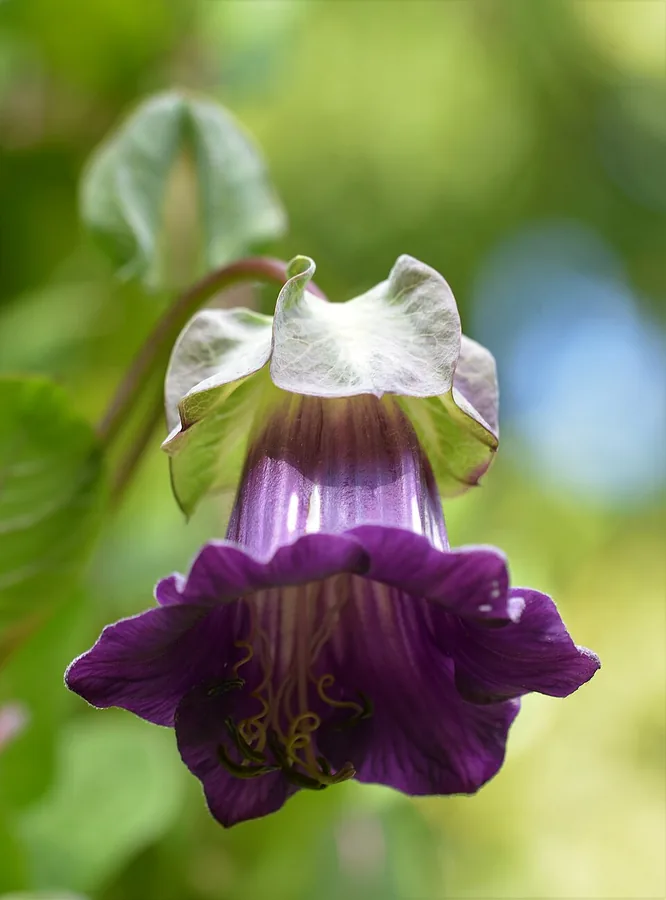
The common name describes the flower precisely: a deep, bell-shaped cup seated on a broad, leafy green calyx that reads as a saucer. Each bloom opens creamy green and matures to a rich violet-purple, so a single vine carries both stages of color simultaneously. The species originates in the Mexican highlands, the reason gardeners in cold regions handle it as a tender plant rather than a hardy perennial.
Its defining trait is growth rate. Sown in late winter, it advances 10 to 20 feet or more in one season, attaching to any available structure by means of branched tendrils at the leaf tips. Provide a fence, an arbor, or a tall trellis and it will clothe the entire support by late summer.
Established plants demand little. The essential conditions are firm support, full sun, and restraint with feeding, because rich soil and high nitrogen yield dense foliage and few flowers. Manage that balance and the vine blooms from summer until the first frost.
Care
The short version: full sun, a tall rigid support, and consistent even moisture in fertile but not over-enriched soil, with nitrogen kept low so the plant flowers rather than diverting energy to leaf.
Light
Site this vine in full sun to maximize flowering, though it tolerates light afternoon shade. A position against a warm, sun-facing wall is ideal, because the radiated heat drives both extension growth and bloom.
Water
Maintain evenly moist soil throughout the growing season and irrigate regularly while the vine is in active growth. Avoid complete drying in hot weather, but ensure free drainage, since the roots will not tolerate waterlogged soil.
Soil
It performs in loam, sand, or clay provided drainage is adequate, across a pH of 5.5 to 7.5. Choose fertile rather than heavily enriched ground, because excessive richness shifts the balance toward leaf at the expense of flower.
Temperature
The vine endures a broad range of roughly 25°F to 90°F (-4°C to 32°C), but has no tolerance for hard frost. Treat it as tender and set it outdoors only once the cold has decisively passed.
Humidity
Ambient outdoor humidity meets its needs, so no target value applies. More relevant is air movement through the canopy, which suppresses the sap-feeding pests to which the foliage is prone.
Feeding
Apply a balanced or lower-nitrogen liquid feed monthly through spring and summer. Restrict the nitrogen, because an excess produces a leafy plant that flowers poorly, the opposite of the desired outcome.
Pruning
As an annual it requires almost no pruning. Pinch the growing tips to induce branching and tie the stems to their support as they extend. Where it persists as an evergreen, cut it back in late winter to shape the plant and excise diseased wood.
Repotting
Pot seedlings on as they develop, then transplant outdoors once frost has passed. For a container specimen, shift it to a larger pot when the roots fill the existing one or protrude from the drainage holes.
Size & spacing
This is a large climber, attaining 10 to 20 feet (3 to 6 m) in a single season with a spread of 3 to 6 feet (91 to 183 cm). Allot that area and a support tall enough to bear it.
When to plant
The species is heat-dependent and frost-intolerant, which sets the schedule. Sow seed indoors in late winter, transplant only once frost has passed and the soil has warmed, and expect bloom from summer through to the first frost.
Northern hemisphere
Southern hemisphere
Typical months for a temperate climate: start earlier in warm zones, later where spring frosts linger.
- Sow: Start seed indoors about 8-10 weeks before last frost; sow seeds on edge and keep warm (about 68-72 degrees F), germinating in roughly 14 days.
- Plant: Transplant out after all danger of frost has passed and soil is warm.
- Harvest: Blooms summer into fall until frost; flowers open creamy-green and age to deep violet-purple, each cup sitting on a leafy green calyx saucer.
Hardiness
USDA hardiness zones: 9–11
Temperature: down to -7°C
Troubleshooting
The disorders this vine presents are few and readily diagnosed. The principal three are a plant directed into foliage rather than flower, sap-feeding insects on the lower leaf surfaces, and stems left without a structure to ascend. Identify the case below and intervene promptly.
Heavy leaf growth with few or no flowers
Vigorous foliage paired with sparse bloom points to surplus nitrogen, which favors vegetative growth and suppresses flower initiation. A short or cool season and shade compound the problem, since the plant needs accumulated heat and direct light to set and open buds. Lower the nitrogen, site it in full sun against a heat-holding wall, and sow earlier indoors to extend the warm period available for flowering.
Fix:
- Reduce nitrogen and switch to a balanced or lower-nitrogen fertilizer
- Site in full sun against a warm wall or trellis
- Start seed earlier indoors (8-10 weeks before last frost) to lengthen the growing season
Vine sprawls or tangles rather than climbing
This species ascends by branched tendrils borne at the leaf tips, structures that need a tall, rigid framework to grasp. Lacking one, the rapidly extending stems trail across the ground or overrun adjacent plantings. Erect a substantial trellis, fence, arbor, or wall ahead of planting, then train and loosely secure the young stems until the tendrils establish their own grip.
Fix:
- Install a tall sturdy trellis, fence, arbor, or wall before or at planting
- Guide and loosely tie young stems onto the support until tendrils take hold
Leaves curled, stippled, or yellowing, sometimes webbed
Curling, stippling, and yellowing are classic feeding damage from piercing-sucking insects that drain sap from the foliage. Examine the undersides, where soft aphids, spider mites that spin fine webbing, and whiteflies that scatter when disturbed shelter and breed. A forceful water spray dislodges much of the population, and follow-up applications of insecticidal soap or horticultural oil to the undersides smother what remains.
Fix:
- Spray off pests with a strong jet of water
- Apply insecticidal soap or horticultural oil, covering leaf undersides
- Repeat treatment and improve air circulation
Toxicity
For households with pets and children the verdict is favorable: cup-and-saucer vine is not toxic. It is absent from the ASPCA's poison-plant listings, and no poisoning is documented in animals or people, so it may be grown over a fence or arbor without concern. It is an ornamental, not a food crop.
Safe for
People · Cats · Dogs · Horses · Rabbits · Livestock · Birds
Cats None
The species presents no documented toxicity to cats. An animal that samples the foliage may show transient gastric upset typical of any novel plant material, but no harmful compound is present.
Dogs None
No toxic principle is recorded for dogs. Ingestion of a stem or leaf carries no real risk, though a large quantity of any plant matter can produce brief digestive looseness.
Horses Safe
The foliage is regarded as safe for horses, with no evidence on record that grazing on it produces adverse effects.
Rabbits Safe
Rabbits face no recognized hazard from this vine, as none of its tissues contain a toxin known to affect them.
Livestock Safe
No cases of poisoning are reported in cattle, goats, or sheep, so the plant is considered safe in proximity to grazing stock.
Birds Safe
The plant is safe around birds, whether captive or wild, since its leaves and flowers contain no compound flagged as toxic to avian species.
People Safe
It carries no toxicity to people, and an inquisitive child handling a leaf or flower is at no risk, though the vine is cultivated as an ornamental rather than for consumption.
No special handling required; wash hands after gardening as a general practice.
Varieties
In the type, flower color transitions from green to purple with age, whereas several named selections fix a single color. The cultivars below are the ones worth knowing.
'Alba'
A white-flowered cultivar in which the cups retain a creamy-white pigmentation rather than developing the species' violet-purple maturation.
'Key Lime'
Selected for blooms that express a fresh green to chartreuse lime coloration in place of the purple of the type.
'Royal Plum'
Bred for the deepest, richest purple the vine produces, the choice for growers seeking maximum color saturation.
How to propagate
Cup-and-saucer vine is raised from seed for quantity, or from cuttings when a particular flower color must be reproduced faithfully.
SeedEasy
Start indoors 8-10 weeks before last frost; transplant out after frost. · Germinates in about 14 days at 68-72 degrees F; can be slow to start, then grows rapidly.
Seed is the standard means of propagation for this species. Sow on edge and hold the medium warm at 68°F to 72°F (20°C to 22°C), beginning 8 to 10 weeks ahead of the last frost. Germination is comparatively slow at about 14 days, after which the seedlings accelerate, so transplant outdoors only once frost risk has fully passed.
Stem cuttingsModerate
Spring or summer during active growth · Several weeks to root
Softwood cuttings taken in spring or summer during active growth preserve a named selection true to type, which seed cannot reliably do because flower color segregates. The cuttings require several weeks to form roots before they are fit to pot on.
Myths
An exotic, tropical-looking vine of this kind is necessarily difficult and slow.
The conspicuous bell-shaped flowers suggest a demanding plant, yet it is easy and exceptionally fast from seed, extending 10 to 20 feet or more within one growing season. In cold climates it is simply cultivated as a warm-season annual and re-sown each spring.