Ornamental · Equisetaceae
Horsetail
Equisetum hyemale
Architectural jointed evergreen stems for a wet margin, cultivated only within a container that arrests its rhizomatous spread.
Full sun
Every 1–3 days
USDA 3–11
2–4 ft · 0.6–1.2 m
Overview
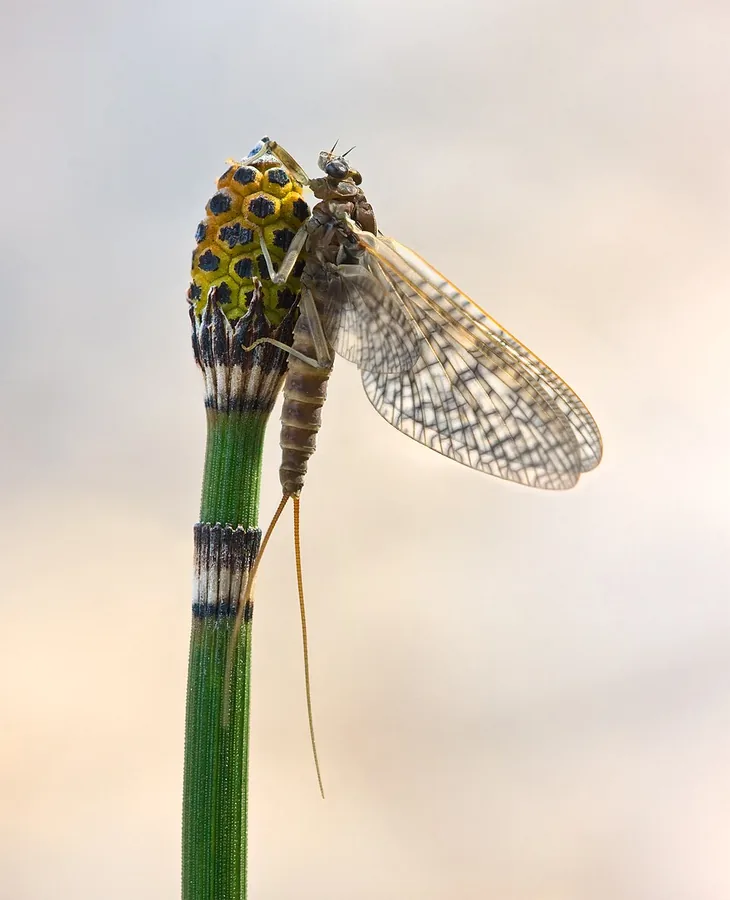
Horsetail, or scouring rush, represents one of the most ancient plant lineages in continuous cultivation, a lineage that predates the flowering plants. It produces stiff, jointed, bamboo-like green stems that persist upright through the year and bear neither true leaf nor flower. Reproduction proceeds by spores released from a terminal cone and, far more consequentially in the garden, by a creeping rhizome.
In design terms it functions as a strong vertical accent along a pond margin or within a bog bed, where the slender evergreen stems supply an almost architectural line. The common name scouring rush records a practical past: the silica embedded in the stem walls gave the tissue enough grit to scour cookware. Its cultural demands amount to little beyond a permanent water supply.
Two liabilities warrant emphasis before planting. The rhizomes descend and spread with such speed that the plant becomes one of the hardest to eradicate once it escapes, which is why a sealed container is non-negotiable in place of open soil. It also synthesizes thiaminase, a compound that poisons grazing horses and livestock, so siting it clear of pastures is a matter of stock safety.
Care
The short version: provide full sun to part shade and a substrate that never dries, ideally a pot standing in water, and cultivate it within a solid container or barrier so its rhizomes cannot run.
Light
Horsetail performs best in full sun, though it accepts partial sun and even partial shade. Adequate irradiance produces stiff, densely packed stems, whereas deep shade yields thin, lax growth prone to lodging.
Water
As a bog plant it demands a constantly wet root zone, so irrigate every 1 to 3 days and never permit the soil to dry. It performs at a pond margin, or with the pot standing in shallow water up to about 4 inches (10 cm) deep.
Soil
Establish it in wet to constantly moist, boggy soil. Texture is immaterial, since it grows in clay, loam, or sand and tolerates standing water, a reflection of its native station along pond and stream edges.
Temperature
Its cold and heat tolerance is exceptional. Horsetail withstands -40°F (-40°C) and endures heat to roughly 100°F (38°C), which accounts for its performance across so broad a climatic range.
Humidity
It favors high humidity, consistent with the damp, waterside habitats it occupies. Maintain a saturated substrate and the ambient moisture of a pond or bog supplies the remainder.
Feeding
The plant is undemanding and requires little to no fertilizer. A single light, balanced application in spring suffices where it is confined to a pot; in open ground it needs none.
Pruning
Cut old or damaged stems to the base in late winter or early spring to renew the clump. Excise the spore cones before they mature to curb dispersal, and never compost the prunings or any stray rhizome tissue.
Repotting
Repot every 1 to 2 years, both to refresh the substrate and, critically, to keep the aggressive rhizomes confined. A dense root mat filling the container or stems overtopping the rim indicates the time has come.
Size & spacing
Mature stems reach 2 to 4 feet (61 to 122 cm), and an unchecked stand extends 1 to 6 feet (30 to 183 cm) across. That lateral reach is the reason cultivation belongs in a contained pot or barrier rather than open ground.
When to plant
As a hardy perennial rated from zone 3 to 11, horsetail persists outdoors year-round across most of the country. Plant in spring once the soil has warmed, confining it to a fully contained pot or a bottomless barrier. It neither flowers nor yields a crop; it raises spore-bearing cones from spring into summer.
Northern hemisphere
Southern hemisphere
Typical months for a temperate climate: start earlier in warm zones, later where spring frosts linger.
- Plant: Spring, once the soil has warmed; site only in a fully contained pot or bottomless barrier
- Harvest: Non-flowering; produces spores in a cone-like tip (strobilus) in spring to summer
Hardiness
USDA hardiness zones: 3–11
Temperature: down to -40°C
Troubleshooting
Horsetail seldom fails to grow. The management problem is spatial rather than horticultural, so the guidance below concerns confining its spread far more than reviving an ailing specimen.
Colonies emerging well beyond the original planting
The trait that defines this plant is its aggressive, deep-running rhizome system, which descends and spreads several feet to knit colonies and can breach a pond edge into adjacent wet ground. Because each severed fragment retains dormant buds, it regenerates readily, which is precisely why excavation and herbicides fail to clear it. The only reliable control is physical: confine it to a solid pot or a bottomless barrier, sever escaping stems as they surface, and destroy every rhizome piece removed from the soil.
Fix:
- Never plant loose in open ground; grow only in a solid pot with no drainage to the soil, or in a bottomless barrier sunk into the bed
- Repeatedly cut or pull emerging stems to starve the rhizomes over time
- Remove and destroy (do not compost) every rhizome fragment when digging out an established stand
Stems lodging, yellowing, or growing thin and sparse
Weak, lodging, chlorotic stems point almost invariably to moisture stress, since this obligate wetland plant declines the moment its root zone dries. Insufficient light compounds the problem, because deep shade reduces vigor and open density. Restore constant saturation, or stand the pot in water, and relocate it to a brighter position anywhere between full sun and part shade to rebuild turgor and stem strength.
Fix:
- Keep soil constantly wet or stand the pot in water
- Move to a site with more sun (full sun to part shade)
Toxicity
This plant merits genuine caution. It is decidedly poisonous to horses and livestock, because its thiaminase degrades vitamin B1 and precipitates weakness, staggering, and worse, and the toxin persists even in dried hay. It poses no major hazard to cats or dogs, yet it is edible for no one, so keep it clear of pastures, grazing animals, and any inquisitive mouth.
Toxic to
Cats · Dogs · Horses · Rabbits · Livestock · Birds · People
Cats Caution
Cats face no documented poisoning risk, and the species does not appear on the ASPCA toxic list for them. Because the tissue is not food, it is still sensible to deter a cat from gnawing the rigid stems.
Dogs Caution
No credible risk is recorded in dogs, and the plant is not classed as toxic to them. The high silica content of the stems can nonetheless provoke mild gastric upset in a persistent chewer, so exclusion remains the prudent course.
Horses Toxic
Horses carry the greatest hazard. Thiaminase in the plant enzymatically depletes vitamin B1, and an animal that ingests a sufficient quantity, whether fresh or cured in hay, loses condition and strength before progressing to ataxia, tremor, convulsion, and, at the extreme, death.
Rabbits Caution
The same thiaminase that endangers larger grazers argues for excluding horsetail from any rabbit's forage. Withhold it entirely, and remove any growth that intrudes on a grazing run.
Livestock Toxic
Cattle, sheep, and comparable stock develop the identical vitamin B1 deficiency termed equisetosis. Monitor for weakness, staggering gait, and incoordination, with fatality possible in advanced cases, and note that dried, contaminated hay retains its toxicity indefinitely.
Birds Caution
Evidence in avian species is inconclusive in either direction, so the plant is best regarded as unsafe by default. Exclude poultry and companion birds from the foliage.
People Caution
This is not an edible species, and its thiaminase acts against human vitamin B1 as well. Avoid casual ingestion and folk preparations, and prevent children from mouthing the stems.
Safe to handle and not a significant pet toxin, but keep this plant well away from pastures, grazing horses, and livestock, and never let it contaminate hay; even dried plants in hay retain the thiaminase toxin.
Helpline numbers

United States
ASPCA Animal Poison Control: (888) 426-4435 (fee applies)
Poison Control: (800) 222-1222



Canada
Poison Centres: 1-844-764-7669
Varieties
The genus comprises dozens of species, of which a small number recur most frequently in cultivation and in discussion of horsetail.
Equisetum giganteum (giant horsetail)
This South American species is the tallest member of the genus, exceeding by a wide margin the stature of the temperate scouring rushes.
Equisetum arvense (field horsetail)
A smaller, branching weed of disturbed ground, it contains the same thiaminase responsible for its toxicity to horses and livestock.
Equisetum scirpoides (dwarf scouring rush)
The most diminutive species of the group, it produces low clumps of slender, wiry, often curled stems reaching only about a foot in height.
How to propagate
Horsetail propagates with almost no effort, which is at once its convenience and its liability. The very readiness to root from a rhizome fragment is what carries it beyond its intended bounds, so any division should be undertaken with containment already assured.
DivisionEasy
Spring · A few weeks to a season
Lift and divide the rhizome clumps in spring, after which the sections establish within a few weeks to a season, and even minute fragments will root independently. That capacity for rooting from tissue this small is the mechanism behind the plant's invasiveness. Return divisions only to a fully contained pot or barrier and destroy any surplus fragments you do not intend to keep.
Myths
Horsetail is an easy, harmless little ornamental for the garden.
In practice it is among the most intractable plants to eradicate, propagating via deep rhizomes that breach ponds and resist herbicides, while the thiaminase it contains poisons grazing horses and livestock. Restrict it to a container and site it well away from pastures.