Houseplant · Araceae
Heartleaf Philodendron
Philodendron hederaceum
Forgiving, fast, and shade-adapted, the heartleaf philodendron asks for little more than the occasional drink.
Bright indirect
50–84°F · 10–29°C
USDA 11–12
3–13 ft · 1–4 m
Overview
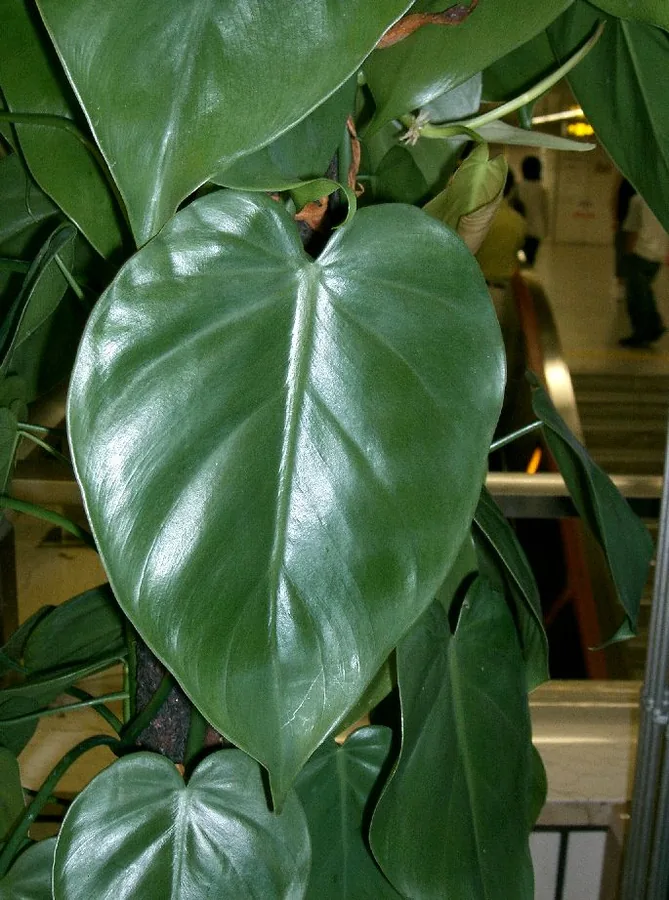
Philodendron hederaceum earns its place among beginner plants because its needs sit well within the range a typical room provides. The glossy, heart-shaped leaves trail from a shelf or climb a support, and the fast growth rate fills a space within a single season. Native to the forests of Mexico and tropical America, it grows there as a hemiepiphyte, ascending tree trunks toward the canopy light, which explains its readiness to both climb and trail.
Its tolerance is what makes it forgiving: adapted to the shaded forest understory, it withstands low light, dry air, and irregular watering far better than most, which is why it holds up in offices and dim hallways. Supply medium to bright indirect light and it responds with tighter leaf spacing and quicker growth, since more light drives more photosynthesis, but reduced light will not kill it.
One caveat governs where it belongs: every tissue contains insoluble calcium oxalate crystals, the same idioblast defense found across the Araceae, making it an irritant to pets, livestock, and people. Positioned out of reach of curious mouths, it remains an undemanding, long-lived plant.
Care
The short version: give it bright indirect light while trusting it to cope with less, water only after the top inch of soil has dried, and feed lightly across the growing season. Keep it warm and out of reach of pets and children.
Light
Its optimum is bright indirect light, positioned near a window but shielded from direct sun, which scorches the foliage of an understory species unaccustomed to it. It endures medium light and even a dim corner, but reduced photosynthesis slows growth and stretches the stems, so favor a brighter position where possible.
Water
Allow the top inch of soil to dry before watering, then water until it drains from the holes, which flushes the medium and rewets the whole root zone. Reduce watering through winter, when lower light and cooler temperatures slow uptake. Persistently soggy soil suffocates the roots and is the commonest cause of death.
Soil
Use a rich, well-drained potting mix, since the roots require oxygen as much as moisture. A loose, freely draining medium admits air between waterings, keeping the roots aerobic and denying the pathogens that cause rot.
Temperature
It performs across normal room temperatures, from 50°F to 84°F (10°C to 29°C). Hold it above 50°F and away from cold drafts and heating vents, because abrupt temperature swings stress a tropical plant and check its growth.
Humidity
Average household humidity suffices, so no target figure applies. A more humid position raises growth slightly by easing transpiration stress, yet the plant remains unbothered by dry winter air.
Feeding
Feed monthly through spring and summer with a dilute water-soluble houseplant fertilizer, matching input to the active growth phase. Withhold feed in autumn and winter as growth slows, and keep the dose light, because surplus salts accumulate in the mix and scorch the leaf tips.
Pruning
Pinch the growing tips to break apical dominance and drive the bushier lateral growth that keeps the plant full rather than sparse. Cut just above a leaf node, and the removed section, carrying its own node, will root readily into a new plant.
Repotting
Repot every 1 to 2 years in spring, or sooner once roots emerge from the drainage holes and the soil dries unusually fast, both signs the root system has filled the pot. Step up by only one pot size, since excess unrooted mix stays wet and invites rot.
Size & spacing
Given support, this trailing or climbing vine reaches 3 to 13 feet (1 to 4 m) and spreads 3 to 6 feet (90 to 180 cm) across. Provide a shelf to drape from or a pole to train it up, in line with its natural climbing habit.
Troubleshooting
Nearly every problem this plant develops traces to watering or light, and it signals the fault early. Yellowing leaves, elongated stems, and the occasional pest are the diagnostic cues. Match the symptom below and correct the cause before it entrenches.
Mushy brown roots and a wilting plant
Chronically saturated soil deprives the roots of oxygen and opens the door to the pathogens behind root rot, the gravest disorder this species meets. A wilting plant with soft, brown roots signals that the root system can no longer take up water. Unpot it, excise every rotted root, replant in fresh free-draining mix, and reduce irrigation so the medium is never soggy.
Fix:
- Unpot and trim rotted roots
- Repot in fresh well-drained mix
- Reduce watering
Lower leaves turning yellow
Yellowing on the oldest, lowest leaves points to overwatering, with insufficient light the secondary cause. Waterlogged soil starves the roots of oxygen, so they cannot support the foliage and the plant sheds it from the bottom up. Let the mix dry, confirm the pot drains, and shift the plant to brighter indirect light to restore the balance.
Fix:
- Reduce watering
- Ensure drainage
- Move to brighter indirect light
White cottony tufts tucked into leaf joints
The white, cotton-like masses lodged in the leaf axils are mealybugs, sap-feeders that shelter in protected joints. Break their waxy coat by touching each with an alcohol-dipped swab, then apply insecticidal soap to reach the nymphs you cannot see. Isolate the plant so the crawlers do not spread to neighboring specimens.
Fix:
- Dab with alcohol-dipped swab
- Apply insecticidal soap
- Isolate plant
Fine webbing and speckled, dull leaves
Spider mites proliferate in dry air, and their feeding punctures leave the fine webbing and stippled, dull surface you see. Rinse the foliage to dislodge the colony, treat with insecticidal soap or a miticide, and inspect the leaf undersides where they congregate. Because the mites favor low humidity, raising it makes the canopy an inhospitable host.
Fix:
- Rinse foliage
- Apply insecticidal soap or miticide
- Raise humidity
Hard brown bumps and a sticky residue
The immovable brown bumps along the stems are scale insects under a protective shell, and the sticky honeydew is their excreted sap. Scrape the shells away by hand, then treat with horticultural oil or insecticidal soap to smother the mobile crawlers that remain. Segregate the plant while you work, since the crawler stage is how they colonize others.
Fix:
- Scrape off scales
- Apply horticultural oil or insecticidal soap
- Isolate plant
Long bare stems with leaves far apart
Elongated internodes and widely spaced leaves are the plant etiolating toward light, extending stems to reach a brighter source. Return it to medium or bright indirect light and the new growth resumes its compact spacing. Pinching the drawn-out stems removes apical dominance and prompts bushier lateral shoots lower down.
Fix:
- Move to medium or bright indirect light
- Pinch stems to encourage branching
Brown, curling tips on the leaves
Crisp, curling tips reflect soluble fertilizer salts accumulating in the mix after overfeeding, which draw moisture from the leaf margins. Leach the pot with plain water until it runs freely from the base, carrying the excess salts out with it. Then lower both the concentration and the frequency of feeding to keep the buildup from returning.
Fix:
- Flush soil with water
- Reduce fertilizer rate
Clusters of small insects on new growth
Aphids cluster on the tender new growth because the soft, unlignified tissue is easiest to pierce and feed on, and their honeydew films the surface. A firm rinse under the tap dislodges the bulk of a colony. Where a residual population persists, insecticidal soap finishes the treatment.
Fix:
- Rinse off with water
- Apply insecticidal soap
Toxicity
Keep this plant clear of anyone inclined to chew it. Every tissue carries insoluble calcium oxalate crystals that penetrate the lining of the mouth and throat, producing burning pain, heavy drooling, and swelling. It irritates cats, dogs, horses, rabbits, livestock, birds, and people alike, with no part safe to ingest, so site it high and out of reach and wash your hands after cutting it.
Toxic to
Cats · Dogs · Horses · Rabbits · Livestock · Birds · People
Cats Moderate
When a cat bites a leaf, it ruptures cells that release sharp calcium oxalate crystals into the mouth. The mechanical irritation produces drooling, pawing at the mouth, vomiting, and swelling of the lips and tongue.
Dogs Moderate
Chewing embeds the same crystals in the oral lining, causing intense burning, heavy drooling, and vomiting. As the tissue swells, some dogs gag or struggle to swallow.
Horses Moderate
The crystals abrade a horse's mouth and throat wherever the foliage is chewed, so drooling and difficulty swallowing follow. Site the plant well away from paddocks and stored feed.
Rabbits Toxic
The irritant crystals are distributed through every tissue, so even a small nibble leaves a rabbit drooling and refusing food. Exclude the plant from any area a rabbit can access.
Livestock Toxic
Goats, sheep, and cattle that browse the foliage meet the oxalates with oral pain and feed refusal. The species has no place within reach of grazing stock.
Birds Toxic
A bird that chews the leaves incurs the same crystal-induced burning and swelling of the mouth. Position the plant, hung or placed, beyond any perch a bird can reach.
People Caution
No part is edible. Biting the tissue burns the mouth and can swell the lips and tongue, while contact with the sap can leave skin itchy, so wash after pruning and keep it from small children.
Sap may irritate skin; wash hands after cutting stems
Helpline numbers

United States
ASPCA Animal Poison Control: (888) 426-4435 (fee applies)
Poison Control: (800) 222-1222



Canada
Poison Centres: 1-844-764-7669
Varieties
Beyond the plain green species, selection has produced several named cultivars distinguished by pigmentation and leaf surface.
'Brasil'
A bright lime-yellow band of variegation runs the length of the midrib on otherwise green leaves.
'Micans'
The foliage is velvety in texture, iridescent bronze-green above and reddish beneath.
'Lemon Lime'
The entire plant carries a uniform bright chartreuse to neon yellow-green pigmentation.
'Rio'
A central band of cream and silver variegation streaks down the middle of each leaf.
How to propagate
Few houseplants propagate as readily. A single nodal cutting in a glass of water roots within a few weeks, and a longer vine can be air layered when a larger established start is wanted.
Stem cuttingsEasy
Spring or growing season · Roots in 2-4 weeks
Stem cuttings are the standard and near-universal method for this species. In spring or across the growing season, sever a stem just below a node bearing one or two leaves, since that node holds the meristematic tissue that generates roots, then set it in water or moist potting mix. Adventitious roots emerge in roughly 2 to 4 weeks, yielding an independent plant.
Air layeringModerate
Growing season · Several weeks
Air layering is the slower, more controlled option, best applied to a longer vine during the growing season. Wounding a stem and enclosing the site induces roots to form while the section stays attached and nourished, and over several weeks a rooted length develops that can be severed and potted independently.
Myths
Philodendrons clean the air in your home.
The claim originates in a sealed-chamber laboratory assay, conditions no living room reproduces. A peer-reviewed analysis concluded the VOCs a single potted plant clears are negligible against the effect of simple ventilation. Grow it for its foliage, not as an air filter.
Heartleaf philodendron and pothos are the same plant.
The two are superficially similar but sit in separate genera. The diagnostic traits are the petiole, smooth in philodendron and grooved in pothos, and the emergent leaf, which unfurls from a papery sheath in philodendron that pothos never produces.
This plant is a deadly poison to children.
The insoluble calcium oxalate crystals do inflict genuine, painful oral irritation, yet they are graded low-severity, and serious outcomes are uncommon. Keep it beyond a small child's reach and manage a chewed leaf by rinsing and observing rather than as an emergency.
It thrives in a dark corner.
It persists in low light, but its optimum is medium to bright indirect light. Confined to deep shade it etiolates, drawing the stems thin and spacing the leaves sparsely.
It needs high humidity to survive.
Elevated humidity benefits it, but the plant is fully tolerant of ordinary household air. No mister or pebble tray is required to sustain a healthy specimen.
Sources
- ASPCA Animal Poison Control
- North Carolina Extension Gardener Plant Toolbox (NC State)
- Missouri Botanical Garden Plant Finder
- Pet Poison Helpline
- University of Florida IFAS Gardening Solutions
- Clemson Cooperative Extension HGIC
- Plants of the World Online, Royal Botanic Gardens Kew
- Cummings & Waring 2020, J Exposure Science & Environmental Epidemiology (PubMed/NLM)
- Atlas of Florida Plants, Institute for Systematic Botany, University of South Florida