Tree · Myrtaceae
Guava
Psidium guajava
Meet its needs for full sun, warmth, and frost protection, and a guava tree returns fragrant fruit for years.
Full sun
Every 5–10 days
90–150 days
USDA 9–11
Overview
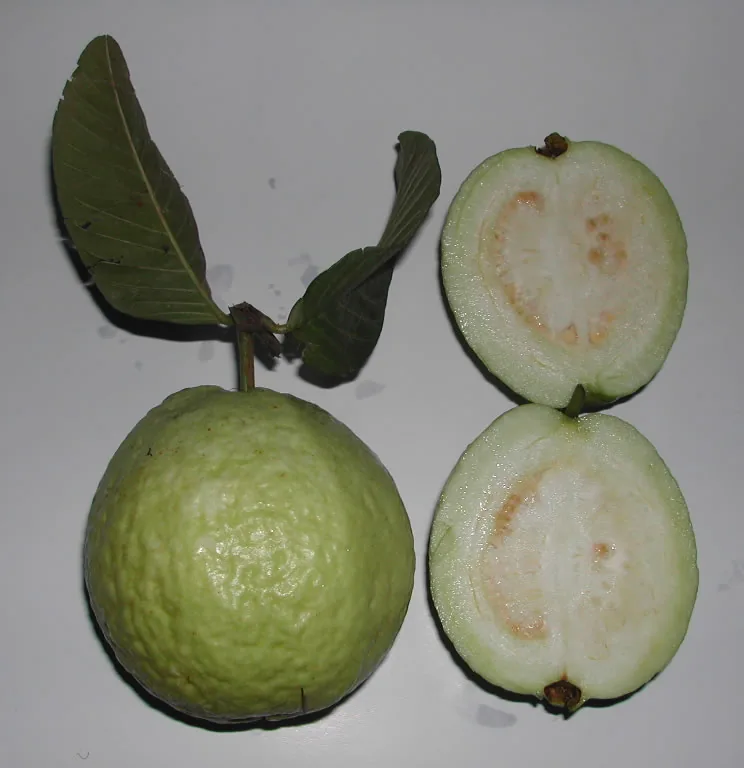
Guava is a fast-growing tropical tree in the myrtle family, native to the American tropics and now cultivated throughout the warm zones of the world. Its natural stature runs 10 to 30 feet (3 to 9 m), though growers routinely hold it lower with pruning to keep the fragrant, vitamin-rich fruit at pickable height.
Its ease in cultivation rests on real tolerance. The species accepts a broad range of soils, from sand to limestone, and withstands short droughts once its roots are established. The limiting factor is temperature, because a single near-freezing night kills the tender growth outright.
In climates with mild winters, guava establishes in the landscape and reaches bearing within a few years. Where frost occurs, container culture lets growers move the tree under cover through cold weather. In both settings, full sun and sustained warmth are what drive the heaviest, sweetest crops.
Care
The short version: prioritize full sun and warmth, water deeply through flowering and fruiting, and taper off once the fruit begins to color to concentrate flavor. Feed lightly across the growing season, prune after harvest to maintain a supply of new fruiting wood, and protect the tree from any degree of frost.
Light
Guava fruits best in full sun and manages adequately in partial sun. Because shade shifts the tree toward vegetative growth at the expense of flowering, the brightest available position yields the best cropping.
Water
Water deeply and regularly during establishment and throughout flowering and fruiting, when demand peaks. Mature trees tolerate drought, but consistent moisture improves fruit, and withholding water just before harvest concentrates the flavor.
Soil
The species is undemanding, accepting well-drained loam, sand, and even limestone. It performs across a wide pH range of 4.5 to 7.0, so most garden soils are suitable provided drainage is free.
Temperature
Guava grows over a range of 32°F to 95°F (0°C to 35°C) but has no frost tolerance. A single near-freezing night burns back tender growth, making warmth the dominant variable in sustained productivity.
Humidity
Average humidity of 40% to 70% suits guava, consistent with the warm, moderately humid tropics of its origin. Outdoors, no active management of humidity is required.
Feeding
Apply a balanced fruit-tree fertilizer with micronutrients monthly through spring and summer. Young trees respond best to light, frequent feeding rather than heavy doses, and excess nitrogen suppresses fruiting in favor of foliage.
Pruning
Prune after harvest to remove deadwood, restrain height for accessible picking, and open the canopy to light and air. Since guava fruits on new growth, light tip pruning renews the flush of fruiting shoots.
Repotting
Pot on a container guava every 2 to 3 years, ideally in spring. Root-bound indicators include roots circling the pot or emerging from the drainage holes, water passing straight through, and growth and fruiting that have slowed.
Size & spacing
Unpruned, a guava attains 10 to 30 feet (3 to 9 m) in height and spreads 10 to 20 feet (3 to 6 m) across. Most growers prune well below this to keep the fruit within reach.
When to plant
Guava is a frost-intolerant warm-climate tree, so timing is dictated by cold avoidance. Sow seed in late winter under warm conditions, transplant young trees in spring once frost has passed, and expect fruit from late summer through fall, with year-round bearing where climates remain frost-free.
Northern hemisphere
Southern hemisphere
Typical months for a temperate climate: start earlier in warm zones, later where spring frosts linger.
- Sow: late winter to early spring in warm conditions
- Plant: spring after all danger of frost has passed
- Harvest: flowers in spring; fruit ripens late summer through fall, with some bearing year-round in frost-free climates
Hardiness
USDA hardiness zones: 9–11
Temperature: down to -7°C
Troubleshooting
Most guava problems reduce to three causes: cold injury, fruit-infesting pests, or a tree biased toward foliage rather than flowers. Identify the match below and intervene early, before a setback forfeits a season's crop.
Cold-blackened shoot tips and wilting foliage
Blackened, wilting shoots following a cold night point to frost damage, a disorder guava resists poorly because it is a cold-sensitive tropical species. Near-freezing temperatures kill the tender young growth first while the woodier trunk frequently survives, which is why the damage looks worse than it is. Defer pruning until spring so the flush of new growth defines the live boundary, and buffer the tree beforehand with frost cloth or a trunk wrap against the next cold event.
Fix:
- Wait until spring to prune out clearly dead wood once new growth shows the live boundary
- Protect with frost cloth, mulch, or trunk wraps during cold snaps
- Grow in a container that can be moved indoors in marginal climates
Larval infestation within prematurely softening fruit
Larvae tunneling through ripening fruit indicate the fruit fly, and guava ranks among its most heavily used hosts. A female stings the fruit to lay eggs, the larvae feed inside, and the fruit responds by softening, discoloring, and abscising before maturity. Interrupt the cycle by harvesting as ripening begins rather than allowing fruit to soften on the tree, bagging developing fruit so females cannot oviposit, and removing every dropped fruit that would otherwise carry the next generation.
Fix:
- Harvest fruit early as it begins to ripen rather than leaving it to fully soften on the tree
- Bag developing fruit to exclude egg-laying females
- Collect and destroy fallen and infested fruit promptly to break the breeding cycle
Plenty of leaves but little or no fruit
Dense foliage with little fruit is a vegetative-versus-reproductive imbalance, driven by excess nitrogen or heavy shade that both favor leaf growth over flowering. A tree left with only old wood compounds the problem, since guava flowers on the current season's shoots rather than aged branches. Correct the balance by moving the tree into full sun, shifting from high-nitrogen feed to a balanced fruiting formula, and pruning lightly to force the fresh shoots that carry the flowers.
Fix:
- Move to or maintain full-sun exposure
- Reduce high-nitrogen fertilizer and use a balanced fruiting formula
- Lightly prune to stimulate fresh fruiting shoots
Toxicity
Guava sits firmly among the safe species. Its fruit is a well-established food eaten with skin, flesh, and seeds together, and no part of the plant is listed as poisonous to cats, dogs, or other animals. Offer ripe fruit freely, observing only the ordinary moderation any treat warrants.
Safe for
People · Cats · Dogs · Horses · Rabbits · Livestock · Birds
Cats None
A cat that samples guava faces no toxic risk, since no part of the plant is poisonous to felines.
Dogs None
Ripe guava causes dogs no harm in modest quantity. Restrict the amount, because a surfeit of any fruit can produce loose stools.
Horses Safe
Guava carries no toxins for horses, so grazing on the foliage or fruit presents no hazard.
Rabbits Safe
Rabbits may take the fruit in small quantity, though hay should remain the dietary staple over sugary items.
Livestock Safe
Cattle, goats, and sheep browse guava without adverse effect, and fallen fruit serves as established forage throughout the tropics.
Birds Safe
Birds consume ripe guava avidly and disperse the seed over long distances, the very mechanism by which the species naturalizes.
People Safe
People consume guava fresh or cooked, and the entire fruit, skin and seeds included, is edible.
The ripe fruit is safe; as with any new food, offer pets only small amounts and avoid letting them swallow large seeds or pits of other fruits.
Varieties
Named guava cultivars are distinguished chiefly by flesh color, sweetness, and tree size. A few recur consistently in home plantings.
Ruby Supreme
A pink-fleshed Florida selection valued for sweet, aromatic fruit and consistent cropping.
Mexican Cream (Tropical White)
It bears mild, sweet, creamy white flesh on a relatively compact tree suited to confined gardens.
Lucknow 49 (Sardar)
A prominent Indian cultivar prized for high yields of large, white-fleshed fruit.
How to propagate
Guava propagates readily, and the chosen method determines genetic fidelity to the parent. Seed is the simplest but variable, whereas cuttings, layering, and grafting each preserve a cultivar true.
SeedEasy
Spring in warm conditions · Germinates in 2 to 8 weeks; bears fruit in 2 to 4 years
Seed is the least demanding method: sow in the warmth of spring and germination follows over 2 to 8 weeks. Because guava does not come true from seed and requires 2 to 4 years to reach bearing, reserve seedlings for rootstock or informal trialing rather than reliable fruit.
Stem cuttingsModerate
Warm growing season · Several weeks to root under mist or high humidity
Semi-hardwood cuttings taken in the warm growing season root reliably given bottom heat and a rooting hormone. Allow several weeks under mist or sustained humidity for roots to form, after which the plant reproduces the parent's traits exactly.
Air layeringModerate
Warm growing season · Roots in about 6 to 10 weeks before severing
Air-layering copies a cultivar true to type with high reliability. Performed in the warm season, the girdled and wrapped branch generates roots in roughly 6 to 10 weeks, and only once rooted is it severed to stand as an independent plant.
GraftingDemanding
Warm season onto vigorous seedling rootstock · Unions establish over several weeks
Grafting is the standard commercial technique for named cultivars and the most dependable guarantee of fruit quality. Worked onto vigorous seedling rootstock in the warm season, the graft union develops over several weeks before the tree is grown on.
Myths
It is commonly held that guava must be grafted or paired with a second tree for cross-pollination to fruit.
Guava is largely self-fertile, so a solitary tree, seedlings included, sets fruit through self-pollination. Grafting is justified on other grounds, namely fixing a defined cultivar and shortening the interval to first fruit. A single tree fruits without a pollination partner.