Ornamental · Orchidaceae
Ground Orchid
Bletilla striata
A hardy terrestrial orchid that grows in ordinary garden soil and flowers pink each spring.
Partial shade
Every 3–7 days
USDA 5–9
12–24 in · 30–60 cm
Overview
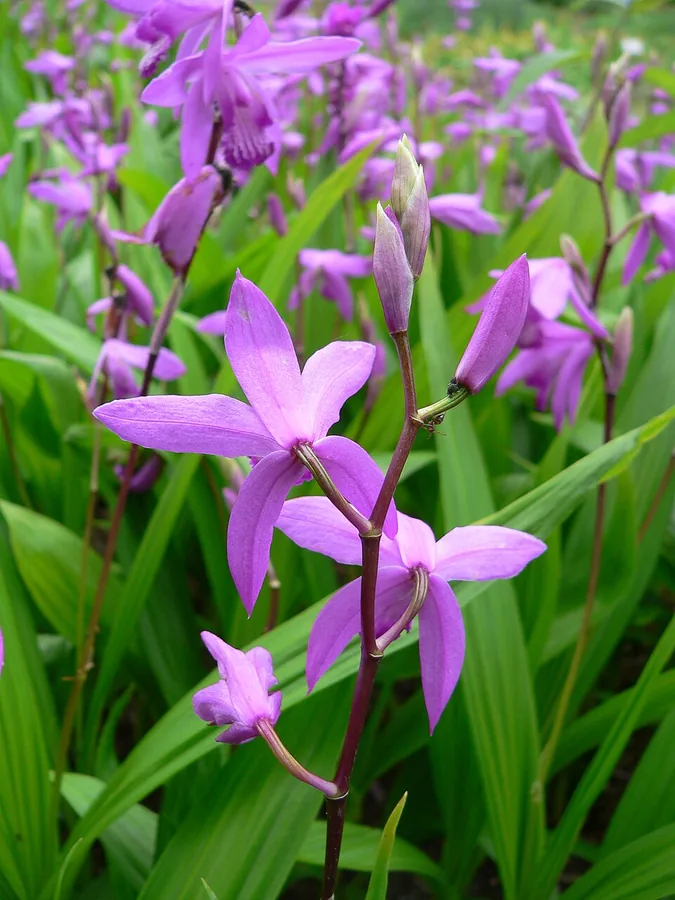
The ground orchid is the species that dismantles the idea that orchids demand specialist care. It is a terrestrial that grows in ordinary garden soil from small underground corms, returns of its own accord each year, and needs little intervention. In spring it produces pleated, almost bamboo-like leaves followed by a slender stem of magenta-pink flowers as striking as those of any epiphytic relative.
Its constitution is far more durable than the delicate flowers imply. The species is hardy to roughly USDA zone 5, dying back to ground level each fall and regenerating from the corm as the soil warms. Sited in humus-rich, well-drained soil under dappled shade or morning sun, a single clump extends steadily into a substantial colony over several seasons.
After establishment, restraint is the guiding principle. Water it consistently through the growing season, withhold water so it rests dry and dormant over winter, and divide the clump every few years to sustain flowering and prevent the congestion that suppresses bloom.
Care
The short version: site it in rich, well-drained soil in partial shade, hold it evenly moist through spring and summer, and let the corms rest dry over winter. Divide the clump every few years and it will return pink blooms each spring.
Light
Ground orchids perform best in partial shade, the dappled light or soft morning sun characteristic of a woodland margin. They tolerate more exposure, up to full sun, provided the soil is kept moist, since moisture offsets the higher transpiration load. Deep, heavy shade is the single condition under which they flower poorly, as the low light starves the plant of the energy a bloom requires.
Water
Hold the soil evenly moist through spring and summer during active growth, checking every 3 to 7 days to match supply to demand. After the foliage yellows and dies back, reduce watering and let the dormant corms overwinter on the dry side. Saturated winter soil is the principal cause of rot, because the resting tissue cannot process standing water.
Soil
Grow it in humus-rich, well-drained loam amended with generous organic matter to hold moisture without waterlogging. A pH between 5.5 to 7.0 suits it, a band that covers most garden soils. Sharp drainage is the decisive factor, above all approaching the cold months when saturation turns lethal.
Temperature
This is a cold-hardy orchid, tolerant across a broad span from about -13°F to 86°F (-25°C to 30°C). The top growth is cut down by the first hard frosts, while the corms overwinter underground insulated by the soil and resume growth in spring.
Humidity
Average humidity near 40% to 60% meets its needs, and outdoor air supplies that range without supplement. No misting or additional humidity management is warranted.
Feeding
Apply a balanced general-purpose fertilizer monthly through spring and summer while the plant is in active growth and drawing on nutrients. Discontinue once the foliage fades in fall, since the dormant plant makes no use of applied feed.
Pruning
Pruning requirements are minimal. Remove the spent flower stalks once bloom finishes, and cut the dead foliage back in late fall after it has yellowed and returned its reserves to the corm. Nothing further is needed.
Repotting
A clump can remain undisturbed for 3 to 4 years before it warrants attention. Lift and divide when the pseudobulbs crowd above the soil, flowering declines, or the clump center weakens, all signs of congestion. The same operation serves as the means of propagation.
Size & spacing
Mature plants stand 12 to 24 inches (30 to 60 cm) tall with a spread of 12 to 18 inches (30 to 45 cm). Space divisions at roughly that interval so each clump can develop to full size without competing with its neighbors.
When to plant
Plant ground orchids in early spring as the soil warms and the corms break dormancy, which lets the roots resume before the demands of top growth. Flowering follows in late spring, generally across May and June, and the foliage persists through summer before dying back for winter.
Northern hemisphere
Southern hemisphere
Typical months for a temperate climate: start earlier in warm zones, later where spring frosts linger.
- Plant: early spring
- Harvest: late spring (May to June)
Hardiness
USDA hardiness zones: 5–9
Temperature: down to -29°C
Troubleshooting
Ground orchids present few disorders, and those that arise are straightforward to diagnose. Most reduce to excess winter moisture, slug or snail pressure, or a clump grown congested enough to suppress bloom. Match the symptom below and intervene while the correction is still minor.
Shoots that fail to appear in spring or rot at the base
Shoots that stall or collapse at the base point to pseudobulb rot, which sets in when soil holds water around the dormant corms through winter and pathogens attack the saturated tissue. In the colder end of the range, frost can also destroy corms left without mulch. Lift a corm to judge it, since firm pale flesh remains viable while soft brown tissue has already broken down. Replant only the sound pseudobulbs into fast-draining soil, then mulch the bed so the dormant corms hold above the killing point.
Fix:
- Lift and discard rotted corms, replant healthy firm pseudobulbs in fast-draining amended soil
- Improve drainage by incorporating grit or planting in a raised bed
Healthy leaves but few or no flowers
Healthy foliage with scant bloom usually reflects an overcrowded clump or a site too deep in shade, since congested pseudobulbs compete for resources and low light limits the energy for flowering. Excavate a little and the pseudobulbs will read packed hard against one another. Divide the clump in early spring to restore vigor to each piece, and reset it where it catches morning sun or dappled light so it can build the reserves a bloom demands.
Fix:
- Divide congested clumps in early spring to reinvigorate flowering
- Relocate to a site with morning sun or dappled light
Ragged holes chewed through leaves and flowers
Ragged holes are the signature of slugs and snails, which are drawn to the tender emerging shoots because that soft spring growth is easiest to rasp through. They feed after dark and in the damp, so inspect at dusk or following rain for the animals themselves and their slime trails. Remove them by hand, then set a barrier or bait around the new shoots to intercept the next feeders before the tissue hardens off.
Fix:
- Hand-pick slugs and snails in the evening
- Use barriers or appropriate slug controls around emerging shoots
Toxicity
For households with pets and children the assessment is clear: the ground orchid is non-toxic and safe. Orchids as a family carry no harmful principle, and no toxin resides in the leaves, flowers, or corms. The most a nibble can produce is a mild, transient digestive upset, the same response the roughage of any plant provokes.
Safe for
People · Cats · Dogs · Horses · Rabbits · Livestock · Birds
Cats None
Cats are safe. A leaf chewed out of curiosity might prompt some drooling or mild nausea, but that response follows the roughage of almost any houseplant, and this orchid contains no toxin.
Dogs None
Dogs are safe. No toxic principle is present, though a dog that swallows a large volume of foliage at once may show brief digestive upset from the plant fiber alone.
Horses Safe
Horses are unaffected. The tissue carries no harmful compound, so an incidental graze produces no adverse effect.
Rabbits Safe
Rabbits are unaffected. Neither the foliage nor the corms hold a toxin, so an occasional bite is inconsequential.
Livestock Safe
Cattle, goats, and sheep are unaffected. Nothing in the foliage constitutes a poisoning hazard to grazing stock.
Birds Safe
Birds are unaffected. Pet and backyard birds may occupy the same space as this orchid with no risk.
People Safe
People, children included, are unaffected. The plant is not cultivated for consumption, but an incidental taste presents no hazard.
No special handling precautions are needed, though as with any plant, ingestion of large amounts may cause mild stomach upset.
Varieties
Beyond the typical pink form, several named selections merit attention for their flower color or greater vigor. These are the ones encountered most often in cultivation.
'Alba'
It substitutes pure white flowers for the pigment that gives the species its usual magenta-pink.
var. albostriata
Creamy white variegation edges and stripes its leaves, giving it ornamental value in the foliage phase apart from bloom.
'Big Bob'
A vigorous selection with a taller, stockier habit and correspondingly larger flowers.
How to propagate
Ground orchids increase readily, with no need for seed or specialist technique. An established clump yields new plants each spring, whether by division of the whole or by detachment of its offset corms.
DivisionEasy
Early spring before or as new growth emerges · One growing season
Division is the standard means of increase, timed to early spring just before or as the new shoots break the surface so each piece resumes growth immediately. Lift the entire clump and separate it so every division retains at least one sound pseudobulb bearing a live growth eye, then replant without delay to limit desiccation. Each division roots in and consolidates over a single growing season.
Bulbs & cormsEasy
Early spring · One growing season
A planting can also be increased by detaching the offset corms the clump produces. In early spring, break the offset pseudobulbs from the parent and reset them at their former depth so the growth eye sits correctly. Over one growing season each offset establishes into an independent clump.
Myths
Every orchid is a fussy tropical confined to indoor culture.
Many orchids are indeed tender epiphytes, but this species is a hardy terrestrial grown outdoors in the open garden. It withstands winters down to about USDA zone 5, retreating to dormancy at ground level in fall and regenerating from the corm in spring.
Orchids are parasites that draw nutrients from trees and damage them.
A terrestrial ground orchid anchors in the soil and photosynthesizes all its own carbohydrate in its leaves. It draws nothing from neighboring plants, arising instead from pseudobulb-like corms held just beneath the surface.