Tree · Ginkgoaceae
Ginkgo
Ginkgo biloba
Slow, durable, and near indestructible, the ginkgo is a specimen tree planted for the long term.
Full sun
Every 7–14 days
USDA 3–8
50–80 ft · 15.2–24.4 m
Overview
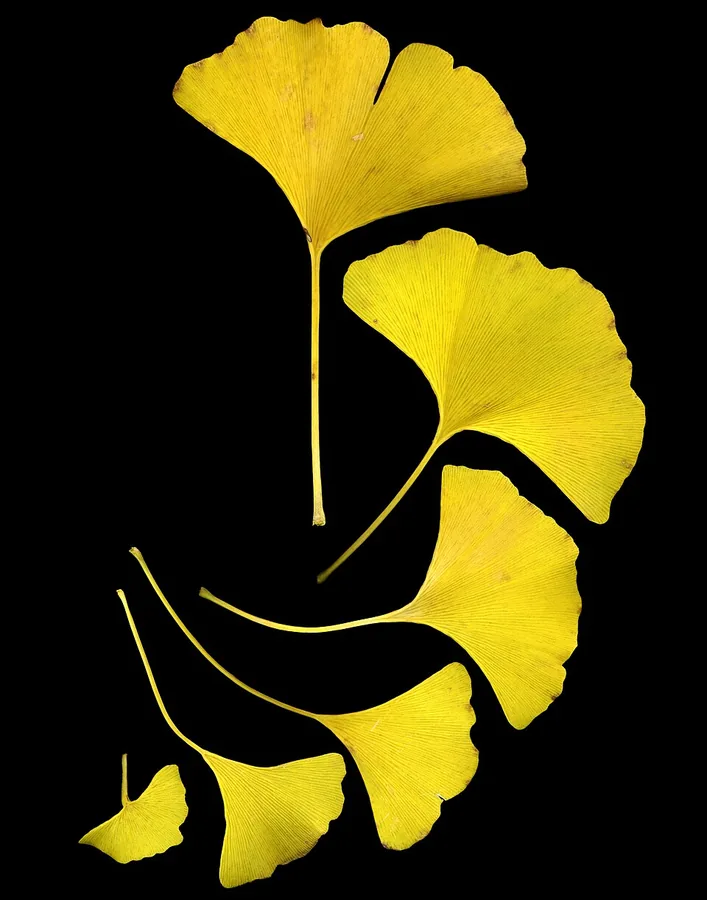
The ginkgo is a living fossil, the sole surviving member of a lineage that reaches back more than 200 million years. Its fan-shaped foliage and singular architecture set it apart from any other tree in cultivation, and it withstands drought, heat, pollution, road salt, and pests that degrade most shade trees. That resilience, coupled with exceptional longevity, explains its persistence as a street tree.
Growth is slow and the tree is very long-lived, so it rewards patience rather than intervention. A specimen attains 50 to 80 feet (15.2 to 24.4 m) in height over time and develops a broad, open crown, which means the grower allocates space and then largely stands back. The seasonal payoff is a uniform, clear-gold autumn canopy that abscises rapidly, often within a day or two.
A single reproductive trait governs cultivation: the ginkgo is dioecious, so a given tree is either male or female. Female trees produce a fleshy, malodorous fruit in autumn, whereas fruitless male cultivars remain clean. Nearly every tree offered for landscaping is a grafted male selected precisely to avoid that fruit.
Care
The short version: site it in full sun and well-drained soil, sustain regular water through the first few years until the root system establishes, and thereafter a mature tree is essentially self-sufficient.
Light
Site a ginkgo in full sun, the exposure under which it develops the densest crown and the best autumn color. It accepts partial shade, but the canopy grows more open and sparse as available light decreases.
Water
Provide a young tree with consistent water through its first few years while the root system establishes, allowing the top half of the profile to dry between irrigations. Once established, the ginkgo is genuinely drought-tolerant and requires supplemental water only through an extended dry period.
Soil
It is unexacting as to soil and performs in loam, sand, or clay provided the medium drains freely. A pH anywhere from 5.0 to 8.0 accommodates it, a range that covers most sites without amendment.
Temperature
This is a cold-hardy, heat-tolerant tree operating across -40°F to 100°F (-40°C to 38°C). That amplitude is why it succeeds from the northern zones through hot southern urban plantings.
Humidity
Ambient outdoor humidity meets its needs entirely, so nothing is managed here. Average air suits it in any climate where it is hardy.
Feeding
Apply a balanced slow-release tree fertilizer in spring to a young tree to support early growth. An established ginkgo seldom requires feeding and subsists on the fertility already present in the soil.
Pruning
Prune a young tree in late winter to establish a single strong central leader and sound branch architecture. A mature ginkgo needs very little, so once the framework is set the tree is largely left alone.
Repotting
As a landscape tree the ginkgo is rarely repotted, though a young specimen confined to a container signals when it has outgrown the vessel. Look for roots circling the pot or emerging from the drainage holes, water passing straight through, and new growth stalling.
Size & spacing
Allow for a large tree reaching 50 to 80 feet (15.2 to 24.4 m) in height and spreading 30 to 40 feet (9 to 12 m) wide. Allocate that much open ground clear of buildings, walkways, and power lines so the broad crown can develop unimpeded.
When to plant
The ginkgo is hardy across zone 3 to zone 8 and is planted in spring or fall, when mild conditions let the roots establish before the next period of heat or cold stress. Growth is slow, so the establishment years turn on consistent irrigation rather than rapid gains, and the recurring reward is the gold canopy each autumn.
Northern hemisphere
Southern hemisphere
Typical months for a temperate climate: start earlier in warm zones, later where spring frosts linger.
- Plant: spring or fall
- Harvest: April (inconspicuous; dioecious)
Hardiness
USDA hardiness zones: 3–8
Temperature: down to -40°C
Troubleshooting
The ginkgo presents remarkably few problems, which is central to its appeal as a landscape tree. The issues that do arise concentrate on a young tree during establishment or on the litter and irritation associated with a female tree's fruit. Match the symptom below, then intervene while intervention still helps.
Marginal leaf browning, scorch, and dieback in the crown
On an unestablished young tree, uniform browning confined to the leaf margins during hot, dry weather points to heat or drought stress, a transpiration deficit the root system cannot yet meet. The more serious diagnosis is bacterial leaf scorch caused by Xylella fastidiosa, distinguished by a progressive, section-by-section decline that spreads across several seasons. Deep irrigation and mulch address the moisture-stressed sapling, whereas a tree confirmed with the xylem-limited bacterium warrants removal.
Fix:
- Water deeply during drought, especially for newly planted trees
- Mulch to conserve soil moisture
- Remove severely declining trees if bacterial scorch is confirmed
An itchy, blistering rash following contact with crushed fruit
The fleshy pulp of a female tree carries ginkgolic acids, urushiol-like catechols that provoke the same allergic contact dermatitis as poison ivy. Wash the affected skin with soap and water to remove residual allergen, then manage the reaction as you would any urushiol exposure. Gloves interrupt contact, and a male cultivar removes the fruit, and therefore the allergen, from the equation entirely.
Fix:
- Wash the affected skin thoroughly with soap and water
- Treat dermatitis symptomatically as for poison ivy
A rancid odor and slippery fallen fruit beneath the tree in autumn
This traces to a female ginkgo shedding its sarcotesta, the fleshy seed coat whose butyric acid content produces the rancid-butter smell as it decomposes. Clear the fruit before it is crushed underfoot and tracked indoors, and glove up, since the pulp irritates skin. Because ginkgo is dioecious, the reliable prevention is to establish a fruitless male cultivar at planting.
Fix:
- Rake and remove fallen fruit promptly
- Wear gloves when handling crushed fruit to avoid skin irritation
Toxicity
The ginkgo is a low-toxicity tree, and its fan-shaped foliage presents little risk to pets, livestock, or people. The relevant caution attaches to the female tree's fruit and raw seeds: the fleshy pulp can elicit a poison-ivy-like dermatitis on bare skin, and raw or excessive quantities of the inner seed contain ginkgotoxin. Most landscape specimens are fruitless males, but where a female fruits, exclude pets and inquisitive children from the litter.
Toxic to
Cats · Dogs · Horses · Rabbits · Livestock · Birds · People
Cats Caution
Foliar toxicity is low, so incidental browsing of the leaves presents no meaningful hazard to a cat. The exposure that matters is the female tree's fallen fruit and raw seeds, which can provoke gastrointestinal upset, so exclude the animal from seed litter accumulating beneath the tree.
Dogs Caution
Ingestion of the leaves is unlikely to harm a dog given their low toxicity. The concern is a dog chewing the dropped fleshy fruit or raw seeds, which can induce hypersalivation and gastrointestinal signs, with quantity driving the severity of the response.
Horses Caution
The foliage carries little toxicological risk to a horse. The prudent measure is to restrict access to windfall seeds and crushed fruit, because the raw seed contains ginkgotoxin.
Rabbits Caution
Given the low foliar toxicity, a small amount of leaf material poses no real threat to a rabbit. Withhold access to the raw seeds, however, since a small-bodied animal tolerates ginkgotoxin poorly.
Livestock Caution
Cattle, goats, and sheep can browse the foliage at minimal risk. The material to exclude is the autumn drop of fleshy fruit and raw seeds beneath a female tree.
Birds Caution
Birds act as dispersal agents for the fallen seed, and the foliage poses no appreciable risk to them. Even so, the raw inner seed contains ginkgotoxin, so it should not be offered to backyard poultry.
People Caution
The leaves and leaf extracts register low in toxicity, but two exposures warrant care. Contact with the female fruit's pulp can induce a poison-ivy-like dermatitis, and consuming raw or excessive quantities of the inner seed can cause ginkgotoxin poisoning, so cooked seed is limited to small servings.
Only FEMALE trees produce fleshy seed coats; the fruit pulp contains ginkgolic acids (urushiol-like) that can cause poison-ivy-like contact dermatitis in people handling the crushed fruit, and RAW seeds/nuts contain ginkgotoxin (4'-O-methylpyridoxine) which can cause toxicity such as seizures if many are eaten raw. Plant fruitless male cultivars.
Helpline numbers

United States
ASPCA Animal Poison Control: (888) 426-4435 (fee applies)
Poison Control: (800) 222-1222



Canada
Poison Centres: 1-844-764-7669
Varieties
Almost every ginkgo planted in a yard or along a street is a fruitless male cultivar, specified to eliminate the messy autumn fruit. The selections below are the ones most frequently encountered.
Autumn Gold
A fruitless male selection valued for a broad, symmetrical crown and clear golden autumn color, maturing to roughly 50 feet (15 m) in height and 30 feet (9 m) in spread.
Princeton Sentry
A fruitless male selection with a narrow, upright, conical habit suited to confined sites and street-side placement where lateral room is limited.
Magyar
A fruitless male selection carrying a uniform columnar-to-pyramidal habit that recommends it as a street tree.
How to propagate
Ginkgo is propagated to secure a known male, fruitless tree, so the standard routes are grafting and cuttings rather than seed.
GraftingDemanding
Late winter to spring (dormant scion onto seedling understock) · 1-2 years
Grafting is the standard means of propagating the fruitless male cultivars. A dormant scion is united with seedling understock in late winter or spring, which preserves clonal fidelity and secures a male tree, and the graft union requires a year or two to establish. The technique demands precision, placing it at the exacting end of propagation.
Stem cuttingsModerate
Midsummer (semi-hardwood) · 1-2 years
Semi-hardwood cuttings of 10 to 15 cm are collected from a mature male tree in midsummer, treated with IBA rooting hormone, and maintained under mist. Rooting proceeds over a year or two followed by characteristically slow growth, but the clonal material retains the parent's known sex, which is the entire rationale for the method.
SeedDemanding
Fall, after cleaning and stratifying seed · Several years
Seed can be cleaned, stratified in fall, and sown, though the resulting seedlings develop slowly and require several years to establish. The limiting factor is sex expression: a ginkgo does not disclose whether it is male or female for 15 to 20 years or more, which makes seed an unsuitable route when a guaranteed fruitless male is the objective.
Myths
Ginkgo trees are poisonous and hazardous to plant near pets.
Ginkgo does not appear on ASPCA toxic-plant lists, and the fruitless male trees supplied for landscaping are regarded as non-toxic to cats and dogs. The actual hazard is narrowly defined: it resides in the female tree's fallen fruit and raw seeds, not in the foliage or wood, and those are what pets are kept from.
Every ginkgo produces a foul-smelling mess in autumn.
Only the female tree develops the fleshy seed coats whose butyric acid generates the odor as they decompose on the ground. The male cultivars propagated for landscaping are fruitless and odorless, which accounts for their dominance in the nursery trade.