Vegetable · Zingiberaceae
Ginger
Zingiber officinale
Supply warmth, even moisture, and filtered light, and a single rhizome yields a full season's harvest of fresh ginger.
Partial shade
Every 2–4 days
59–86°F · 15–30°C
240–300 days
Overview
Ginger is a tropical perennial cultivated for the pungent, aromatic rhizome central to so much cooking. Its origin in the warm, humid forests of Asia explains its cultural requirements at every point. Supply heat, moisture, and filtered light and it establishes readily; expose it to cold, waterlogged, or drought conditions and growth falters.
In climates with warm summers it can be grown in the ground, but in cooler regions it is handled as a long season annual. The sequence is to start a rhizome piece indoors in late winter, transplant it once frost has passed, and lift the crop before cold returns. It performs equally well in a container, which makes it one of the few tropical edibles sustainable on a bright porch or windowsill.
The defining constraint is time. Ginger requires most of a year to bulk the rhizome, roughly 8 to 10 months from planting to a mature harvest, though tender baby ginger can be lifted considerably earlier. Held warm, fed, and evenly watered across that interval, one planted rhizome returns many at harvest.
Care
The short version: bright filtered light and steady warmth, soil held evenly moist yet never waterlogged, high ambient humidity, and a long season of patience before lifting.
Light
Ginger performs best in bright but filtered light, matching the understorey shade of its forest origin. Dappled shade, or morning sun with afternoon protection, suits it, whereas direct midday sun overloads the foliage and scorches the leaf margins.
Water
Hold the soil evenly moist throughout active growth, but avoid saturation, since standing water starves the rhizomes of oxygen and invites rot. Taper the watering as the foliage yellows toward harvest, which lets the rhizomes firm and cure.
Soil
Grow it in rich, loose, well drained loam high in organic matter so excess water drains quickly. A slightly acidic pH of 5.5 to 6.5 is optimal, and effective drainage governs success here more than any other single factor.
Temperature
Warmth is the limiting factor. Ginger grows within 59°F and 86°F (15°C to 30°C) and arrests or dies in the cold, so it must not go outdoors until all frost has passed and the soil has warmed.
Humidity
The species demands high humidity and is at its best at 70% to 90%. Dry indoor air desiccates the leaf tips, so group it with other plants, stand it on a pebble tray, or site it where the air is naturally humid.
Feeding
Feed monthly through the spring and summer growth period with a balanced fertilizer or compost, side-dressed as new shoots emerge. The extended season draws heavily on reserves, so consistent nutrition translates directly into rhizome yield.
Pruning
Ginger needs no structural pruning. Remove yellowed or dead foliage, cut off flower stalks where the crop is grown for rhizome, and cut back the top growth as it senesces ahead of harvest.
Repotting
In containers, refresh ginger every year or season, because the rhizomes spread quickly and rise to the surface. Repot into fresh medium with more volume once roots circle the pot or exit the drainage holes and shoot vigor declines.
Size & spacing
The plant forms a clump of upright, reed-like shoots reaching 2 to 4 feet (60 to 120 cm) in height and spreading 12 to 24 inches (30 to 60 cm) as the rhizomes extend underground.
When to plant
Ginger requires a long, warm season and tolerates no frost. Start a rhizome piece indoors in late winter, transplant outdoors once the soil has warmed beyond the last frost, and harvest from early autumn as the foliage yellows and dies back.
Northern hemisphere
Southern hemisphere
Typical months for a temperate climate: start earlier in warm zones, later where spring frosts linger.
- Sow: late winter to early spring (start rhizome pieces indoors in warmth)
- Plant: after all danger of frost has passed and soil has warmed
- Harvest: harvest young 'baby' ginger about 4-5 months after planting; mature ginger about 8-10 months when foliage yellows and dies back
Hardiness
USDA hardiness zones: 9–12
Temperature: down to -7°C
Troubleshooting
Most disorders of ginger originate below ground or in the moisture regime around the roots. Monitor the rhizomes and the lower foliage, where rot, wilt, and stress declare themselves first. Match the symptom below to the record and intervene before it moves through the planting.
Water-soaked rhizomes breaking down in wet soil
This is soft rot, driven by Pythium or Fusarium fungi that colonize rhizomes once soil moisture has nowhere to drain. The tissue turns to slime and sours because those pathogens digest it from within, and no treatment reverses that collapse. Lift and discard the affected plants, correct the drainage that let the pathogens establish, and replant only clean, healthy seed pieces in fresh media.
Fix:
- Remove and discard affected plants and rhizomes
- Improve drainage and avoid waterlogging
- Replant only clean, healthy seed pieces in fresh or pasteurized media
Whole-plant wilt with a milky vascular stream
Rapid collapse of the shoots signals bacterial wilt caused by Ralstonia solanacearum, the most damaging disease of the crop because it plugs the vascular tissue and moves readily through warm, wet soil. The diagnostic streaming test confirms it: a cut stem suspended in clear water sheds a milky plume of bacteria from its severed vessels. Destroy infected plants and keep ginger and its relatives out of that ground, since the pathogen persists in soil for years.
Fix:
- Remove and destroy infected plants
- Do not replant ginger or related crops in infested soil
- Practice long crop rotation and use clean seed
Marginal leaf scorch on the sun-facing side
Browning that follows the leaf margins points to excess direct sun or heat stress, which is why it concentrates on the face exposed to the strongest light. Inconsistent moisture and low fertility produce a similar marginal dieback, since the plant cannot keep the leaf edges supplied. Shift it into dappled shade over the hottest hours, hold the soil evenly moist, and feed if growth has stalled.
Fix:
- Provide dappled shade during the hottest part of the day
- Maintain even soil moisture
- Apply balanced fertilizer if growth is poor
Toxicity
Ginger is among the most benign plants a household can grow. The rhizome is a globally consumed spice, and it is safe for people and pets alike, carrying nothing the ASPCA classifies as toxic. It can be grown, handled, and cooked with freely.
Safe for
People · Cats · Dogs · Horses · Rabbits · Livestock · Birds
Cats Safe
Because ginger does not appear on the ASPCA's toxic list, a cat that samples a leaf or a fragment of rhizome faces no toxic risk. The only likely response is transient gastric upset in a sensitive animal that consumes a large quantity of the pungent root.
Dogs Safe
Foliage and rhizome are both non-toxic to dogs, which is why small quantities of ginger are formulated into many commercial treats. Overconsumption of the pungent root may produce a day of loose stool, and nothing more serious.
Horses Safe
Horses tolerate ginger without adverse effect, and it is incorporated into certain equine supplements. The plant contains no compound known to harm them.
Rabbits Safe
The foliage is safe forage for rabbits. Most decline the rhizome because its pungency deters them, so restrict any offering to very small amounts.
Livestock Safe
Cattle, goats, and sheep can browse ginger foliage without harm, since it lacks the compounds responsible for the gastrointestinal and neurological signs of genuinely toxic species.
Birds Safe
Poultry and pet birds may sample ginger without hazard. As a culinary spice, it presents no toxicological concern to them.
People Safe
Ginger is a widely consumed spice, taken fresh, dried, or as an infusion, and is safe for adults and children alike. Both the rhizome and the young shoots are edible.
No special handling precautions; the rhizome is a common food and is safe to handle.
Varieties
Nearly all cultivated ginger belongs to the single culinary species, but it is worth identifying precisely what occupies the bed.
Common culinary ginger (Zingiber officinale)
This is the standard market species, cultivated for the pungent, aromatic rhizome that flavors cuisines worldwide.
How to propagate
Ginger propagates readily, because any rhizome section bearing a viable bud constitutes a complete new plant.
DivisionEasy
Late winter to early spring, before planting out after frost · About 2 to 8 weeks for sprouts to emerge under warm, moist conditions
Ginger is propagated vegetatively by rhizome division, each planted piece being a section of root that carries its own dormant buds. Working in late winter or early spring, sever the rhizome so every division bears at least one healthy bud, then hold the cut surfaces for a day or two to dry and callus, which limits pathogen entry. Set the divisions shallow in warm, moist, well drained medium, and expect the first shoots to emerge in 2 to 8 weeks.
Myths
Grocery store ginger will never sprout because it has been treated.
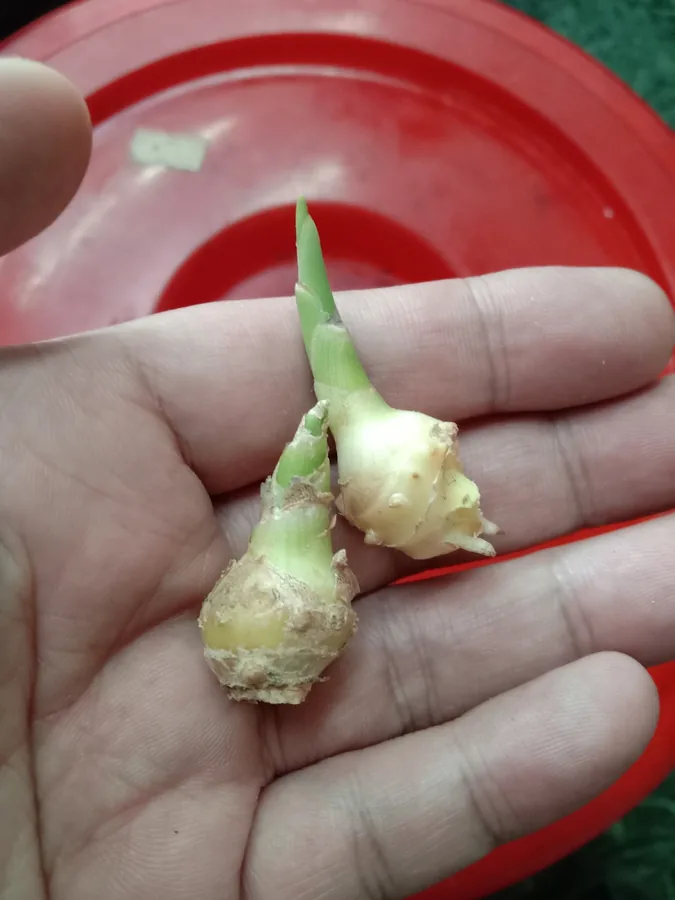
A firm, fresh grocery rhizome bearing visible buds, the nodes gardeners call eyes, will frequently break dormancy and sprout. An overnight soak followed by warm, moist conditions further raises the germination rate. Failures trace to aged stock and applied growth inhibitors, not to supermarket produce as a category.