Ornamental · Onagraceae
Gaura
Gaura lindheimeri
Site it in full sun and lean, well-drained soil, and gaura produces clouds of butterfly-like blooms from spring to frost.
Full sun
Every 7–14 days
USDA 5–9
3–5 ft · 0.9–1.5 m
Overview
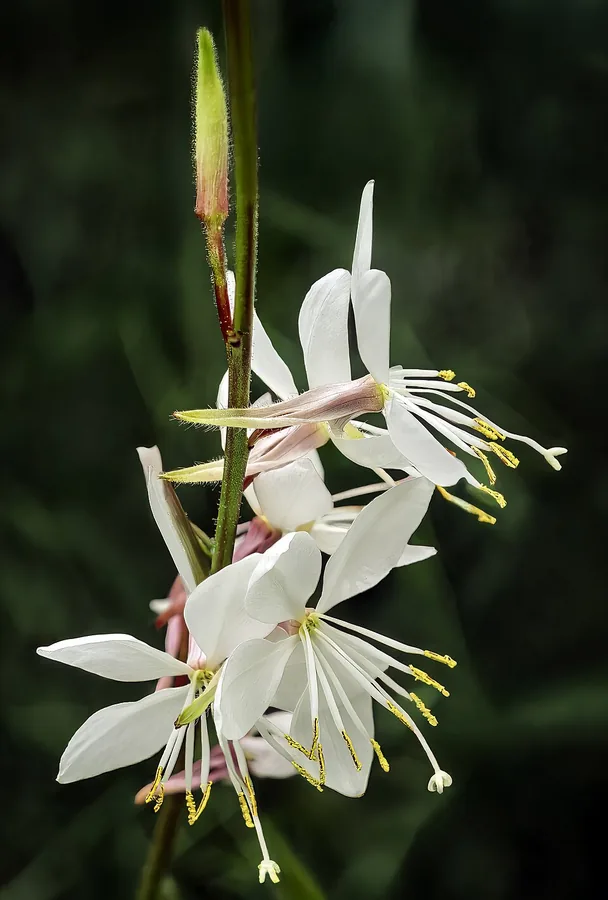
Gaura reads as its common name whirling butterflies because slender wands hold small white or pink flowers that appear to hover and flutter above the foliage. The species is a taprooted perennial in the Onagraceae family, adapted to tight, lean substrates where more demanding plants decline. That adaptation is the key to understanding its care.
The plant asks little because the deep taproot reaches moisture and buffers it against drought and heat once established. Flowering is actually stronger in poor ground than in enriched beds, since fertility diverts resources into foliage. The limitation lies in the thin, wiry stems, which lodge without support, so full sun, adequate spacing, and sturdy neighbors keep the plant upright.
Hardy across zones 5 to 9, gaura flowers from late spring or summer until the first fall frost. The flowers recruit pollinators, and the extended, airy bloom period makes it a dependable structural element at the front or middle of a sunny border.
Care
The short version: full sun, lean and sharply drained soil, and a deep but infrequent watering. Withhold rich feeding, deadhead to sustain bloom, and cut floppy stems back to force a fresh flush.
Light
Gaura requires full sun to flower fully and hold an upright form. It tolerates light partial shade, but under heavier shade the stems etiolate, lodge, and flower far less.
Water
Once established, the deep taproot sustains gaura through drought and heat, which is why frequent watering is counterproductive. Water moderately, allowing the top half of the soil to dry between applications, and avoid saturated ground, which induces root rot. A deep soak every 7 to 14 days suits it better than frequent shallow watering.
Soil
Plant into sandy or loamy, sharply drained soil, because drainage is the single non-negotiable requirement. A slightly acidic pH of 5.5 to 6.5 is ideal. Avoid rich, heavily amended beds, which favor vegetative growth over flowers.
Humidity
Ambient outdoor humidity is sufficient, so there is no target figure. Air movement is the operative factor, since crowded, static foliage is precisely what allows powdery mildew and rust to establish.
Feeding
Flowering is best on a lean regime, so feed only lightly during the growing season, if at all. Rich or heavily fertilized soil reduces flowering by promoting soft, floppy stem growth instead.
Pruning
Deadhead spent blooms to prolong flowering, and cut floppy or leggy stems back to induce denser rebloom. Shear the flower spikes in fall, then remove the dead foliage in spring.
Size & spacing
Gaura attains 3 to 5 feet (91 to 152 cm) in height with a spread of 1 to 3 feet (30 to 91 cm). Allocate that full spread per plant so air passes through the canopy and the stems have room to stand.
When to plant
Gaura is warm-season and intolerant of frost, so timing follows soil temperature rather than the calendar. Start seed indoors 6 to 8 weeks before the last spring frost, transplant once the soil has warmed, and expect bloom from late spring or summer through the first fall frosts.
Northern hemisphere
Southern hemisphere
Typical months for a temperate climate: start earlier in warm zones, later where spring frosts linger.
- Sow: Start seed indoors 6 to 8 weeks before the last spring frost.
- Plant: Transplant after the last spring frost once soil has warmed.
- Harvest: Blooms from late spring or summer through the first fall frosts.
Hardiness
USDA hardiness zones: 5–9
Temperature: down to -29°C
Troubleshooting
Most disorders in gaura originate either at the roots, from excess soil moisture, or on the foliage, where poor air movement favors fungi. Reading the early symptoms lets you correct the underlying cause before it damages the plant. Match the presentation below and intervene while the correction still works.
Basal blackening, wilt, and sudden collapse
Wilt paired with a blackened base and collapse indicates root rot, which develops when soil holds water against the roots and denies them oxygen. Lift the crown and the diagnosis is confirmed by dark, soft, mushy roots in ground that never fully dries. Relocate the plant to a raised or sandier position, reduce irrigation, and discard specimens too degraded to recover.
Fix:
- Improve drainage or move the plant to a raised or sandier site
- Reduce watering and allow soil to dry between waterings
- Remove and discard severely rotted plants
Powdery white film over foliage and stems
A dusty white coating that rubs cleanly off the surface is powdery mildew, a fungus that colonizes foliage where plants stand crowded and air stagnates around them. The spores establish on still, humid surfaces, so the remedy is ventilation. Thin and space the planting to admit air, remove the most affected leaves, and keep irrigation off the foliage.
Fix:
- Improve air circulation by spacing and thinning plants
- Remove affected foliage
- Avoid overhead watering
Raised orange pustules on lower leaf surfaces
Raised orange to brown pustules on the leaf undersides are the fruiting bodies of rust, a fungus whose spores move on damp, motionless foliage. Removing and destroying infected leaves cuts the inoculum before it disperses. Increase air movement through the planting and direct water to the soil rather than the canopy, since dry leaves deny the fungus the moisture it needs.
Fix:
- Remove and destroy infected leaves
- Improve air circulation
- Avoid wetting foliage when watering
Elongated stems that lodge and sprawl
The thin, wiry stems lack the rigidity to stay upright unaided, so they lodge, and rich soil or excess shade compounds the weakness by driving soft, elongated growth. The sprawl shows most after rain loads the canopy or when low light stretches the stems. Cut the leggy growth back to force denser rebloom, site the plant in full sun and leaner soil, and let sturdy neighbors provide mechanical support.
Fix:
- Cut back leggy stems to encourage bushier rebloom
- Plant near sturdy companions that provide support
- Grow in full sun and leaner soil
Toxicity
For households with animals, gaura is reassuring: it is non-toxic throughout. The species does not appear on the ASPCA list of plants toxic to dogs or cats, and no part of it presents a poisoning risk to pets, livestock, or people. It may be planted freely wherever curious animals investigate.
Safe for
People · Cats · Dogs · Horses · Rabbits · Livestock · Birds
Cats None
Gaura presents no toxicity to cats. An exploratory nibble will not poison them, so the species raises no concern in a household with a cat.
Dogs None
Dogs face no risk from gaura in the garden. The species is absent from the ASPCA toxic list, and ingestion of the foliage produces no harm.
Horses Safe
Horses may graze near gaura safely, since the plant contains no known toxin capable of troubling them.
Rabbits Safe
Rabbits browse the foliage without ill effect, though sound practice introduces any unfamiliar green gradually.
Livestock Safe
Cattle, goats, and sheep graze around gaura without poisoning, as it presents no toxic threat in pasture.
Birds Safe
Birds encounter no toxicity in gaura. The flowers in fact recruit pollinators, and no part of the plant harms avian visitors.
People Safe
Gaura is harmless to people and cultivated strictly as an ornamental, so handling and planting it carry no hazard.
Varieties
Several named selections resolve gaura to a defined size and color for a given position. The following cultivars are the ones worth knowing.
Whirling Butterflies
A compact selection of 2 to 3 feet bearing white flowers and pink buds on wiry stems, and its sterility prevents the self-seeding common to the species.
Siskiyou Pink
A pink-flowered cultivar identified by its dark stems and reddish new growth.
Belleza
A dwarf, compact series selected for a more restrained habit and heavy flowering.
Summer Breeze
A larger cultivar of roughly 3 to 4 feet tall and 2 to 3 feet wide that carries abundant pink-tinged white flowers.
How to propagate
Gaura is propagated from seed or by division of an established clump, though the deep taproot demands care with either method.
SeedModerate
Sow in spring; the species self-seeds readily while many named cultivars are sterile. · Blooms the first or second season from seed.
Sown in spring, the species germinates and reseeds freely, producing its first flowers in the first or second season. Because many named cultivars are sterile, however, they set no viable seed and must be propagated vegetatively by division or cuttings.
DivisionModerate
Divide in spring, taking care with the deep taproot. · Reestablishes over one growing season.
Division is best undertaken in spring and executed carefully, since the deep taproot is easily damaged and resents disturbance. A divided clump reestablishes across a single growing season, and where the taproot renders division risky, basal cuttings offer the more reliable alternative.
Myths
Gaura needs frequent watering and rich, fertile soil to thrive.
The taproot gives gaura genuine drought and heat tolerance once established, so frequent watering is unnecessary. Lean, well-drained soil is the correct medium, whereas rich ground and heavy irrigation suppress flowering and predispose the roots to rot.
Gaura is poisonous to dogs and cats.
The ASPCA does not list gaura among plants toxic to dogs or cats. Gaura is classed as non-toxic, which makes it appropriate for a garden shared with companion animals.