Ornamental · Onagraceae
Fuchsia
Fuchsia × hybrida
Give it cool shade and steady moisture and the fuchsia keeps producing its dangling, two-tone flowers all season.
Partial shade
Every 2–4 days
59–70°F · 15–21°C
USDA 10–11
Overview
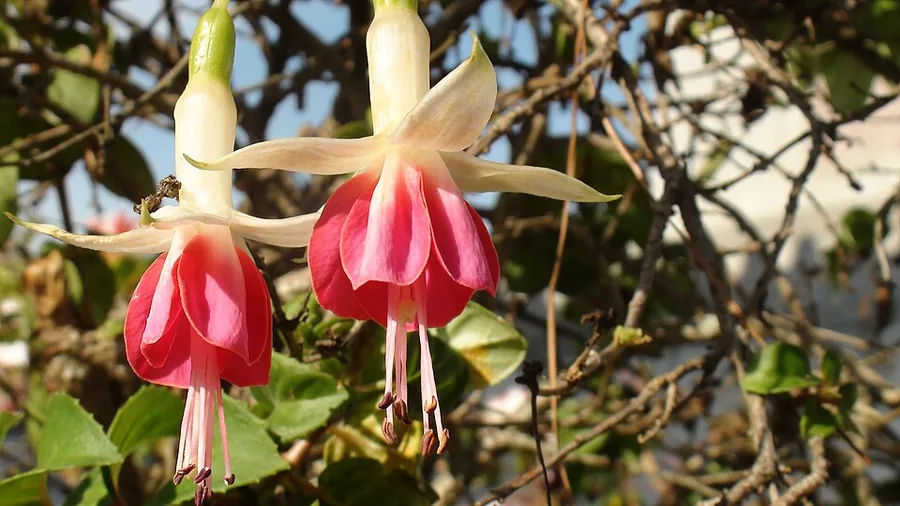
Little else flowers with the display a fuchsia gives at its peak. The pendant blooms, often in two contrasting colors, dangle from the stems like small eardrops, the resemblance that fixed the old common name of lady's eardrops. Nearly all garden fuchsias are hybrids selected for that flowering, grown either trained upright or allowed to cascade from a basket.
At its core this is a shade plant. Fuchsias perform in cool, part-shaded positions and stall in heat, which is why a sheltered corner away from hot afternoon sun rewards the grower. Meet that requirement and the plant flowers from spring through fall.
Most growers treat fuchsia as an annual or overwinter it under cover, though the hardy types can remain in the ground where the winter stays mild. In any case the plant is both a heavy drinker and a heavy feeder, and consistent care returns months of bloom.
Care
The short version: cool part to full shade, soil held evenly moist and never allowed to dry to the point of wilting, a balanced feed every two weeks across the growing season, and shelter from hot afternoon sun and drying wind.
Light
Site a fuchsia in part to full shade, favoring the cooler end. It handles bright indirect light too, but direct afternoon sun scorches the foliage and suppresses flowering, so a sheltered, shaded position is the target.
Water
Hold the soil evenly moist and never let it dry out, because fuchsias wilt quickly once the root zone runs short. Containers and hanging baskets lose moisture fast and call for frequent watering along with shelter from drying wind. Taper the water in fall to ease the plant toward dormancy.
Soil
Use a rich, moisture-retentive loam amended with generous organic matter. A slightly acidic pH of 5.5 to 6.5 suits the roots, and a mix that holds water while still draining prevents the waterlogging that would otherwise stress them.
Temperature
Fuchsias favor cool conditions, ideally 59°F to 70°F (15°C to 21°C). Above an average daily temperature of 76°F (24°C) the plant stops setting flowers, which makes summer heat the primary limiting factor.
Humidity
The foliage prefers moist air in the range of 50% to 70% humidity. Dry air both stresses the plant and creates the conditions spider mites exploit, so a sheltered, slightly humid location outperforms an open, sun-baked one.
Feeding
Fuchsias are heavy feeders. Supply a soluble, balanced complete fertilizer every two weeks throughout the growing season to sustain the continuous flush of flowers.
Pruning
Pinch each new shoot once it has formed two full sets of leaves to force branching and a fuller habit, then halt pinching about a month before the first frost so late growth is not left tender. For hardy types, cut them back in mid-March after the risk of a freeze has passed.
Repotting
Shift potted fuchsias into fresh medium every spring. Roots circling the pot, soil that dries almost immediately after watering, and stalled growth each indicate the plant has become rootbound.
Size & spacing
Expect a height of 1.5 to 3 feet (46 to 91 cm) and a spread of 12 to 24 inches (30 to 61 cm). Space plants so air circulates freely through the canopy, which keeps the leaf surfaces dry enough to discourage rust and mildew.
When to plant
Fuchsias respond to cool conditions rather than the calendar summer. Root cuttings indoors in early spring, transplant outdoors after the last frost once nights stay above freezing, and expect flowers from spring through fall, with a pause when midsummer heat arrives.
Northern hemisphere
Southern hemisphere
Typical months for a temperate climate: start earlier in warm zones, later where spring frosts linger.
- Sow: Cuttings rooted indoors in early spring; seed germinates in 21-28 days at 70-75°F
- Plant: After the last spring frost when nights stay above freezing
- Harvest: Spring through fall, slowing in summer heat
Hardiness
USDA hardiness zones: 10–11
Temperature: down to -1°C
Troubleshooting
Most fuchsia problems come down to heat stress or to a short list of common pests and a fungus or two. Inspect the flowers and the undersides of the leaves, since the earliest evidence shows up there. Match the signs below and intervene before the cause spreads.
Deformed, swollen growing tips with lumpy galls and reddened foliage
The cause here is the fuchsia gall mite (Aculops fuchsiae), a mite far too small to see that hijacks the growing points and flowers into thickened, misshapen galls. Because the damage is at the meristem, prune off and destroy every affected part, then follow with horticultural oil or insecticidal soap at 2 to 3 week intervals to catch successive generations. Keep the plant separate from others and disinfect tools, hands, and clothing, since the mite travels readily by contact.
Fix:
- Remove and destroy all infested plant parts
- Apply horticultural oil or insecticidal soap at 2-3 week intervals
- Isolate infested plants and clean tools, hands, and clothing
Bloom production halts and buds abort as the season heats up
Fuchsias set flowers in response to cool conditions, and bud initiation stops once the average daily temperature climbs past 76°F (24°C). The plant is not failing; it is holding until conditions favor it again. Shift containers into a cooler, shadier position, hold the soil evenly moist so heat stress does not compound the pause, and blooming resumes as autumn temperatures fall.
Fix:
- Move containers to a cooler, shadier location
- Keep soil evenly moist
- Provide protection from hot afternoon sun and wind
Powdery orange spores coating the lower leaf surfaces
Those pustules are the fruiting bodies of fuchsia rust, a fungus that colonizes the underside of the leaf while the upper surface may yellow above each infection. Remove and destroy the affected leaves to cut the spore load, open the canopy so moisture does not linger, and keep irrigation water off the foliage, since the spores need a wet surface to establish.
Fix:
- Remove and destroy affected leaves
- Improve air circulation
- Avoid wetting foliage when watering
Tacky foliage, black sooty film, and a flurry of small white insects
Whiteflies are the most likely offender: disturb the leaves and they lift off in a cloud, and their honeydew excretion feeds the black sooty mold that follows. Aphids and spider mites produce similar honeydew and residue, with aphids curling the leaves and mites leaving fine stippling and webbing under dry stress. Wash the plant down with water, apply insecticidal soap or horticultural oil, and repeat the treatment so newly hatched insects do not restart the population.
Fix:
- Rinse foliage with water
- Apply insecticidal soap or horticultural oil
- Repeat applications to break the life cycle
Toxicity
The safety picture here is straightforward: fuchsia poses no toxic risk. The ASPCA lists it as non-toxic to cats, dogs, and horses, no part of the plant contains a poison, and the small dark berries are edible for people. It can be planted with no concern for pets, livestock, or inquisitive children.
Safe for
People · Cats · Dogs · Horses · Rabbits · Livestock · Birds
Cats None
The ASPCA classifies fuchsia as non-toxic to cats, so a leaf or flower taken in play carries no chemical hazard. As with any greenery eaten in volume, a large mouthful might trigger a short bout of vomiting from bulk alone, not poison.
Dogs None
Cleared by the ASPCA for dogs, and the berries digest without incident. A dog that overindulges on foliage may pass soft stool briefly, an effect of the fiber load rather than any toxin.
Horses None
Fuchsia holds no compounds that act against horses, so a mouthful grabbed in passing from a low basket produces no toxic response. Nothing in the plant warrants keeping it out of reach.
Rabbits None
A rabbit may browse the leaves and flowers freely, since none of the tissue is toxic. The small berries are edible as well, so nibbled fruit poses no problem.
Livestock None
Goats, sheep, and cattle can graze near fuchsia safely; every part of the plant is free of the toxic compounds that harm ruminants. Access to a planting requires no restriction on their account.
Birds None
The ripe berries are edible and attract birds, which forage them without any risk from the plant. In the garden they frequently clear the fruit off the stems before it can be picked.
People None
No part of fuchsia is toxic to people, and the dark berries are genuinely edible, carrying a mild flavor that runs from sweet to faintly peppery. Let the fruit ripen fully, since that is when the taste is at its best.
Varieties
Garden fuchsias run to hundreds of named hybrids, yet they fall into a few practical groups worth recognizing before purchase.
Gartenmeister
A triphylla hybrid bearing coral-red tubular flowers above dark bronze-green foliage, and it holds up under summer heat more reliably than most fuchsias.
Hardy fuchsia (Fuchsia magellanica types)
Shrubbier and more cold-tolerant selections that can remain planted in the ground and survive the winter outdoors where the season stays mild.
Trailing or basket types
Cascading forms with lax stems that trail over a basket rim, in contrast to the upright shrubs that hold themselves at 1 to 2 feet (30 to 60 cm) tall.
How to propagate
Fuchsias propagate readily, and cuttings are the only dependable method for holding a hybrid true to type.
Stem cuttingsEasy
Spring or late summer using softwood cuttings about 6 inches long · Roots typically form in 2-4 weeks
Cut softwood tips roughly 6 inches (15 cm) long in spring or late summer, and expect roots within 2 to 4 weeks. Cuttings are the reliable route because the hybrid cultivars do not come true from seed, so only vegetative propagation preserves the exact flower and habit of the parent.
Myths
Fuchsia berries are poisonous to people and pets.
The record shows the reverse. The ASPCA classes fuchsia as non-toxic to cats, dogs, and horses, and the dark berries are safe and edible for people, carrying a mild peppery sweetness once fully ripe.
Fuchsias grow best in full sun.
They are shade plants by nature. Flowering peaks in part to full shade with cool temperatures, and a hot afternoon exposure undercuts that, because heat above 76°F (24°C) halts bud production entirely.