Ornamental · Poaceae
Fountain Grass
Pennisetum alopecuroides
Site it in full sun and lean soil, and fountain grass arches into a soft, plumed mound that carries color straight through winter.
Full sun
Every 7–14 days
USDA 5–9
2–5 ft · 0.6–1.5 m
Overview
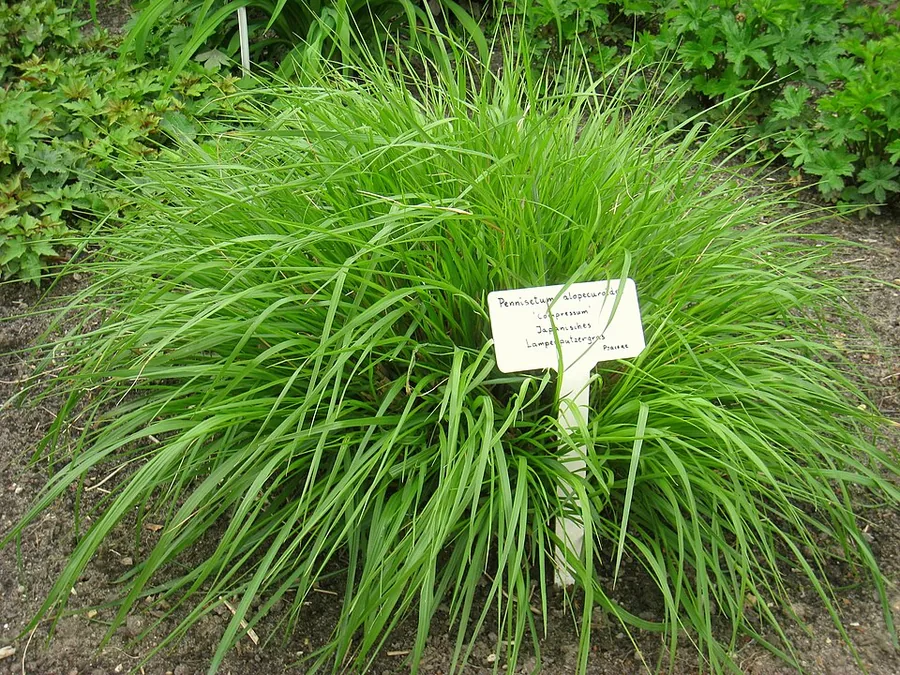
The name describes the plant exactly. Foliage rises and curves back over itself into a neat mound, and by late summer the soft, bottlebrush plumes lift clear of the leaves and sway with every breeze. This is a warm-season clump-former in the grass family, grown across a broad band of cold-hardy ground from zone 5 to zone 9.
Its value as a garden workhorse comes from its low demands. Once it has rooted in, it tolerates drought, asks for almost no feeding, and carries no serious pests with it. The plumes emerge silvery to pinkish and the entire clump shifts to gold in fall, holding both form and color well beyond the first hard frosts.
The single trait to monitor is its tendency toward seeding itself around. The hardy fountain grass can self-sow into neighboring beds and even break out into wild ground, while its tender relative, crimson fountain grass, is a serious weed across warm, dry regions. Cut the plumes before the seed sheds and you keep every ornamental quality without the liability.
Care
The short version: give it full sun and average, well-drained soil, water it regularly until it's established and then mostly leave it alone, and cut the whole clump to the ground in late winter before new growth starts.
Light
Fountain grass performs best in full sun, where growth stays dense and the stems hold upright. It will accept partial shade, but under too little light the stems turn soft and the clump splays open, because low light yields weak, unsupportive growth.
Water
Provide regular water through the first season while the roots establish. From then on it is drought tolerant and lives on rainfall in most settings, though it does best where the soil stays medium to wet, so a deep soaking during a prolonged dry spell keeps it looking fresh.
Soil
Average, well-drained soil suits it perfectly, and it is indifferent to pH. Steer clear of rich, heavily amended beds, since excess fertility drives floppy stems that cannot hold the fountain form.
Temperature
It is tough across a wide span, hardy from roughly -20°F to 100°F (-29°C to 38°C). That cold-hardiness is precisely what allows it to grow as a true perennial up through zone 5.
Humidity
Ordinary outdoor humidity is all it requires, so there is no figure to target. Air moisture is irrelevant to a grass this resilient.
Feeding
This is a low-feed plant. A light application of balanced fertilizer or a little compost in spring is ample, and many growers omit it entirely, since rich soil only encourages the clump to flop.
Pruning
Cut the entire clump back to a few inches above the ground in late winter or early spring, before the new growth emerges. Where self-seeding is a worry, snip off the plumes in fall before the seed sheds.
Repotting
Divide a clump every 2 to 4 years to keep it vigorous. Once the center dies out and bare ground rings the middle, the plant is signaling that it is overdue for splitting.
Size & spacing
A clump reaches 2 to 5 feet (60 to 150 cm) tall and roughly as wide. Allow it that much space so the arching fountain shape can develop without crowding its neighbors.
When to plant
Everything about fountain grass tracks the warm season. Sow seed indoors in late winter or set divisions out in spring once the cold has broken and the soil has warmed, then expect plumes from late summer onward, holding through fall and into winter.
Northern hemisphere
Southern hemisphere
Typical months for a temperate climate: start earlier in warm zones, later where spring frosts linger.
- Sow: 8 to 10 weeks before last frost
- Plant: spring after last frost once soil has warmed
- Harvest: late summer into fall, plumes often persisting through winter
Hardiness
USDA hardiness zones: 5–9
Temperature: down to -29°C
Troubleshooting
Disease is rare in fountain grass, so most trouble comes down to habit rather than infection. The handful of issues that arise show up in the form of the clump or in seedlings appearing where nothing was planted. Match the description below and the remedy is generally straightforward.
Volunteer seedlings cropping up across the bed
Those handsome plumes are also seed factories, and in regions with mild winters the dropped seed overwinters and germinates come spring. That self-seeding is the mechanism behind fountain grass turning weedy and slipping into uncultivated ground. Remove the plumes in autumn before they shatter, and pull or hoe young volunteers while their roots are still shallow.
Fix:
- Cut off and remove flower plumes before seeds mature and shatter
- Pull or hoe volunteer seedlings while young
- Choose sterile or low-seed cultivars where available
Hollow, lifeless middle circled by green growth
After a few seasons an established clump stops producing from its core and pushes new growth only at the perimeter. That center die-out is the natural aging of the clump, not a pathogen at work. Lift the entire plant in early spring, discard the spent core, and reset the vigorous outer fragments.
Fix:
- Dig and divide the clump in early spring
- Discard the dead center and replant healthy outer divisions
Sprawling, splayed stems that won't stay upright
The plant should arch and cascade the way its common name promises, so a clump that splays outward is signaling too little light or soil that is too rich. Flopping traces directly to shade and heavy feeding, which drive soft, weakly lignified growth that cannot support itself. Relocate it to full sun, cut back the feeding, and the stems regain their backbone.
Fix:
- Move or plant in full sun
- Avoid heavy fertilizing and overly rich soil
Toxicity
Reassuring news for pet owners: fountain grass is not poisonous to animals or people. The only part demanding care is the plant itself, since the leaf margins can cut and the bristly seed plumes bear barbed awns that catch in fur or skin like a foxtail.
Safe for
People · Cats · Dogs · Horses · Rabbits · Livestock · Birds
Cats Safe
A cat that grazes a blade faces no risk of poisoning from this grass. The point of concern is the bristly seed head, whose barbed awns can snag in fur or burrow into skin much like a foxtail.
Dogs Safe
Chewing the foliage carries no toxic danger for a dog. Watch the seed-laden plumes instead, since the small barbed awns can work into the ears or lodge between the toes.
Horses Safe
Horses can graze it without harm. The ripe seed heads are the lone nuisance, their stiff awns capable of irritating the mouth, so cut or mow it before it sets seed in a pasture.
Rabbits Safe
The leaves are safe for rabbits to eat, and they favor the soft new spring growth above all.
Livestock Safe
Cattle, goats, and sheep graze it with no toxic consequence. The only caution is the sharp-edged foliage and bristly seed heads, since the awns can trouble the mouth once the plumes have hardened.
Birds Safe
No hazard exists for birds, and finches and other seed-eaters frequently pick over the ripe plumes through fall and winter.
People Safe
There is nothing in this plant that will poison a person. Pull on gloves before cutting it back, because the leaf margins are keen enough to deliver a paper-cut sting.
Not chemically poisonous, but the bristly flower and seed plumes carry tiny barbed bristles and awns that can act as a mild mechanical or foxtail-type irritant, and the leaf edges can be sharp; handle plumes with care around pets and children.
Varieties
A handful of fountain grass cultivars are worth knowing, distinguished chiefly by size and plume color. These are the ones you are most likely to encounter.
Hameln
A compact dwarf selection that flowers ahead of the straight species and weathers cold winters with greater reliability.
Little Bunny
The most diminutive of the group, reaching only about 12 to 18 inches, which suits it well for edging and small containers.
Moudry
Prized for its near-black, purple plumes, yet it self-seeds more aggressively than any other cultivar and can turn into a nuisance.
Pennisetum setaceum 'Rubrum' (purple/crimson fountain grass)
A frost-tender, burgundy-foliaged relative treated as an annual in cold climates that becomes badly invasive in warm, dry regions and ought to be kept out of those gardens.
How to propagate
Increasing fountain grass is simple, done either by dividing an established clump or by sowing the straight species from seed.
DivisionEasy
Early spring before new growth · One growing season
Division is the standard method for increasing fountain grass. Lift the clump in early spring ahead of new growth, discard any spent center, and break the healthy outer ring into pieces that knit back in within a single season. It is also the only way to keep a named cultivar true, because those selections will not reproduce faithfully from seed.
SeedEasy
Spring · One to two growing seasons
The straight species germinates readily from a spring sowing, needing one to two seasons to form a full clump. Proceed with caution, though, since named cultivars will not breed true by this route and seed-raised plants can self-sow hard enough to become a weed.
Myths
Every fountain grass is interchangeable and safe to put anywhere.
Two distinct plants go by this name. The cold-hardy, clump-forming Pennisetum alopecuroides is the dependable garden grass, whereas the tender Pennisetum setaceum, 'Rubrum' included, is grown as an annual and escapes into warm, dry country such as California, Hawaii, and the arid Southwest. Even the hardy species can self-seed and turn weedy, so cut the plumes before the seed drops wherever spread is a concern.