Ornamental · Poaceae
Feather Reed Grass
Calamagrostis × acutiflora
Sited in full sun, feather reed grass holds a tall, feathered column from its June bloom right through winter.
Full sun
Every 5–10 days
USDA 4–9
3–5 ft · 0.9–1.5 m
Overview
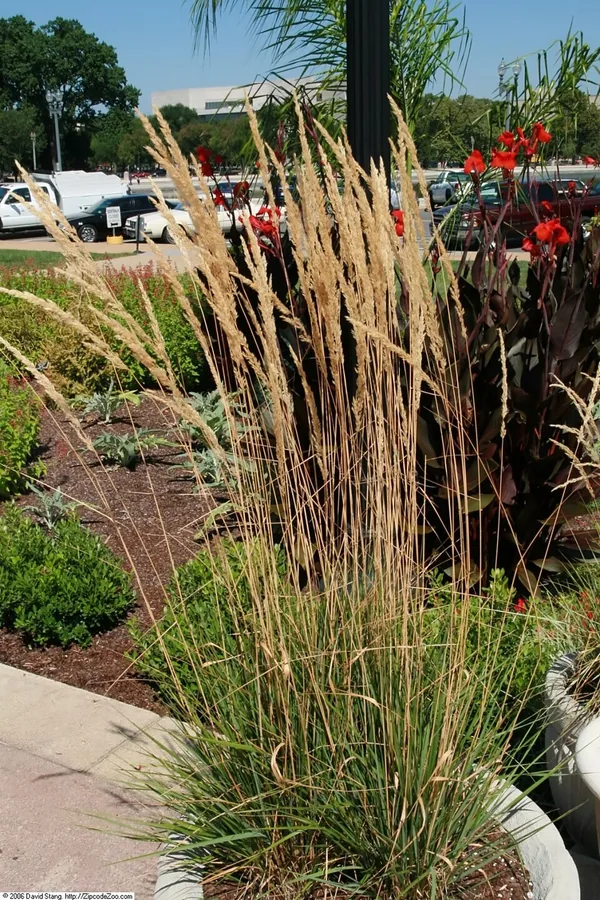
Feather reed grass is the strictly upright grass you have seen flanking drives and anchoring the back of a border. It is a sterile hybrid of two European species, and its most recognized clone, Karl Foerster, took Perennial Plant of the Year in 2001. The crown pushes narrow green blades in spring, then sends up tall flowering culms that open into feathery inflorescences in early summer.
Its defining trait is the rigid vertical habit. The culms rise dead straight and hold that line even after the plumes age to a wheat color, so the silhouette persists long after looser grasses have lodged. As a cool-season grass, it concentrates growth in the cooler weather of spring and fall and largely idles through peak summer heat.
Demands on the gardener are minimal once it is established. Hardy across zones 4 to 9, it tolerates heavy clay, hard winters, and saturated ground that would rot less adaptable grasses. Leave the plumes intact through the cold season for winter structure, then cut the clump to the base before new shoots emerge in spring.
Care
The short version: full sun, average to moist soil, and minimal intervention. Irrigate through extended drought, withhold heavy feeding so the culms stay rigid and upright, and cut the clump to the ground once a year in late winter.
Light
Site feather reed grass in full sun for the most rigid, upright culms. It tolerates partial sun or light shade, but as light decreases the stems lean and lodge and flowering drops off, because lower light yields weaker supporting tissue.
Water
Once established it spans a wide range, from dry banks to wet, heavy ground that would suffocate most grasses. It performs best in fertile soil that never dries out completely, so irrigate the clump through extended drought. Water roughly every 5 to 10 days during dry spells, and otherwise let rainfall meet its needs.
Soil
It accepts nearly any soil. Well-drained fertile loam is the optimum, yet it handles heavy clay, lean ground, and damp sites markedly better than other ornamental grasses, which is a chief reason gardeners choose it.
Temperature
This is a notably cold-hardy grass, comfortable across roughly -29°F to 100°F (-34°C to 38°C). Zone 4 winter cold does not damage it, though as a cool-season grass it can stall and brown somewhat through the most oppressive heat and humidity of summer.
Humidity
Ambient humidity is not a factor, so there is no target reading. Air movement matters far more: still, muggy air within a crowded planting is precisely what allows rust to establish on the foliage.
Feeding
Feed sparingly in spring with a balanced fertilizer or a thin top-dressing of compost, and leave it at that. Excess fertility drives soft, succulent growth that lodges and destroys the upright form the plant is grown for.
Pruning
It needs a single cut each year. Shear the entire clump to a few inches above the ground in late winter or very early spring, ahead of the emerging green shoots, and the crown regenerates within weeks.
Repotting
In the ground the relevant operation is division, not repotting. Every few years, as the crown thins or vigor falls off, lift and split it in spring or fall, retain the healthy outer divisions, and discard the dead center.
Size & spacing
A flowering clump reaches 3 to 5 feet (91 to 152 cm) while remaining narrow, with a spread of about 18 to 30 inches (46 to 76 cm). That compact footprint is what makes it effective as a vertical accent or planted in a row.
When to plant
Plant feather reed grass in spring or fall, when soil temperatures are cool and roots can establish without the stress of summer heat. The flowering culms emerge in early summer, around June, then persist as tan spikes through fall and into winter.
Northern hemisphere
Southern hemisphere
Typical months for a temperate climate: start earlier in warm zones, later where spring frosts linger.
- Plant: Spring or fall
- Harvest: Early summer (June); plumes persist through fall and winter
Hardiness
USDA hardiness zones: 4–9
Temperature: down to -34°C
Troubleshooting
Nearly every problem with feather reed grass traces back to one of three causes: too little light, too much summer heat, or an aging crown. Each leaves a clear diagnostic signature. Match the symptom below, then correct the single underlying condition.
Rusty pustules that smear orange when touched
The powdery orange spots are rust, a fungal disease that establishes after extended rain or stretches of hot, wet weather. Remove the worst-affected blades, thin the planting to let air move freely through the foliage, and keep irrigation off the leaves. Because spores overwinter on debris, clear all infected growth during the late-winter cutback to break the cycle.
Fix:
- Improve air circulation and avoid overhead watering
- Remove and discard badly affected foliage
- Cut back and dispose of infected growth at the late-winter cleanup
A hollow, dead crown opening in the heart of the clump
Grasses grow outward from the crown, so an aging clump dies out in the center while the live outer ring keeps expanding. That bare middle is the signal to divide. Lift the plant in spring or fall, replant the vigorous outer divisions, and discard the spent core. Repeating this every few years renews the crown and keeps the clump dense.
Fix:
- Dig and divide the clump in spring or fall
- Replant healthy outer divisions and discard the dead center
Heat-checked, browning blades during the muggiest weeks of summer
Calamagrostis is a cool-season grass, meaning its metabolism peaks in the moderate temperatures of spring and fall and slows sharply once heat and humidity climb, a pattern most pronounced in southern gardens. Resist cutting it back. Keep it watered through the heat and the foliage resumes active growth and re-greens as conditions cool.
Fix:
- Water during prolonged heat and drought
- Tolerate the temporary summer decline; do not cut the whole plant back
- Site in full sun in cooler regions for best vigor
Culms leaning and splaying instead of holding a column
When the columnar form collapses, the cause is almost always insufficient light or excess soil fertility. Both push soft, weak stem tissue that cannot support its own height. Relocate the clump to full sun and withhold feeding. Lean, bright conditions are what build the rigid culms that keep this grass standing straight.
Fix:
- Transplant to a full-sun location
- Reduce fertilization and avoid overly rich soil
Toxicity
This is a low-risk plant to live with. Feather reed grass is non-toxic and absent from the ASPCA poison lists, so it is safe around cats, dogs, and the wider household. The only real hazard is mechanical: the blades and seed heads bear sharp edges that can scratch, and a pet that eats a mouthful of grass may regurgitate it.
Safe for
People · Cats · Dogs · Horses · Rabbits · Livestock · Birds
Cats Safe
No toxic compounds are present, so a cat is safe around it. Chewing a blade may trigger the same reflexive cough or regurgitation that any grass does, with no poisoning risk.
Dogs Safe
Free of toxins, so a dog can investigate and nibble it without harm. The most you might observe is mild vomiting after eating a large quantity of foliage.
Horses Safe
Not recorded as toxic to horses. The only consideration is mechanical: the stiff, sharp leaf margins can scratch on contact.
Rabbits Safe
Contains nothing poisonous to rabbits. The coarse, sharp-edged blades have little palatability, so rabbits generally pass it by.
Livestock Safe
Cattle, goats, and sheep can graze nearby with no risk of poisoning. It is cultivated as an ornamental rather than forage, so livestock seldom feed on it.
Birds Safe
Poses no hazard to birds, which may probe the seed heads. The widely grown forms are sterile, so very little viable seed is available to them.
People Safe
Safe for people, with no ingestion concern. Wear gloves at cutback time, since the leaf edges and seed spikes can abrade or cut bare skin.
Foliage and seed heads have sharp edges and points that can scratch; grass pollen may bother allergy sufferers, and pets that nibble grass may vomit, but it is not poisonous.
Varieties
A short list of named selections accounts for almost every feather reed grass on offer at the nursery. These are the ones worth being able to tell apart.
Karl Foerster
The benchmark upright sterile hybrid, awarded Perennial Plant of the Year in 2001; its green blades and tan vertical plumes produce no viable seed and therefore never self-sow.
Overdam
A more compact variegated selection reaching about 3 feet, identified by green leaves margined with crisp white striping.
Avalanche
A variegated form standing close to 4 feet, distinguished by a wide white stripe down the center of each leaf rather than along the edge.
Calamagrostis brachytricha (Korean feather reed grass)
A related warm-season species with a looser, arching habit and pinkish plumes that emerge in late summer and fall rather than early summer.
How to propagate
Since the popular forms are sterile, you increase feather reed grass by dividing the crown rather than sowing seed. The same operation that multiplies the plant also renews an aging one.
DivisionEasy
Spring or fall · One growing season
Division is the standard method for increasing feather reed grass, and it simultaneously rejuvenates a clump that has hollowed at the crown. Lift and separate an established plant in spring or fall, replant the vigorous outer divisions, and they re-root and fill in over a single growing season.
SeedDemanding
Not applicable for sterile cultivars · Not applicable; sterile cultivars set little or no viable seed
Seed propagation is not workable for the cultivars in general cultivation. Sterile hybrids such as Karl Foerster set little or no viable seed, leaving nothing to sow, so raising the named forms from seed is not a practical option.
Myths
All ornamental grasses self-seed and take over the garden.
The widely sold forms of feather reed grass, Karl Foerster included, are sterile hybrids that produce little to no viable seed. With no fertile seed, there is no self-sowing, so the standard cultivars stay where you plant them and are non-invasive. The wild species and rare chance seedlings can spread, but the named hybrids in commerce will not.