Ornamental · Poaceae
Mexican Feather Grass
Nassella tenuissima
In lean soil and full sun this fine-textured bunchgrass holds form all season, provided its seed output is managed.
Full sun
Every 10–21 days
90–120 days
USDA 7–10
Overview
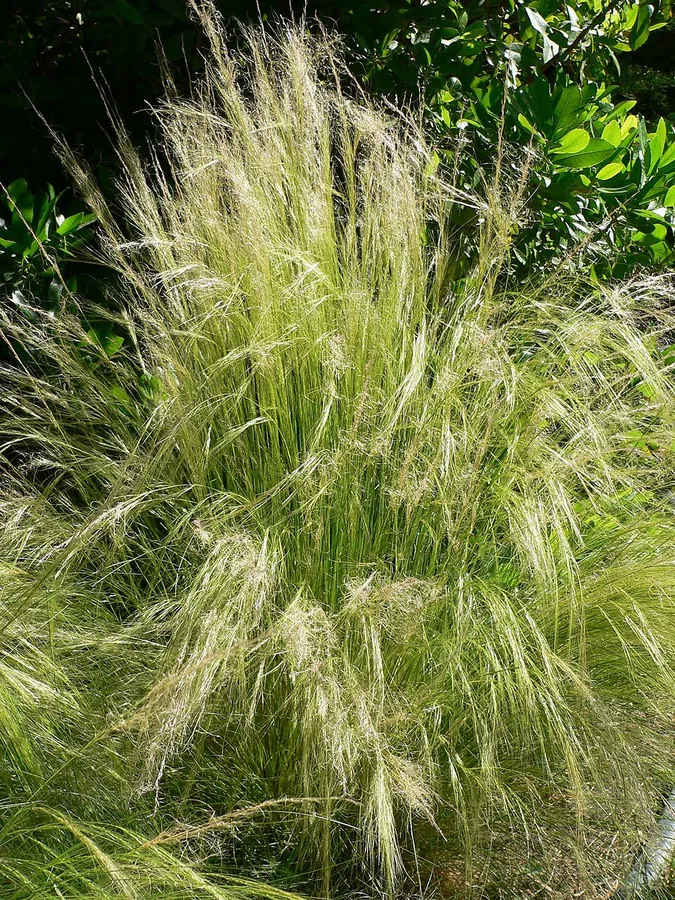
Nassella tenuissima is a fine-textured, clump-forming perennial grass whose needle-thin blades respond to the lightest air movement, producing the characteristic rippling motion. Pigment shifts from green to a wheaten straw color as the season advances and the foliage matures and dries. The plant maintains a compact, fountain-shaped habit, which is what makes it equally suited to a gravel planting or as repeated texture through a mixed border.
As a species adapted to the arid southwest and Mexico, it is built for drought and lean ground. Its tolerance for heat and infertile soil reflects that origin, which is why it persists where less adapted plants stall. The midsummer browning that alarms many growers is a heat-driven semi-dormancy, a protective response in which the crown remains viable and resumes growth as temperatures fall.
The defining horticultural problem is reproductive output. A single clump can release thousands of wind-borne seeds that form a persistent seed bank, and in mild-winter regions such as California this has driven escape into open grassland and an invasive classification. Removing the inflorescences before seed matures interrupts that pathway and keeps the plant ornamental rather than weedy.
Care
The short version: site it in full sun on lean, sharply drained sandy soil, water only sparingly once established, withhold fertilizer, comb the clump out in late winter, and remove seed heads before they ripen to prevent self-seeding.
Light
Site it in full sun, which drives the most intense foliage color and the densest, most erect clump. It tolerates light afternoon shade, but reduced light weakens stem turgor and the habit opens up, sacrificing the upright fountain form that defines the plant.
Water
Established plants are very drought tolerant and require irrigation only every 10 to 21 days, with less needed in cool weather. Supplemental soaking is warranted during prolonged drought, but the root zone must never remain saturated, since waterlogging triggers the root rot the species is prone to.
Soil
It performs best in lean, sharply drained sandy loam and accepts rocky or clay substrates provided they are not kept wet. The species spans a wide pH range of 5.5 to 8.0, so reaction is rarely limiting; soil moisture, not acidity, is the controlling variable.
Temperature
Hardiness extends across a broad thermal range, roughly 0°F to 100°F (-18°C to 38°C), corresponding to USDA zones 7 through 10. Temperatures below that lower limit are lethal, so in colder zones the plant functions only as a short-lived seasonal subject.
Humidity
Adapted to arid conditions, it prefers low humidity and gains nothing from moist air. Persistent humidity can be detrimental because it keeps the crown damp, so open siting with free air movement is preferable to a sheltered, stagnant location.
Feeding
Fertility requirements are minimal. The plant thrives in poor soil, and at most a light spring feed is justified, if any, because excess fertility produces lax, floppy growth and stimulates still heavier seed production.
Pruning
Comb out or cut back the strawy old foliage in late winter or early spring ahead of new growth, and accept a ragged appearance through summer dormancy. The most consequential operation is removing the seed heads before maturity, since this directly limits the self-seeding that defines the plant's weediness.
Repotting
Container specimens seldom need moving, but division is warranted when roots circle the pot, the center dies out, or water drains through immediately, all signs of a congested or aging clump. Replant the vigorous outer divisions in fresh, gritty medium and discard the exhausted center.
Size & spacing
A mature clump reaches roughly 12 to 24 inches (30 to 61 cm) in both height and width. Space plants at the same 12 to 24 inches (30 to 61 cm) so each fountain can arch fully without the crowding that degrades form and airflow.
When to plant
Sow seed indoors in late winter, six to eight weeks before the last frost, since the plant needs a head start to reach planting size. Transplant after frost has passed, from spring into early summer, when soil has warmed. Flowering runs from June through September, and cutting the inflorescences before seed set is the single most effective check on spread.
Northern hemisphere
Southern hemisphere
Typical months for a temperate climate: start earlier in warm zones, later where spring frosts linger.
- Sow: Late winter to early spring, 6-8 weeks before last frost
- Plant: After last frost, spring through early summer
- Harvest: June to September
Hardiness
USDA hardiness zones: 7–10
Temperature: down to -18°C
Troubleshooting
The two failure modes that matter both trace to a single mechanism each: excess seed production, or a root zone held too wet. Midsummer browning, by contrast, is physiological dormancy rather than disease. Identify the cause below before intervening, because the correct response differs sharply between them.
Seedlings emerging across the garden and into adjacent ground
This is self-seeding, the species' principal liability. A single clump disperses thousands of wind-borne seeds that establish a long-lived seed bank and migrate into lawns, paths, and uncultivated ground. Interrupt the cycle by cutting and bagging the feathery seed heads before maturity, excavating young volunteers with their roots, and discarding spent plants in the trash rather than compost where the grass is invasive.
Fix:
- Cut off and bag the feathery seed heads before they ripen and shed seed
- Pull or dig volunteer seedlings while young, including the roots
- Remove and dispose of spent plants in the trash, not compost, where invasive
Brown, soft collapse at the center of the clump
Saturated soil induces root rot, to which this grass is highly susceptible because it cannot tolerate sustained moisture at the crown. Poor drainage or heavy watering turns the crown and roots soft and dark. Reduce irrigation and correct drainage, then lift the clump, retain the sound outer growth, and discard the dead core. Decline in an old specimen may also reflect the species' naturally short lifespan.
Fix:
- Improve drainage and reduce watering
- Lift and divide healthy outer portions, discarding the dead center
- Replant in sharply drained, lean soil
Strawy brown foliage with a dead appearance in midsummer
This is typically summer semi-dormancy, a normal heat response rather than pathology, in which the crown stays alive and green regrowth follows cooling or cutting back. Accumulated dead blades exaggerate the effect, so comb them out by hand or rake, and shear the clump in late winter to reset the foliage.
Fix:
- Comb out dead blades by hand or rake
- Cut foliage back in late winter to early spring to refresh growth
Sticky residue, distorted blades, or small leaf lesions
Sticky, deformed foliage indicates aphids feeding on the blades, whereas discrete lesions indicate leaf spot disease. A strong water jet dislodges aphids, which seldom rebuild significant numbers afterward. Strip the worst-spotted foliage and open the clump to improve air circulation, which suppresses the fungal pathogens.
Fix:
- Rinse aphids off with a strong jet of water
- Remove badly spotted foliage and improve air circulation
Toxicity
From a toxicology standpoint this is a benign plant. Nassella tenuissima is not toxic to cats, dogs, horses, or other animals, nor to people, and ornamental grasses of this type are treated as non-toxic. The only hazards are mechanical and allergenic: the bristly awns can lodge in fur or paws like a foxtail, and the grass pollen can provoke symptoms in hay fever sufferers.
Safe for
People · Cats · Dogs · Horses · Rabbits · Livestock · Birds
Cats Safe
No toxic constituents are present, so an investigating cat faces no poisoning risk. Mechanical ingestion of blades may induce vomiting, and the fine seeds can lodge in a long coat.
Dogs Safe
Dogs may safely contact and ingest the grass. The principal concern is mechanical: the bristly awns behave like a foxtail, tangling in fur and penetrating paws or ears, so grooming after exposure is advisable.
Horses Safe
Horses are unaffected toxicologically and graze the grass without harm.
Rabbits Safe
Rabbits can consume the foliage with no risk of poisoning.
Livestock Safe
Cattle, goats, and sheep graze it without toxic effect, though its forage value is negligible.
Birds Safe
Birds incur no toxic risk and frequently feed on the ripe seed, in doing so dispersing it well beyond the planting.
People Safe
No plant part is toxic to people. The relevant exposure is allergenic: grass pollen can trigger symptoms in individuals susceptible to hay fever.
The fine, bristly seeds and awns can cling to and tangle pets' coats (a minor foxtail-type mechanical nuisance), and pets that nibble grass may vomit. Grass pollen may bother allergy-prone people.
Varieties
Cultivar choice is limited because most of the trade sells the straight species, but a few labels recur and one group of native analogues is worth understanding where invasiveness is a concern.
Pony Tails
Pony Tails is the dominant commercial selection, valued for exceptionally soft, fine foliage that moves in the slightest air, but it self-seeds and spreads exactly as freely as the species.
Stipa tenuissima (synonym)
Stipa tenuissima is the same taxon under its earlier botanical name, still in wide nursery use, so the grass is frequently sold labeled Stipa rather than Nassella.
Native needlegrasses (Nassella / Stipa species)
Native needlegrasses in the Nassella and Stipa group, such as purple needlegrass, deliver comparable airy texture without the invasive behavior, making them the sounder choice where the Mexican species is problematic.
How to propagate
Two propagation routes apply, and the deciding factor is whether seed dispersal is acceptable in the planting site. Both are technically undemanding.
SeedEasy
Sow indoors late winter to early spring, or it self-sows readily outdoors · One growing season
Seed is the most efficient method, and the plant largely propagates itself, germinating freely wherever it sets seed. Sow indoors in late winter to early spring or allow self-sowing outdoors, and a seedling develops into an established clump within one growing season. That same fecundity drives unwanted spread, so seed production must be controlled where invasiveness is a concern.
DivisionEasy
Spring · One growing season
Division is the method that avoids seed dispersal entirely. Lift an established clump in spring, separate it, and discard the dead center, then reset the living outer fragments, which re-establish over a single growing season.
Myths
Mexican feather grass is a harmless, well-behaved ornamental in every climate.
The record contradicts this. It self-seeds aggressively and carries an invasive listing in California and other mild-winter regions, where it escapes cultivation and displaces native grass across open country. Several jurisdictions now discourage or restrict it. Remove the seed heads before they ripen, and where it naturalizes, substitute a native bunchgrass.