Ornamental · Juncaceae
Corkscrew Rush
Juncus effusus 'Spiralis'
Hold its roots wet and never dry, and corkscrew rush returns a full season of twisting green coils.
Full sun
Every 1–3 days
USDA 4–9
12–18 in · 30–46 cm
Overview
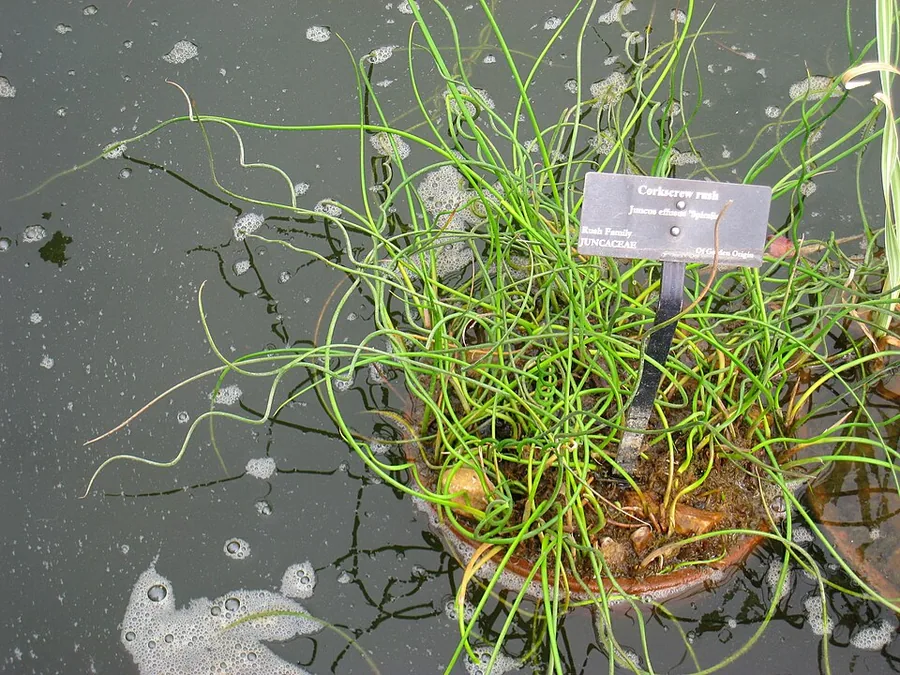
Corkscrew rush is named for its most diagnostic feature. Each leafless culm spirals and coils like a green corkscrew, arising directly from the crown in a dense clump that carries no true foliage. Botanically it is a rush, not a grass or a sedge, a member of Juncaceae, and that architecture gives a planting a kinetic quality few other perennials supply.
Its defining cultural requirement, and what separates it from most garden subjects, is a constant supply of water. This is a bog and pond-margin plant by ecology, performing best in saturated ground or beneath a few inches of standing water. Site it at a water feature's edge, in a permanently waterlogged pocket, or in a container standing in a reservoir of water, and its remaining demands are slight.
It is a durable, cold-hardy perennial that retains its curls through much of the year. The behavior to monitor is its propensity to throw plain straight culms, a genetic reversion to its wild progenitor. Remove those as they appear and the spiral character holds the display.
Care
The short version: full sun to part shade, a substrate that never dries, and a wet or boggy position it can occupy all season. Cut out any straight reverted culms, and divide the clump every few years to maintain vigor.
Light
Site corkscrew rush in full sun for the best, tightest curls, though it accepts partial sun and partial shade without injury. Higher irradiance generally drives denser, more vigorous spiral growth, because the plant has more energy to invest in new culms.
Water
This is the governing factor: the substrate must never dry out. Hold it consistently moist to wet, or stand a potted specimen in a saucer of water to maintain a permanent reservoir. It thrives in boggy ground and even under standing water up to a few inches over the crown, so inspect moisture every day or two during warm spells when evaporative loss climbs.
Soil
It grows in rich, constantly moist to wet soil and is indifferent to texture, performing in clay, loam, or sand alike. A broad pH window from 6.0 to 8.0 accommodates it, and it succeeds in bog conditions or shallow standing water where many perennials would rot.
Temperature
Corkscrew rush is exceptionally cold-tolerant, withstanding the full span from -29°F to 100°F (-34°C to 38°C). That hardiness allows it to overwinter outdoors across much of the country without supplemental protection.
Humidity
Ambient humidity is sufficient, so no target percentage applies. The physiology that matters here is root-zone saturation, not atmospheric moisture, which is why it adapts readily indoors or out.
Feeding
It is a low-demand feeder. A single light spring application of a balanced general-purpose or aquatic-plant fertilizer supplies the season, and excess nutrition offers no benefit and can coarsen growth.
Pruning
Maintenance is minimal. During the season, comb out or trim away dead and straight reverted culms to preserve the corkscrew form, then cut tatty or aged clumps to ground level in late winter to early spring to clear the way for fresh growth.
Repotting
Divide or repot every 2 to 3 years, or whenever the clump center dies out. A bare core, a congested crown, or a decline in new spiraled culms each signals that renewal is due.
Size & spacing
Mature clumps reach roughly 12 to 18 inches (30 to 46 cm) in height and an equal width. Allow each plant a corresponding 12 to 18 inches (30 to 46 cm) of spacing so the spiraling culms can develop without crowding.
When to plant
As a hardy perennial that regrows from its rhizomes each year, corkscrew rush needs no seed-starting schedule. Establish new plants in spring once frost risk has passed, expect the inconspicuous summer inflorescence, and lift and divide mature clumps in spring when they require renewal.
Northern hemisphere
Southern hemisphere
Typical months for a temperate climate: start earlier in warm zones, later where spring frosts linger.
- Plant: Spring after frost danger passes
- Harvest: Inconspicuous yellowish-green to brown flowers in loose cymes, summer (roughly June to September)
Hardiness
USDA hardiness zones: 4–9
Temperature: down to -34°C
Troubleshooting
Corkscrew rush is largely trouble-free, and its few disorders read clearly in the stems. Dry soil and straight reverting culms account for nearly everything you will encounter. Identify the sign below and intervene early, while correction is still straightforward.
Stems browning and crisping as the plant fades
The single leading cause of failure in this species is dry soil. Adapted to bog and pond margins, it has no drought reserve, so once the substrate dries the stems desiccate, brown, and collapse. Restore saturated conditions immediately, standing a container in a tray of water so the rootball never falls below field capacity. Once turgor returns, remove the dead stems.
Fix:
- Move to consistently moist or wet soil immediately
- Stand container in a saucer or tray of water, or place at a pond/bog edge
- Keep soil saturated; the plant tolerates standing water up to a few inches over the crown
- Trim out dead browned stems once moisture is restored
A dead, hollow center ringed by healthy growth
As a clumping perennial ages, the oldest central rhizomes exhaust and the plant dies out from the middle, leaving a vigorous outer ring around a spent core. This congestion typically takes hold over several years. The corrective is rejuvenation by division: lift the clump in spring, discard the dead center, and replant the strong peripheral divisions. Repeating this on a multi-year cycle resets the clump's vigor.
Fix:
- Lift and divide the clump in spring
- Discard the dead central portion and replant vigorous outer divisions
Straight green stems pushing up among the curls
Those rigid verticals are reversion, the cultivar reasserting the form of its straight wild parent, common rush. Because the spiral is a selected mutation rather than a stable species trait, a clump will periodically produce non-spiraled stems. Excise them at the base as they emerge to deny them a foothold. Where reversion runs heavy, divide the clump and propagate forward only the most tightly curled portions, which carry the selected form most reliably.
Fix:
- Cut or pull out the straight reverted stems at the base as they appear
- Remove reverted growth promptly and repeatedly to keep the corkscrew appearance
- If a clump reverts heavily, divide and replant the most strongly spiraled portions
Toxicity
For households with animals, the toxicological picture is reassuring: corkscrew rush is not poisonous to pets, livestock, or people. It is absent from the ASPCA toxic-plant listings. An animal that chews the wiry stems may bring up a little fiber, but that reflects mechanical irritation from the texture, not any toxic compound.
Safe for
People · Cats · Dogs · Horses · Rabbits · Livestock · Birds
Cats None
The stems hold no compound toxic to cats. A cat that masticates the wiry tissue may regurgitate a little of the indigestible fiber, an irritation driven by the coarse texture rather than any chemical agent.
Dogs None
Dogs face no chemical hazard from it. The fibrous stems can abrade the throat of a persistent chewer and provoke a transient gag reflex, yet the plant contains no poisonous principle.
Horses Safe
Horses tolerate it without risk. Rushes of this kind colonize the wet pasture margins where horses graze, and the genus carries no recognized toxin.
Rabbits Safe
Rabbits incur no harm from it. The tough, fibrous stems function more as a gnawing substrate than as forage, and they hold nothing injurious to a rabbit.
Livestock Safe
Cattle, goats, and sheep are unaffected. Native rushes occur throughout damp grazing land and pass through ruminant digestion without consequence.
Birds Safe
Birds are at no risk. As a constituent of wetland habitat, the plant presents no toxicological threat to avian species.
People Safe
It is non-toxic to humans, children included. The plant is ornamental rather than culinary, so no part is offered for consumption, but an incidental nibble carries no poisoning risk.
Generally safe around pets and people; pets that nibble the stems may occasionally vomit from the fibrous material, but the plant is not poisonous.
Varieties
Several named selections of corkscrew rush reach the nursery trade, differing chiefly in stature, curl intensity, and foliage color. The following are the ones worth identifying.
Juncus effusus (common rush / soft rush)
This is the straight-stemmed wild species, with upright green culms, from which corkscrew rush was selected as a spiral mutation, and it represents the plain form 'Spiralis' tends to revert toward.
'Unicorn'
Developed at the University of British Columbia, it is taller at roughly 18 inches and carries slightly tighter curls and a darker green than the standard spiral selection.
'Big Twister'
Selected for vigor of curl, it produces larger, more pronounced spiraling stems that twist more emphatically than the typical form.
'Blonde Ambition'
A compact variegated cultivar with blonde-gold foliage, it holds at roughly 6 to 9 inches tall while spreading to about 18 inches wide.
How to propagate
One reliable technique propagates corkscrew rush well, and it is both quick and predictable once the timing is understood.
DivisionEasy
Spring · A few weeks to a couple of months
Vegetative division in spring is the dependable method, because it clones the selected form. Lift the clump, separate the rhizomes by hand, and set the most strongly spiraled divisions into substrate kept continuously wet. Establishment runs a few weeks to a couple of months. Avoid seed propagation, since sexual recombination commonly yields straight rather than curled progeny.
Myths
Corkscrew rush is an ornamental grass.
Taxonomically it is no grass; it is a true rush in the family Juncaceae, distinct from Poaceae. The classic mnemonic resolves the three look-alike groups at a glance: rushes are round with solid, pithy stems, grasses are hollow and jointed at the nodes, and sedges have edges with triangular stems. Rolling a culm between finger and thumb confirms the cylindrical, pith-filled cross-section diagnostic of Juncus.