Ornamental · Cleomaceae
Cleome
Cleome hassleriana
Sown once in full sun, the spider flower reaches full height, blooms until frost, and reseeds itself.
Full sun
Every 5–10 days
55–90°F · 13–32°C
70–80 days
Overview
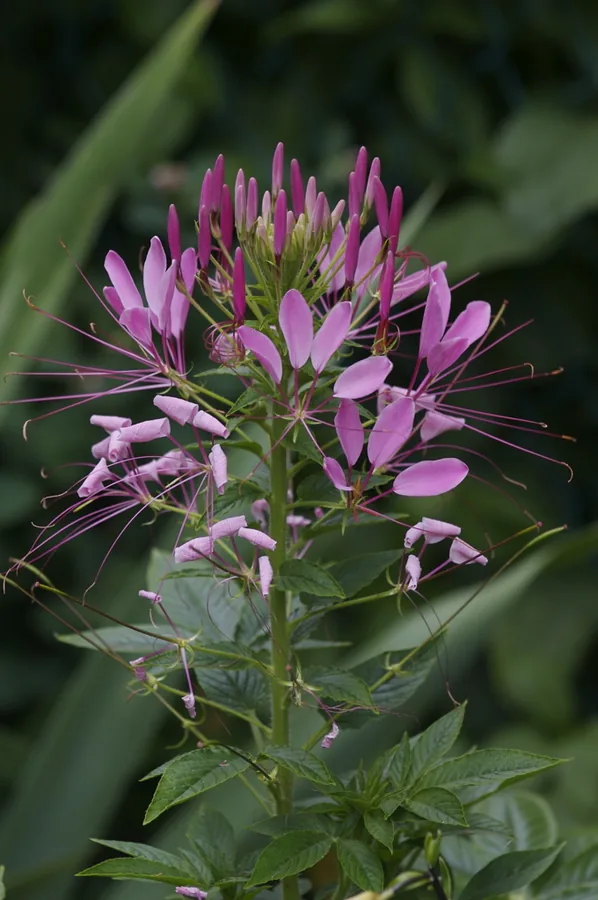
Cleome, the spider flower, is a tall garden annual cultivated for the airy, whiskered inflorescences borne at the stem tips throughout summer. Each flower extends long stamens and develops slender seed pods that splay outward like spider legs, the trait behind the common name. Growth is rapid, reaching 2 to 6 feet (60 to 180 cm) within a single season, which suits the plant to the back of a border.
Its cultural requirements are modest. Given full sun and free-draining ground, it withstands heat, drought, and the lean soils that limit more demanding species. The principal management issue is prolific self-sowing: seed shed at the end of the season germinates as volunteers the following spring unless the spent pods are removed.
Bees, butterflies, and hummingbirds work the flowers from early summer until the first frost terminates the plant. The stems carry small prickles and the foliage emits a musky scent, so gloves are advisable during handling, or one of the thornless, scentless selections can be grown instead.
Care
The short version: provide full sun, average well-drained soil, and only occasional water once the plant is established. Fertilize sparingly, pinch young plants to maintain a branching habit, and deadhead the pods to suppress volunteer seedlings the following year.
Light
Cleome requires full sun, 6 or more hours daily, to develop sturdy, upright stems and full flowering. It tolerates light afternoon shade, but inadequate light produces tall, floppy stems and substantially fewer blooms.
Water
Maintain moist soil while plants are young, then reduce watering once they are established, since the species withstands drought. Irrigate only during sustained dry periods, because excess moisture drives the soft, leggy growth that weakens the stems.
Soil
Average, well-drained loam is the optimal medium, though the plant accepts clay or rocky ground provided drainage is adequate. Target a pH of 6.0 to 7.0, and avoid heavy enrichment of poor soil, since lean conditions keep the habit compact.
Temperature
Cleome performs in warmth, growing between 55°F and 90°F (13°C to 32°C). It requires heat to develop and does not survive frost, so it completes a single season in cold-winter gardens.
Humidity
Ambient outdoor humidity poses no problem, so no specific level need be maintained. Air circulation is the more significant factor, because crowded, stagnant plantings promote mildew and rust on the foliage.
Feeding
Feed lightly during the growing season with a balanced fertilizer, once a month at most. Excess feeding is counterproductive, yielding a soft, leggy plant with weak stems, so err toward less when uncertain.
Pruning
Pinch the stem tips in early summer to redirect growth into a bushier, branching form. Deadhead or strip the spent seed pods through the season to limit the prolific self-seeding.
Size & spacing
Plants attain 2 to 6 feet (60 to 180 cm) in height and 1 to 5 feet (30 to 150 cm) in spread according to the strain. Space them 10 to 15 inches (25 to 38 cm) apart to maintain the air movement that limits mildew.
When to plant
Cleome is a warm-season annual that depends on heat and is killed by frost. Seed is started indoors in late winter or sown directly once the soil warms, after which the plant blooms from early summer until the first frost.
Northern hemisphere
Southern hemisphere
Typical months for a temperate climate: start earlier in warm zones, later where spring frosts linger.
- Sow: 6 to 8 weeks before the average last spring frost
- Plant: After all danger of frost has passed and soil reaches 70 to 75°F; or direct sow then
- Harvest: Early summer until first frost
Hardiness
USDA hardiness zones: 10–11
Temperature: down to -1°C
Troubleshooting
Cleome ranks among the more trouble-free garden flowers, and most disorders trace to excess water, insufficient light, or crowding. Identify the symptom below, and the correction is usually a single adjustment to the growing conditions.
Tall, floppy stems carrying abundant foliage and few flowers
Soft leggy growth follows from excess water or fertilizer, or from light too weak to support sturdy tissue and flower set. Correct it by reducing both inputs and relocating the plant to full sun with 6 or more hours of light, since this species flowers best under high irradiance. Pinching the stem tips in early summer redirects growth into lower branches and firms the habit.
Fix:
- Reduce watering and feeding
- Site in full sun (6+ hours)
- Pinch back stem tips in early summer to force branching
White powdery film or rust-colored pustules on the leaves
Heat, high humidity, and crowded plantings favor the fungal pathogens behind powdery mildew and rust, which colonize foliage held in stagnant, moist air. Improving airflow, removing the most affected leaves, and watering at the base to keep foliage dry all deny the fungi the conditions they need. Spacing plants 10 to 15 inches apart restores the air movement that suppresses infection.
Fix:
- Improve air circulation
- Remove affected foliage
- Water at the base to keep leaves dry
Distorted new growth with a sticky residue on the leaves
Colonies of aphids, spider mites, or whiteflies feed on the soft new growth, and the sticky residue is the honeydew they excrete as they draw sap. A strong jet of water dislodges most colonies mechanically, with insecticidal soap reserved for heavy infestations. Vigorous, unstressed plants tolerate this feeding and recover without intervention.
Fix:
- Spray off with a strong jet of water
- Apply insecticidal soap if infestation is heavy
Chewed holes and notches in the leaves
Small holes and notches point to chewing damage from flea beetles or cabbage budworm. Handpicking any caterpillars present removes the feeding stage directly. Cleome is a tough, largely pest-free species, so a vigorous plant grown in full sun outgrows occasional damage of this kind.
Fix:
- Handpick caterpillars
- Tolerate minor damage as plants are generally pest-free
Toxicity
For households with pets, the assessment is favorable: cleome is non-toxic to cats, dogs, and horses, with no ASPCA records of toxic ingestion. The only consideration is the prickly stems and musky leaves, which make gloves advisable during handling.
Safe for
People · Cats · Dogs · Horses · Rabbits · Livestock · Birds
Cats Safe
The ASPCA classifies spider flower as non-toxic to cats, so exploratory chewing presents no toxicological concern. The only deterrent is the prickly stems, which a cat avoids of its own accord.
Dogs Safe
Cleome poses no poisoning risk to dogs under the ASPCA listing. A dog that ingests a large quantity of any plant may show mild gastrointestinal upset, but the foliage contains no harmful compound.
Horses Safe
The record documents no known toxins in cleome for horses. Its pungent, musky foliage acts as a feeding deterrent, so grazing animals generally avoid it before ingestion occurs.
Rabbits Safe
Cleome carries no poisoning risk for rabbits. The prickly leaves and strong scent function as physical and olfactory deterrents, directing them toward more palatable plants in the bed.
Livestock Safe
Cattle, goats, and sheep can occupy a pasture or garden edge alongside cleome without risk. No records of toxic ingestion exist, and the musky foliage rarely attracts grazing in the first place.
Birds Safe
Cleome presents no toxic threat to backyard or wild birds. The flowers attract pollinators and hummingbirds, and the seed pods supply forage for birds later in the season.
People Safe
The plant holds no poisonous parts and is safe to cultivate around children. The single handling consideration is the small prickles on the stems and leaves, so gloves are advisable when working with it.
Stems and leaves bear prickles/spines and the foliage has a pungent, musky scent; wear gloves when handling. Thornless cultivars exist. These are handling nuisances, not toxicity.
Varieties
Cleome is offered as several named strains that differ chiefly in height, flower color, and whether they retain the typical thorns and scent. The selections below are the most widely available.
Helen Campbell
A long-cultivated selection bearing fragrant, pure white flowers on tall plants that reach 4 to 5 feet.
Queen series
The standard 3 to 5 foot strain available in rose, violet, pink, and white under names such as Rose Queen and Violet Queen.
Linde Armstrong
A compact 18 to 24 inch pink selection bred without the thorns and without the musky scent.
Senorita series
Thornless, odorless sterile hybrids propagated from cuttings, which sustain bloom all season because they set no seedlings.
How to propagate
Cleome is propagated by seed alone, and an established plant carries out most of the reproduction itself once it occupies a site.
SeedEasy
Start indoors 6 to 8 weeks before last frost, or direct sow after frost when soil is 70 to 75°F · Germinates in 7 to 14 days; blooms about 70 to 80 days after germination
Cleome propagates by seed only. Sow indoors 6 to 8 weeks before your last frost, or, because the species resents root disturbance, direct sow into warm ground once soil reaches 70°F to 75°F (21°C to 24°C). Cover the seed lightly; germination follows in 7 to 14 days, and flowering follows germination by roughly 70 to 80 days. Certain strains such as the Queen series germinate more reliably after 4 or 5 days of cold stratification in the refrigerator, and an established plant reseeds the following generation without intervention.
Myths
Cleome is poisonous to cats and dogs.
The ASPCA classifies spider flower as non-toxic to cats, dogs, and horses, and no records of toxic ingestion exist. The perceived hazard arises from the prickly stems and the musky scent, both of which are handling nuisances rather than toxic traits. Cleome is safe to grow around pets and children.
Cleome has to be started indoors and transplanted to do well.
The species resents root disturbance, so transplanting checks its growth and sets it back. Sowing seed directly into warm ground after frost lets the seedling establish without that disturbance. Direct sowing often works as well as transplants, and an established plant self-seeds freely on its own.