Ornamental · Typhaceae
Cattail
Typha latifolia
Root it in mud or shallow water and the cattail flourishes, but allow it open ground and it colonizes the entire pond.
Full sun
USDA 3–10
4–10 ft · 1.2–3 m
Overview
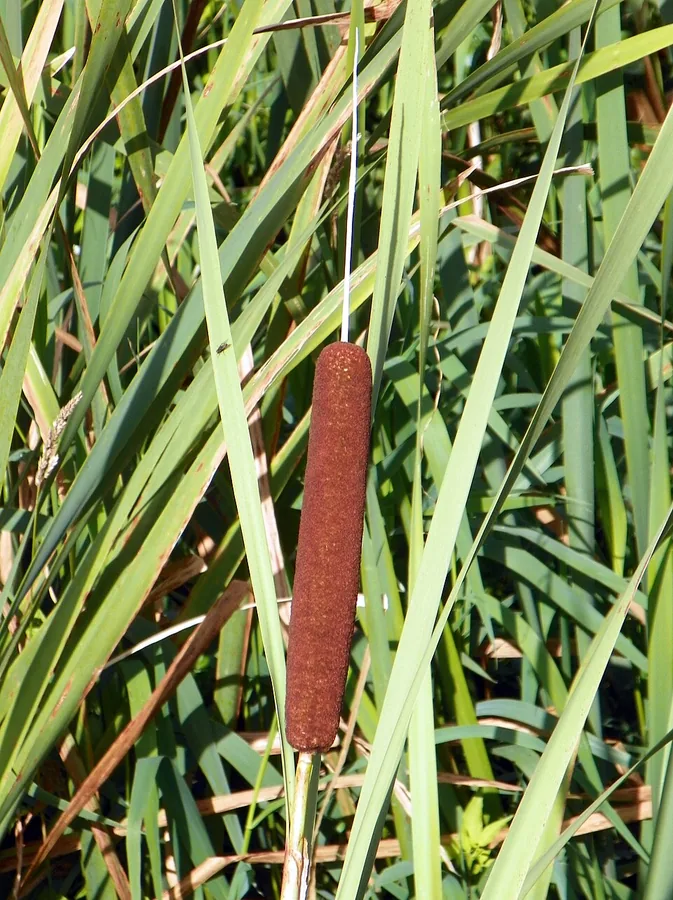
Typha latifolia is the tall, brown-spiked plant that fringes the margin of nearly every pond, ditch, and marsh across North America. It is an emergent aquatic perennial, anchored in mud while its foliage and reproductive spikes stand well clear of the water surface. The sword-shaped gray-green leaves and the cylindrical brown seed head make it among the most readily identified wetland plants.
Growth is rapid and demands little beyond a permanently wet root zone. Hardy across USDA zones 3 to 10, the species withstands cold to -40°F (-40°C) and tolerates a broad spectrum of soils and water regimes, yet it has no drought tolerance and will not persist if the root zone dries. That same vigor carries the principal liability, because stout creeping rhizomes allow a single individual to build a dense, single-species stand within a year or two.
Most plant parts have a long record of use as wild food, and the stand supplies forage and cover for waterfowl, marsh birds, and other wildlife. The horticultural case for growing it rests on that wildlife value and on the strong vertical structure it brings to a pond margin. The standing recommendation is to contain it from the outset, since an uncontained cattail seldom remains where it was set.
Care
The short version: site it in full sun on permanently wet ground, with the root zone in saturated mud or up to about a foot of standing water. Fertility needs are minimal, and a submerged basket is the standard means of preventing it from overrunning the planting.
Light
Cattails perform best in full sun, which maximizes both growth and flowering, although they tolerate light partial shade. Higher irradiance yields a denser and taller stand.
Water
Water management is the decisive cultural factor. Hold the root zone saturated at all times or stand the crown in shallow water, roughly 0 to 12 inches (0 to 30 cm) deep, and never allow the mud to dry. Planting within a submerged basket additionally restrains the spreading rhizomes.
Soil
The species roots in heavy, mucky, fertile mud or in saturated loam, clay, or sand at the water's edge and accepts a wide range of wet substrates. It tolerates an unusually broad pH band of 3.7 to 8.5, so soil reaction is rarely limiting.
Temperature
Cold hardiness is exceptional. Cattails endure approximately -40°F to 100°F (-40°C to 38°C), dying back over winter and regenerating from the rhizome each spring.
Humidity
Because it grows in or beside water, the cattail occupies a high humidity environment by default, leaving no value to manage. The required wet siting keeps the surrounding air moist on its own.
Feeding
In a natural pond or wetland, supplementary feeding is rarely needed, as the nutrient-rich mud sustains the plant. For container culture, a single aquatic plant tab in spring is sufficient.
Pruning
Cut the senescent foliage to the waterline in late winter or early spring ahead of new shoot emergence. Removing the brown female spikes before dehiscence is the simplest measure against self-seeding.
Repotting
A container specimen requires division every 1 to 2 years, because the vigorous rhizomes fill the basket quickly. Divide and replant when roots circle the rim, leaves diminish, or the plant heaves itself out of the pot.
Size & spacing
A mature plant attains 4 to 10 feet (1.2 to 3 m) in height and a spread of 4 to 6 feet (122 to 183 cm). Allow that footprint, or preferably a basket, so a single clump does not engulf the pond margin.
When to plant
The species follows the phenology of a temperate climate. Divide and plant out rhizomes in spring once the water has warmed and frost has passed, observe spike development through early summer, and cut the senescent foliage back in late winter before new shoots emerge.
Northern hemisphere
Southern hemisphere
Typical months for a temperate climate: start earlier in warm zones, later where spring frosts linger.
- Sow: Late winter to early spring; seeds need warmth, light, and moist or flooded conditions to germinate
- Plant: Spring after frost, once water has warmed; divide and set out rhizomes in spring
- Harvest: May to July (brown cylindrical female spike topped by a narrower yellow male spike)
Hardiness
USDA hardiness zones: 3–10
Temperature: down to -40°C
Troubleshooting
Cattail problems are almost entirely matters of spread rather than pathology, since the plant is robust and seldom suffers disease. The diagnostic signs are a stand that advances each season and recruitment of seedlings outside the planted area. Match the observation below, then intervene before the colony outpaces management.
A founding clump develops into a dense monodominant stand
The mechanism is clonal: the cattail's fast-creeping rhizomes travel horizontally just beneath the mud and raise new ramets well beyond the parent clump, and nutrient enrichment of the water accelerates that lateral growth. Because the colony expands below the surface, the practical answer is a physical barrier, so set the plant in a submerged basket to confine the rhizome mass. Excavate stray runners and cut stems below the waterline through the season, since severing photosynthetic tissue at depth steadily depletes the rhizome reserves.
Fix:
- Grow the plant in a submerged planting basket or tub instead of open pond mud to physically confine the rhizomes
- Dig out and remove unwanted rhizome runners; repeated removal is needed because fragments resprout
- Cut stems below the waterline repeatedly through the season to weaken the colony
- Hand-pull or thin new shoots before they establish
Recruitment of new plants beyond the planted clump
Two dispersal routes are at work. Each mature spike releases thousands of fluffy, wind-borne seeds that travel on air currents and germinate on exposed saturated mud, while detached rhizome fragments float to fresh sites and re-root. Interrupt both pathways: remove the female spikes before dehiscence so no seed is shed, lift volunteer seedlings while their root systems are shallow, and keep the parent contained to prevent fragment escape.
Fix:
- Cut and remove the brown female spikes before they mature and shed seed
- Pull volunteer seedlings while young and easy to remove
- Keep the plant contained so stray rhizome pieces cannot spread
Foliar chlorosis and necrosis, or a thinning stand
Timing distinguishes the two causes. In late fall, uniform browning is normal seasonal dieback as this perennial enters dormancy and translocates reserves to the rhizome, and growth resumes unaided in spring. Browning outside that window almost always traces to a dry root zone, a stress this obligate wetland species cannot withstand. Maintain saturated soil or hold the crown in shallow water, and cut the spent foliage to the waterline in late winter.
Fix:
- Keep the soil saturated or the crown standing in shallow water at all times
- Cut spent foliage to the waterline in late winter; vigorous new growth returns in spring
Toxicity
The toxicological verdict is favorable: cattail is non-toxic to people, pets, and livestock. Numerous parts are edible, and the stand is a recognized wildlife food. The only caveat is the fluffy seed down, a mechanical irritant capable of affecting the eyes or airways when a quantity is inhaled.
Safe for
People · Cats · Dogs · Horses · Rabbits · Livestock · Birds
Cats Safe
No toxic principle is present, so a cat that mouths the leaves is unaffected. The cottony seed down acts only as a mechanical irritant and may prompt a sneeze if inhaled.
Dogs Safe
Ingestion poses no risk of poisoning to dogs. The leaves and shoots contain no harmful compound, and the rhizome is itself a historical human food, so an exploratory chew is harmless.
Horses Safe
Grazing carries no toxic hazard for horses. The species holds no poisonous principle, and its young shoots and roots are a documented forage in wet pasture.
Rabbits Safe
The tender shoots and leaf bases are free of toxins and suit rabbits well. Offered in small amounts, they serve as an acceptable green.
Livestock Safe
Cattle, goats, and sheep may browse the foliage and shoots without harm. The plant contains no poison, and grazing stock commonly take it along watercourses.
Birds Safe
Seed consumption and roosting within the stand produce no adverse effect. Waterfowl and marsh birds depend on the species for both forage and cover.
People Safe
The species has a long record as a wild food, with edible young shoots, rhizomes, and pollen. The sole concern is the airborne seed down, a mechanical irritant that can affect the eyes or airways when inhaled in quantity.
Not poisonous. The fluffy seed down is a non-toxic mechanical irritant only; it can be messy and may irritate eyes or airways if inhaled, but it is not chemically toxic.
Varieties
Several cattails occur in gardens and wetlands and differ in stature, leaf width, and the difficulty of confining them. The following taxa are the ones worth distinguishing.
Typha latifolia (common / broadleaf cattail)
The type species reaches 4 to 10 feet with broad, flat, gray-green leaves, and its diagnostic trait is a thick brown female spike contiguous with the yellow male spike, leaving little or no gap between them.
Typha angustifolia (narrowleaf cattail)
This species is identified by its narrower leaves and a bare internode of stem separating the female and male spikes, and it behaves invasively and aggressively once it escapes containment.
Typha × glauca (hybrid cattail)
The hybrid of the broadleaf and narrowleaf parents expresses intermediate morphology and is markedly invasive, forming dense monodominant stands that displace native wetland flora.
Typha minima (dwarf / miniature cattail)
The smallest taxon in cultivation, reaching only about 18 inches with slender leaves and diminutive spikes, has a restrained spread that makes it the sole cattail genuinely suited to small water gardens, pools, and tubs.
'Variegata'
Selected as an ornamental, this cultivar bears foliage longitudinally striped in creamy yellow to white.
How to propagate
Cattail propagates with minimal intervention, whether by dividing an established clump or by raising it from seed.
DivisionEasy
Spring · One growing season; rhizome divisions root and spread quickly
Vegetative division is the most reliable and rapid means of increase. In spring, lift the plant and sever the stout rhizome into sections, each retaining an active growing shoot, then reset them into saturated mud or shallow water, where they root and extend within a single growing season.
SeedModerate
Late winter to spring · Seedlings establish over one season; flowering may take a year or more
Seed propagation is slower and exploits the species' germination requirements. Sow in late winter to spring onto warm, moist or flooded substrate in bright light, since germination is favored by warmth on exposed wet mud. Seedlings establish across one season, but anthesis may be delayed a year or more, which accounts for the prolific self-sowing observed in wild populations.
Myths
Cattail is a good, easy plant for a small backyard pond.
Common cattail is unsuited to a small pond on account of its vigor. Its stout rhizomes extend rapidly and will dominate a small water garden within a year or two unless restricted to a submerged basket, and seed recruitment compounds the spread. For a small feature, reach for the dwarf cattail (Typha minima) instead, or keep the broadleaf species under strict containment.
All cattails are native and harmless to wetlands.
Broadleaf cattail is indeed native across most of North America, yet the narrowleaf cattail and the hybrid Typha x glauca are invasive across many regions and assemble dense stands that exclude other wetland species. Even the native species can run wild, which is why none belongs in a natural waterway.