Ornamental · Campanulaceae
Cardinal Flower
Lobelia cardinalis
Pair wet feet with light shade, and cardinal flower answers with scarlet, hummingbird-pollinated spikes in late summer.
Partial shade
Every 2–4 days
USDA 3–9
2–4 ft · 0.6–1.2 m
Overview
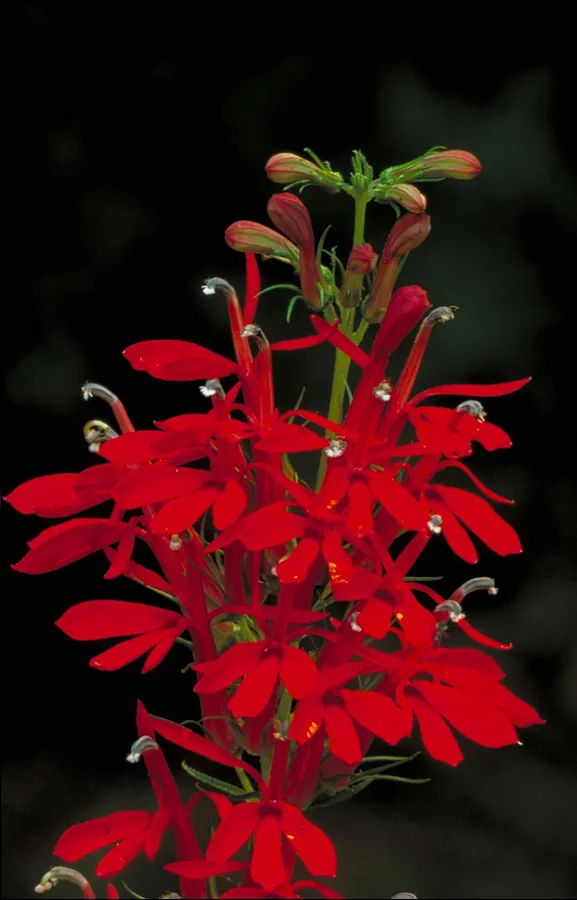
Lobelia cardinalis is a North American wetland perennial of stream banks, wet meadows, and pond margins, and its habitat explains its garden behavior. It produces tall racemes of brilliant scarlet flowers from late summer into fall on stems reaching 2 to 4 feet (60 to 120 cm). The tubular red form suits hummingbirds, which carry out most of the pollination, while butterflies forage the spikes as secondary visitors.
The defining requirement is moisture, and it inverts the usual perennial rule. Where most border plants demand free drainage to keep roots oxygenated, cardinal flower is adapted to medium-to-wet ground that never fully dries, and it tolerates brief inundation because its native sites flood. That adaptation is why it performs in a rain garden, a saturated low spot, or a pond margin where drainage-dependent species fail.
Persistence here is clonal and reproductive rather than individual. The founding crown is short-lived, commonly declining after a few seasons, but it generates basal rosettes (offsets) and sheds light-germinating seed that replace it. Manage the planting for that renewal and a single introduction maintains itself indefinitely.
Care
The short version: site it in part shade to full sun, hold the soil consistently moist to wet so the root zone never dries, use rich humusy ground, and renew it yearly by dividing rosettes or allowing self-seeding.
Light
Cardinal flower performs best in part shade, and it accepts full sun only where soil moisture is high enough to offset the greater transpirational demand. Deep shade reduces flowering, so the working target is moderate light supplied together with constant moisture.
Water
Moisture is the governing variable for this species. Maintain consistently moist to wet soil and never let the root zone dry, irrigating every 2 to 4 days when rainfall is insufficient. Its tolerance of brief flooding reflects a wetland origin, which is why pond and stream margins suit it.
Soil
Use rich, humusy ground high in organic matter, because that medium both retains water and supplies fertility. A pH of 6.0 to 7.0 is appropriate, and growth improves as the site becomes wetter and more fertile.
Temperature
Cold hardiness is exceptional: the plant withstands winter lows to -40°F (-40°C) and summer highs near 95°F (35°C). That range corresponds to USDA zones 3 through 9, so most gardeners can maintain it as a permanent perennial in the ground.
Humidity
Atmospheric humidity is not a limiting factor, and ambient outdoor air suffices. The plant's water relations are driven by wet soil at the roots, not by air moisture.
Feeding
Fertility from rich organic soil usually meets the plant's demand without supplementation. A light topdressing of compost or a balanced fertilizer during the growing season covers any additional requirement.
Pruning
Deadheading spent spikes redirects resources to prolong bloom and limits heavy self-seeding, while the basal rosettes should remain intact through winter. In cold climates, mulch the roots so freeze-thaw cycles do not heave the crowns from the soil.
Size & spacing
Mature plants reach 2 to 4 feet (60 to 120 cm) in height and 12 to 24 inches (30 to 60 cm) in spread. Allotting that footprint per clump keeps light and air around the spikes, which supports flowering and limits damp-loving pests.
When to plant
The species follows a cool-start, late-finish cycle tied to its stratification needs. Surface-sow seed indoors in late winter so light and a cold period can trigger germination, transplant after the last frost once the soil has warmed, and the scarlet spikes open from midsummer through mid-fall.
Northern hemisphere
Southern hemisphere
Typical months for a temperate climate: start earlier in warm zones, later where spring frosts linger.
- Sow: Surface sow on moist medium in late winter; seed needs light and benefits from cold stratification.
- Plant: After last frost in spring once soil has warmed.
- Harvest: Late summer through mid-fall (July to October).
Hardiness
USDA hardiness zones: 3–9
Temperature: down to -40°C
Troubleshooting
Cardinal flower presents few disorders, and almost all reduce to soil moisture, the single factor its physiology hinges on. Damp, shaded sites invite certain pests, while a drying root zone produces stress symptoms directly. Identify the pattern below, correct the moisture regime, and most issues resolve.
The clump thins and disappears after a few years
This reflects the plant's biology as a short-lived perennial that persists through basal offsets and shed seed rather than crown longevity. Crown rot or frost heaving accelerates the loss where soil dries or rosettes are left unmulched. Allow some seed to drop or divide the rosettes in spring, and the population regenerates.
Fix:
- Allow some seed to drop or collect and resow to maintain the stand
- Divide and replant basal rosettes in spring
- Mulch crowns in cold climates to prevent heaving
Wilting, browning leaf margins, and stalled summer growth
These symptoms indicate drought stress, because the species has no tolerance for a dry root zone. Irrigate deeply to re-establish even moisture, apply organic mulch to conserve it, and relocate the plant to a wetter position such as a rain garden or pond edge where a site keeps drying out.
Fix:
- Water deeply to restore even moisture
- Add organic mulch to retain soil moisture
- Relocate to a wetter site such as a rain garden or pond edge
Ragged holes chewed through leaves and rosettes
The moist, shaded conditions cardinal flower requires are equally favorable to slugs and snails, which preferentially feed on the tender young growth. Hand-collect them in the evening when they are active, remove the damp litter accumulated against the crowns to reduce shelter, and apply iron-phosphate bait where pressure persists.
Fix:
- Hand-pick slugs and snails in the evening
- Reduce surface debris and mulch piled against crowns
- Use iron-phosphate slug bait if pressure is high
Toxicity
Regard the entire plant as poisonous. All tissues contain lobeline and related piperidine alkaloids, toxic to dogs, cats, horses, livestock, and people on ingestion, producing nausea, vomiting, and, at high doses, effects on cardiac and respiratory function. The alkaloids are themselves emetic, so the plant tends to limit how much is retained, but keep it away from pets, grazing animals, and children regardless.
Toxic to
Cats · Dogs · Horses · Rabbits · Livestock · Birds · People
Cats Toxic
A cat that ingests any tissue typically salivates, becomes quiet and depressed, and vomits, frequently with diarrhea and abdominal discomfort. Larger amounts can disturb the heart rhythm, so cut stems should never be left within a cat's reach.
Dogs Toxic
After a dog consumes the leaves or flowers, expect heavy salivation, lethargy, vomiting, and loose stools. The lobeline responsible for the gastrointestinal upset can also disrupt cardiac rhythm once a dog ingests a large quantity.
Horses Toxic
Horses grazing the foliage absorb the same piperidine alkaloids and develop colic, salivation, and weakness. Heavy intake can compromise cardiac and respiratory function, so the plant should be excluded from paddocks.
Rabbits Toxic
Because lobeline is present throughout every part, the foliage is not safe forage for a rabbit. Ingestion induces salivation, gastrointestinal upset, and a listless, off-color animal.
Livestock Toxic
Cattle, sheep, and goats can be poisoned by grazing it, with salivation, vomiting, and depression appearing first. A large dose progresses to nervous and cardiac involvement, though the plant's own emetic action usually curtails intake.
Birds Caution
Treat it as unsafe and exclude pet birds from the leaves and flowers. The alkaloids that sicken other animals provide no basis for assuming a bird would tolerate them.
People Caution
No part of this plant is food, and ingestion causes nausea, vomiting, and a burning sensation in the throat. Swallowing a substantial amount can affect cardiac and respiratory function, so keep it from children and wash hands after contact with the sap.
Keep away from pets and grazing animals; wash hands after handling sap.
Helpline numbers

United States
ASPCA Animal Poison Control: (888) 426-4435 (fee applies)
Poison Control: (800) 222-1222



Canada
Poison Centres: 1-844-764-7669
Varieties
Commerce is dominated by the straight scarlet species, but several selections were bred for darker foliage that intensifies the contrast with the flowers. The following are the cultivars worth recognizing.
Queen Victoria
Queen Victoria carries deep bronze-purple to maroon foliage that sets off the scarlet flower spikes for a striking two-tone effect.
Black Truffle
Black Truffle bears very dark, almost black-purple foliage beneath bright red blooms, giving the strongest foliage-to-flower contrast in the group.
Fried Green Tomatoes
Fried Green Tomatoes is a green-leaved selection that combines vivid red flowers with noticeably greater garden vigor.
How to propagate
Two propagation routes match the plant's own survival strategy: vegetative division of the basal rosettes it produces, and the fine, light-requiring seed it sets in quantity.
DivisionEasy
Spring, by separating the basal rosettes (offsets) from the parent plant. · One growing season
In spring, lift the crown and separate the basal rosettes from the parent. Replant each division immediately into moist, rich soil and irrigate it well, and it establishes over a single growing season.
SeedEasy
Surface-sow on moist medium in late winter to early spring; seed needs light to germinate. · Blooms typically in the year after sowing
Sow the fine seed on the surface of a moist medium in late winter to early spring and leave it uncovered, since light is required for germination. Seed-grown plants generally flower the year after sowing. On a damp site the species self-seeds freely on its own, the mechanism by which a short-lived perennial maintains a standing population.
Myths
Cardinal flower is named because it attracts cardinals.
The epithet derives from the intense cardinal-red of the flowers, the same red as the robes worn by Roman Catholic cardinals, not from any bird. In practice the flowers attract hummingbirds and butterflies, the actual pollinators, rather than the namesake species.
Lobelia is a gentle herb that is safe to eat.
It contains lobeline and related alkaloids that become toxic once a meaningful quantity is ingested, producing nausea and vomiting and, at higher doses, more serious effects in both people and animals. No part of this plant is safe to eat.